


Enterprise infrastructure teams are confronting an unprecedented operational reality as autonomous AI exploitation agents discover and weaponize critical software vulnerabilities in minutes. Conventional patching lifecycles that demand days of staging and disruptive reboots are no longer viable for modern hyperscale server deployments.
Addressing this severe operational vulnerability window, the OpenAI Shirudo Linux Runtime emerges as a groundbreaking open-source joint security initiative with Cisco. By combining frontier AI code generation with in-kernel eBPF instrumentation, Shirudo deploys hot mitigations to running Linux production workloads without downtime.
Evaluating core system capabilities across modern security stacks illustrates how OpenAI Shirudo Linux Runtime shifts enterprise protection paradigms away from static configuration firewalls toward dynamic, hardware-attested in-kernel program execution.
| Security Runtime Platform | Underlying Execution Layer | Policy Definition Mechanism | Reboot or Restart Required | Hardware Attestation Model | Licensing Architecture |
|---|---|---|---|---|---|
| OpenAI Shirudo Runtime | Linux eBPF & Uprobes Sandboxing | Agentic Autonomous C/eBPF Code | Zero Restarts (Live Injection) | Cryptographic TPM Hardware Chain | BSD 2-Clause & GPL v2 Dual |
| Isovalent Tetragon (Legacy) | Kernel eBPF Tracepoints & Kprobes | Static YAML Security Policies | Zero Restarts (Observability) | Host OS Software Signatures | Apache 2.0 Open Source |
| Canonical Livepatch / kpatch | Kernel ftrace Redirection Hooks | Compiled Kernel C Binary Patches | Zero Kernel Restarts Required | Kernel Module Verification Keys | GPL v2 Enterprise Commercial |
| SELinux & AppArmor | Linux Security Modules (LSM) | Static Labeling & MAC Rulesets | Policy Reload (Service Resets) | None (Filesystem Metadata) | GPL v2 Core Linux Standard |
This architecture demonstrates how OpenAI Shirudo Linux Runtime bridges the dangerous gap between vulnerability disclosure and final package distribution without sacrificing application uptime or cluster stability.
Bridging the Patch Gap: How Machine-Speed Exploits Broke Traditional Linux Defenses
The fundamental challenge of operating contemporary cloud infrastructure is the growing divergence between exploit discovery and remediation rollouts. When threat actors leverage automated models to probe zero-day vulnerabilities across network endpoints, the mean time to initial exploitation frequently drops below zero.
Traditional enterprise remediation pipelines were fundamentally designed for a human cadence where security bulletins triggered rigorous regression testing in staging environments. This multi-week verification process created prolonged exposure windows where production systems remained defenseless against weaponized exploit scripts.
Applying blanket workarounds or shutting down core Linux system calls often causes severe collateral outages for legitimate user requests. Because legitimate transactions and malicious injections frequently traverse identical kernel execution paths, crude firewall rules routinely disrupt mission-critical database clusters and payment gateways.
Modern high-density data centers powering intensive compute workflows require uninterrupted uptime to maintain real-time service level agreements. Similar to how high-performance platforms like the AMD Ryzen 7 9800X3D maximize silicon utilization, hyperscale servers demand continuous execution without sudden reboots.
Software architects recognized that static defensive policies could no longer scale against multi-vector automated exploits targeting enterprise web services. Protecting live Linux infrastructure required an adaptable execution framework capable of surgical intervention right inside active memory spaces.
To solve this systemic vulnerability gap, Cisco and OpenAI detailed their collaborative platform in the official OpenAI announcement. Their joint initiative establishes an autonomous defensive perimeter capable of shielding running services the moment researchers discover an active attack vector.
eBPF Architecture: How OpenAI Shirudo Linux Runtime Injects Kernel Shields
At the technical foundation of the OpenAI Shirudo Linux Runtime lies Extended Berkeley Packet Filter technology, commonly known as eBPF. Originally conceived as a packet filtering tool, eBPF has matured into a universal, high-performance in-kernel virtual machine.
By attaching lightweight sandboxed programs to kernel tracepoints, uprobes, and socket filters, the OpenAI Shirudo Linux Runtime inspects internal system state continuously. This granular observability allows the runtime to intercept sensitive operations before unauthorized state mutations occur inside system memory.
Rather than waiting for upstream vendors to package binary updates, operators deploy targeted protective programs called shields. Each shield runs as a verified eBPF program that monitors specific function parameters, effectively neutering hostile payloads before they execute.
Because these defensive hooks execute directly inside the operating system, they impose virtually zero overhead on running production workloads. Workloads continue processing customer traffic normally while eBPF filters sanitize dangerous inputs and terminate anomalous child process spawning attempts.
The demonstration highlights how engineers load custom bytecode protections into live memory spaces without terminating active database daemon processes. Observing this live injection workflow proves that enterprise Linux security can achieve instantaneous shielding without traditional maintenance downtime.
Integrating eBPF into the OpenAI Shirudo Linux Runtime ensures complete safety through the kernel built-in program verifier. The verifier checks that every submitted shield avoids infinite loops, out-of-bounds pointer dereferences, and invalid memory access patterns prior to host attachment.
Agentic Code Generation: Transitioning From Static Policies to Executable Bytecode
A decisive technical breakthrough behind the OpenAI Shirudo Linux Runtime is the intentional departure from restrictive human-centric configuration languages. Traditional security platforms rely heavily on verbose YAML schemas and complex domain-specific policies that severely limit automated decision-making.
Human operators created declarative abstractions to simplify mental modeling, but these rigid constructs inadvertently bottleneck modern autonomous security agents. Large language models and frontier reasoning systems perform significantly better when generating raw, highly optimized systems programming code.
As detailed in the Cisco Isovalent technical analysis, Shirudo utilizes a native programming paradigm where artificial intelligence models output structured C code. Rather than translating intent into brittle regex rules, AI agents generate executable logic tailored precisely to vulnerable functions.
This programmatic interface allows autonomous guardian agents to digest millions of lines of assembly code and disassemble target binaries rapidly. Within minutes of analyzing a vulnerability disclosure, guardian agents draft targeted input sanitization shields that isolate malicious inputs.
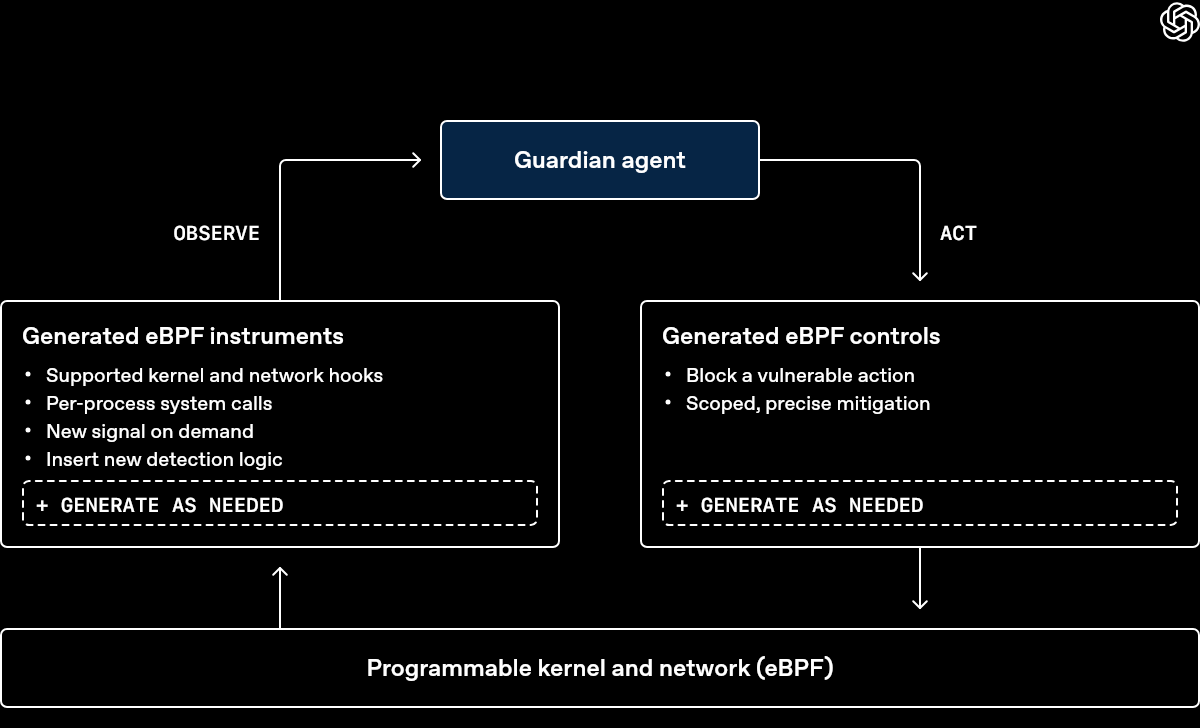
As mapped in the architectural overview, the guardian agent acts as an autonomous co-pilot across enterprise Linux clusters. The agent coordinates with operating system primitives, validating that prospective shields neutralize target vulnerabilities without corrupting valid business application workflows.
Crucially, human site reliability engineers retain absolute governance over production enforcement policies throughout the OpenAI Shirudo Linux Runtime lifecycle. Agents synthesize proposed shields and test them against live telemetry, but designated security personnel maintain definitive authorization over permanent deployment.
Hardware-Backed Attestation: Cryptographic TPM Chains in OpenAI Shirudo Linux Runtime
Deploying dynamic bytecode directly into live kernel environments introduces profound trust and compliance considerations for enterprise infrastructure operators. To ensure absolute integrity, the OpenAI Shirudo Linux Runtime implements rigorous cryptographic signing protocols across every defensive component.
Before any shield program loads into kernel memory, host daemons verify digital signatures against established enterprise certificate authorities. Unauthorized or modified binaries are rejected immediately by kernel access controls, eliminating the threat of malicious code injection via compromised mitigation pipelines.
To establish verifiable audit trails, the OpenAI Shirudo Linux Runtime integrates directly with hardware-based Trusted Platform Module chips. Every loaded shield, configuration modification, and runtime event is cryptographically measured and extended into dedicated TPM platform configuration registers.
This hardware measurement chain generates tamper-proof attestation records that external compliance scanners and orchestration engines inspect remotely. Operators can mathematically verify whether individual cluster nodes maintain authorized protective postures without relying on vulnerable user-space logging tools.
Hardware security roots prove equally critical as enterprises deploy lightweight appliances like the Apple M4 Mac Mini in dense edge data centers. Standardizing cryptographic verification across diverse server silicon guarantees uniform security compliance throughout distributed cloud infrastructure.
By fusing hardware attestation with live eBPF verification, the OpenAI Shirudo Linux Runtime establishes an unassailable defensive standard. Security compliance auditors gain cryptographic certainty that hot patches remain authentic and fully intact across the entire fleet.
The Java4Shell Benchmark: Live Process Defense Without Service Interruption
To validate real-world defensive efficacy, OpenAI and Cisco tested Shirudo against a notorious critical remote code execution vector. The engineering team deployed a vulnerable Java application running on OpenJDK and exposed it to the dangerous Java4Shell vulnerability.
Exploiting the vulnerability involved feeding crafted input strings into the Java standard library Base64 decoding routine to achieve arbitrary code execution. Traditional defensive responses would have required restarting the host application or awaiting patched upstream runtime distribution packages.
Using OpenAI Codex, researchers automatically synthesized an eBPF user-space uprobe shield designed to intercept the vulnerable OpenJDK Base64 decoding function. The generated shield attached directly to an active Elasticsearch service process without requiring a process restart or port drop.
When researchers launched the Java4Shell exploit payload, the active shield intercepted the hostile sequence and rejected the malicious input immediately. The attack was thwarted completely in memory while the underlying Elasticsearch cluster continued serving production search queries seamlessly.
System log traces confirmed that legitimate user traffic experienced zero dropped connections or latency spikes throughout the active mitigation trial. Demonstrating seamless survival under live attack conditions validates the operational viability of the OpenAI Shirudo Linux Runtime in production environments.
This real-world benchmark confirms that targeted live mitigations provide definitive interim protection while core engineering teams prepare permanent software patches. System administrators no longer face the agonizing dilemma between immediate service downtime and prolonged zero-day vulnerability exposure.
Comparative Matrix: Generational Evolution Across Enterprise Linux Defenses
Contrasting enterprise software security architectures demonstrates how OpenAI Shirudo Linux Runtime transforms incident response from reactive patching cycles into automated, hardware-verified live system defenses.
| Evaluation Metric | Traditional Vendor Patching | Standard Web Application Firewall | OpenAI Shirudo Linux Runtime |
|---|---|---|---|
| Remediation Velocity | Days to Weeks (Human Cycle) | Hours (Regex Signature Updates) | Minutes (Autonomous AI Shielding) |
| Application Downtime | Mandatory Service Restart / Reboot | Zero Downtime (Network Proxy) | Zero Downtime (Live In-Memory Attach) |
| Granularity of Defense | Complete Binary Replacement | Network Layer & HTTP Headers | Function-Level Parameter Sanitization |
| Encrypted Traffic Handling | Requires TLS Certificate Offloading | Decrypts Ingress Network Packets | Inspects Host Memory Post-Decryption |
| Collateral Outage Risk | Low (Post-Regression Verification) | High (False-Positive Packet Drops) | Minimal (Surgical Bytecode Target) |
| Cryptographic Provenance | Package Manager PGP Signatures | Vendor Cloud Configuration Push | Hardware TPM Measurement Chain |
Analyzing these comparative performance metrics underscores why modern enterprise infrastructure architects are adopting automated in-kernel shielding technologies to protect distributed production workloads.
Traditional remediation strategies relied on vendors publishing official packages, a process that inherently lags behind automated vulnerability exploitation. Furthermore, as legacy operating systems reach their end-of-life, such as seen when NVIDIA ends Windows 10 support, unpatched flaws persist indefinitely without dedicated live mitigations.
Enterprise web application firewalls offer quick perimeter filtering but remain fundamentally blind to encrypted communications and internal lateral movement attacks. Because firewalls operate externally, sophisticated bypass techniques frequently slip past pattern-matching rules and compromise backend microservices.
The OpenAI Shirudo Linux Runtime eliminates this visibility gap by operating directly inside the operating system execution environment. By inspecting arguments after internal decryption occurs, Shirudo stops attacks that bypass perimeter defenses with absolute precision.
To maximize community adoption and peer review, OpenAI and Cisco released Shirudo under a permissive open-source licensing structure. The runtime daemon is distributed under the BSD 2-Clause license, while core eBPF programs feature dual BSD and GPL licensing.
Industry partners including Cisco Isovalent are expanding ecosystem tooling, linking code directly on the Shirudo GitHub repository. Open governance ensures that cloud providers, software vendors, and independent researchers collaborate on verifiable mitigation standards.
Frequently Asked Questions
What is OpenAI Shirudo and how does it protect Linux systems?
The OpenAI Shirudo Linux Runtime is an open-source security platform developed jointly by OpenAI and Cisco. It injects targeted eBPF shields into running Linux kernels and processes to block active vulnerabilities without service restarts.
How does Shirudo differ from legacy security tools like Tetragon?
While Tetragon relies on human-authored YAML rules, the OpenAI Shirudo Linux Runtime empowers autonomous AI agents to generate executable C and eBPF code. This programmatic interface enables rapid machine-speed responses against emerging zero-day vulnerabilities.
Does installing a Shirudo shield require rebooting the operating system?
No reboots or process restarts are required when deploying shields through the OpenAI Shirudo Linux Runtime. Sandboxed eBPF bytecode attaches dynamically to live kernel tracepoints and application memory without interrupting customer traffic.
How does hardware-backed TPM attestation work in Shirudo?
The OpenAI Shirudo Linux Runtime records every loaded shield and configuration change into Trusted Platform Module registers. This cryptographic chain produces tamper-proof hardware attestation evidence that external compliance scanners inspect to verify node integrity.
Where can developers access the Shirudo open-source codebase?
Developers and infrastructure operators can inspect and contribute to the OpenAI Shirudo Linux Runtime on GitHub under BSD and GPL dual licenses. Interactive hands-on testing labs are also hosted by Cisco Isovalent.
Enterprise Security Verdict: The Future of OpenAI Shirudo Linux Runtime
The official debut of the OpenAI Shirudo Linux Runtime represents a foundational turning point for global cloud infrastructure security. By replacing rigid human-paced patching cycles with autonomous, compiler-verified eBPF shields, Cisco and OpenAI have created a self-defending operating system paradigm.
Demonstrating zero-downtime neutralization of severe exploits like Java4Shell proves that hyperscale infrastructure can withstand sophisticated attacks while maintaining continuous availability. Hardware-backed TPM attestation provides the cryptographic rigor required by stringent enterprise compliance standards.
As automated AI attack capabilities accelerate, adopting the OpenAI Shirudo Linux Runtime offers enterprise defenders a vital machine-speed countermeasure. Infrastructure operators worldwide now possess an open-source framework capable of protecting mission-critical workloads throughout the vulnerability remediation lifecycle.
