



Table of Contents
The unprecedented arrival of Grand Theft Auto VI has sent shockwaves across the entire gaming industry, establishing unprecedented commercial records and technical milestones. Developers worldwide are now reckoning with how to create living open-world environments in the wake of Rockstar Games gargantuan achievement.
Examining the evolving trajectory of Cyberpunk 2 Development reveals how CD Projekt Red leaders view the towering standard established by Vice City. Rather than succumbing to creative despair, veteran studio architects are actively formulating distinct technological paradigms for Project Orion.
Contrasting architectural design goals, rendering engines, and production parameters illustrates how Cyberpunk 2 Development charts a distinct technical path against Rockstar Games and earlier Night City iterations.
| Platform & Project | Rendering Architecture | Primary Design Philosophy | Target World Structure | Estimated Budget Scope | Core Studio Location |
|---|---|---|---|---|---|
| Cyberpunk 2 (Project Orion) | Unreal Engine 5 (Custom Tools) | Branching Narrative First-Person RPG | Dense Vertical Megastructures | $250M – $350M Projected | CDPR Boston & Vancouver |
| Cyberpunk 2077 (Original) | REDengine 4 (In-House Silicon) | Immersive Cybernetic Urban RPG | Night City & Dogtown | ~$440M Total Investment | CDPR Warsaw Studio |
| Grand Theft Auto VI | RAGE 9 Proprietary Engine | Systemic Open-World Crime Sandbox | State of Leonida & Vice City | $1.0B – $2.0B Lifetime | Rockstar Games Worldwide |
| The Witcher 4 (Polaris) | Unreal Engine 5 (Shared Tech) | Third-Person High-Fantasy Open RPG | Expansive Continental Wilderness | $200M – $300M Projected | CDPR Warsaw & Global Hubs |
Evaluating these production metrics confirms how Cyberpunk 2 Development leverages tailored engine pipelines and focused narrative density rather than attempting to duplicate sprawling state-scale sandbox geography.
Creative Shockwaves: Behind the Viral Post-GTA 6 Remarks
The global video game conversation was thoroughly dominated this week as Rockstar Games shattered all entertainment records by crossing three point seven billion dollars in launch revenue. This historic milestone prompted candid public commentary from creative leads steering rival AAA open-world productions.
Taking to social media platform Bluesky, Cyberpunk 2 creative director Igor Sarzynski openly acknowledged the overwhelming cultural and technological gravity of the moment. Sarzynski humorously confessed that open-world developer depression had officially set in, joking that Cyberpunk 2 was officially cancelled.
The playful post immediately drew a bewildered reaction from lead writer Anna Megill, whose notable narrative credits include Control and Dishonored. Megill responded with a swift public question mark, highlighting the lighthearted banter circulating within CD Projekt Red newly established Boston headquarters.
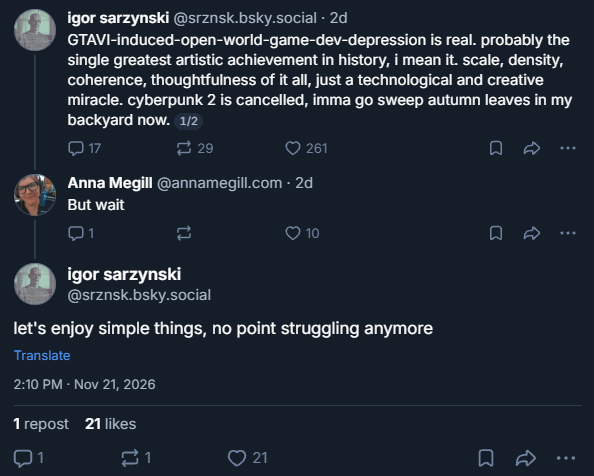
Despite the self-deprecating humor, Sarzynski candidly praised Rockstar Games output as one of the single greatest artistic achievements in human entertainment history. He emphasized the extraordinary scale, structural coherence, visual density, and thoughtful craftsmanship woven into every layer of the Leonida simulation.
As reported by PC Gamer coverage, Sarzynski clarified that admiring great art does not negate building your own vision. Instead, observing another studio expand what interactive media can achieve serves as profound fuel for Cyberpunk 2 Development.
How Cyberpunk 2 Development Navigates Post-GTA 6 Benchmarks
Navigating public expectations represents a massive structural hurdle as Cyberpunk 2 Development progresses through early pre-production and prototyping phases. Gamers emerging from hundreds of hours in Vice City inevitably anticipate similarly deep environmental reactivity across future urban role-playing titles.
However, directly comparing these disparate releases fundamentally misunderstands the core creative intent separating systemic sandboxes from branching role-playing games. While Rockstar excels at emergent physics and procedural pedestrian chaos, the upcoming sequel focuses intently on character choice, cyberware personalization, and deep philosophical narratives.
CD Projekt Red endured excruciating lessons during the initial December 2020 debut of Cyberpunk 2077 on eighth-generation home console hardware. The studio spent nearly three years rebuilding community trust, eventually delivering the critically acclaimed Update 2.0 overhaul and the triumphant Phantom Liberty expansion.
Those grueling redevelopment efforts fundamentally reshaped internal production methodologies and quality assurance standards across all regional teams. Armed with those hard-won insights, Cyberpunk 2 Development benefits from mature production pipelines designed to prevent overpromising features while safeguarding stable performance.
Rather than striving to simulate every mundane aspect of civic infrastructure, CD Projekt Red crafts handcrafted quests with profound branching paths. This specialized focus ensures that the new game delivers intimate emotional resonance that massive sandbox titles rarely attempt to capture.
Industry luminaries including Warren Spector have noted that attempting to mimic Rockstar multi-billion-dollar scale is economically impossible for almost any developer. Recognizing those boundaries enables Cyberpunk 2 Development to cultivate its own unique strengths without compromising creative identity.
Engineering Night City: The Unreal Engine 5 Architectural Shift
Perhaps the most critical technological pivot defining Cyberpunk 2 Development is CD Projekt Red decision to permanently retire their proprietary REDengine architecture. Decades of maintaining custom compiler pipelines, graphics renderers, and animation systems frequently diverted precious engineering resources away from pure gameplay refinement.
By transitioning to Epic Games Unreal Engine 5, Cyberpunk 2 Development gains immediate access to bleeding-edge rendering subsystems including Nanite virtualized geometry and Lumen dynamic global illumination. These advanced toolsets empower level designers to assemble intricate urban verticality without wrestling with bespoke low-level memory allocators.
Furthermore, partnering directly with Epic Games allows CD Projekt Red engineers to co-develop specialized open-world extensions specifically tailored for dense metropolitan simulation. These proprietary custom plugins will seamlessly integrate into the core engine codebase, benefiting both Project Orion and future Witcher titles.
Staffing efficiency represents another immense dividend resulting from this engine migration across North American development centers. Recruiting veteran software engineers in Boston and Vancouver becomes vastly simpler when candidates already possess extensive familiarity with industry-standard Unreal Engine workflows.
This software transition also allows developers to better exploit cutting-edge computer silicon, including systems optimized for AMD Ryzen 7 9800X3D gaming CPU performance during heavy scene loads. High-frequency compute cores and stacked cache architectures effortlessly process complex geometric data generated by modern engines.
Eliminating engine-level technical debt establishes a rock-solid foundation for the entire engineering staff. With underlying rendering mechanics handled by Epic Games core software, Project Orion engineers can channel maximum creative energy into crafting unforgettable cinematic missions.
Why Cyberpunk 2 Development Prioritizes Narrative Agency Over Sandbox Chaos
Understanding the philosophical divergence between contemporary game engines illuminates why Cyberpunk 2 Development refuses to abandon its role-playing heritage. While Grand Theft Auto thrives on emergent crime gameplay and whimsical sandbox chaos, Night City demands claustrophobic tension and visceral personal agency.
Adopting an unwavering first-person perspective remains central to maintaining uncompromising psychological immersion throughout dramatic story arcs. This intimate viewpoint magnifies subtle facial expressions, weapon modifications, and environmental lighting cues, immersing players inside cybernetic body modifications and corporate espionage.
Player agency manifests through branching conversational trees, diverse combat archetypes, and multiple viable infiltrations for every major compound. Whether hacking security feeds through remote cyberdecks or leaping across rooftops using cyberware legs, Cyberpunk 2 Development values tactical problem-solving over sheer vehicular destruction.
Analyzing production expenditures, engineering maintenance, and licensing frameworks between proprietary and commercial game engines clarifies the strategic rationale behind CD Projekt Red technology choices.
| Engine Architecture | Primary Owner & Maintainer | Engineering Tooling Overhead | Talent Onboarding Speed | Platform Porting Complexity | Licensing & Royalty Model |
|---|---|---|---|---|---|
| Unreal Engine 5 (Project Orion) | Epic Games & CDPR Co-Dev | Distributed to Commercial Vendor | Rapid (Universal Industry Standard) | Highly Streamlined Across Systems | Direct Revenue Share / Custom Agreement |
| REDengine 4 (Legacy CP2077) | CD Projekt Red (In-House) | Massive Internal Silicon Maintenance | Slow (Bespoke Studio Pipeline) | High Engineering Friction | 100% Proprietary Ownership (Zero Royalties) |
| RAGE 9 (Grand Theft Auto VI) | Rockstar Games Worldwide | Continuous Multi-Hundred Million R&D | Internal Specialization Required | Proprietary Console Optimization | 100% Proprietary In-House Technology |
| Decima Engine (Death Stranding) | Guerrilla Games & Sony | Dedicated Sony Platform Architecture | Internal PlayStation Studios Network | Console-First Architecture | Exclusive First-Party Proprietary Asset |
Scrutinizing these software paradigms underscores why transitioning Cyberpunk 2 Development to commercial middleware drastically curtails expensive maintenance overhead while accelerating global recruitment pipelines.
Additionally, the emotional depth achieved through tightly scripted cinematic quests resonates far longer than randomized open-world encounters. Memorable relationships forged with iconic characters provide emotional anchors that elevate interactive fiction into memorable contemporary literature.
Balancing complex world states requires rigorous quest design tracking to ensure player choices trigger logical narrative repercussions hours later. By directing engineering budgets toward robust quest scripting, the studio preserves the rich role-playing depth that established CD Projekt Red worldwide reputation.
Production Economics and Studio Headcount: The Billion-Dollar Reality
Examining the financial landscape of modern blockbuster entertainment reveals why modest, sustainable production budgets are essential for studio survival. While Rockstar Games reportedly allocated well over one billion dollars toward creating their Florida-inspired simulation, few corporate entities can sustain such extravagant outlays.
For CD Projekt Red, overall expenditures across the base Cyberpunk 2077 release, post-launch remediation, and Phantom Liberty reached approximately four hundred forty million dollars. By establishing sensible financial guardrails, Cyberpunk 2 Development ensures long-term corporate health while retaining creative independence.
The establishment of CD Projekt Red North America represents a brilliant logistical expansion that distributes workloads across multiple time zones. With veteran directors steering design in Boston while collaborating with Vancouver and Warsaw hubs, Project Orion maintains constant creative momentum around the clock.
Furthermore, the gaming ecosystem is shifting rapidly as legacy software platforms reach the end of their commercial lifecycle. As recently highlighted when Nvidia ends Windows 10 support for PC gamers, contemporary titles must target modern system software to harness modern driver optimizations.
Similarly, expanding cloud streaming infrastructure offers intriguing opportunities for distributing demanding interactive experiences without forcing consumers to purchase premium desktop hardware. Exploring models like Xbox Cloud Gaming pay-as-you-go pricing bundles reveals how future open worlds may reach millions of non-console owners.
Maintaining financial responsibility while embracing technological pragmatism provides a sustainable path forward in an unforgiving commercial climate. Through disciplined financial stewardship, Cyberpunk 2 Development positions itself to deliver a worthy sequel without risking catastrophic corporate overextension.
Hardware Synergies: Preparing Next-Generation Platforms for Project Orion
Targeting future hardware architectures gives CD Projekt Red remarkable creative latitude when conceptualizing futuristic cityscapes. With release windows likely targeting the late 2020s, Cyberpunk 2 Development will arrive alongside next-generation PlayStation and Xbox console platforms equipped with revolutionary graphics silicon.
Anticipated hardware advancements include hardware-accelerated neural rendering, dedicated machine learning tensor units, and standard-issue path tracing processors. These silicon upgrades will enable Cyberpunk 2 Development to render photorealistic neon reflections, volumetric atmospheric haze, and physically based sound propagation effortlessly.
Furthermore, expanding memory architectures will fundamentally transform how open-world streaming engines manage dense metropolitan assets. Innovative architectures such as Apple M4 Pro desktop silicon demonstrate how unified high-bandwidth memory pools eliminate traditional bus bottlenecks during intensive rendering workloads.
Eliminating input-output friction allows game developers to stream high-resolution textures and architectural models instantly into active memory. Consequently, Cyberpunk 2 Development can construct towering skyscrapers featuring fully explorable interiors without subjecting players to immersion-breaking loading transitions.
Artificial intelligence will also play a transformative role in driving non-player character dialogue routines and reactive pedestrian schedules. Rather than repeating pre-recorded soundbites, urban citizens in Night City can generate context-aware reactions tailored to the player reputation and appearance.
As graphics technology marches toward true photorealism, the emotional heart of interactive storytelling remains the ultimate differentiator. Harnessing next-generation computing power will ensure that Cyberpunk 2 Development transports players into an unforgettable vision of technological transcendence.
Frequently Asked Questions
Is Cyberpunk 2 actually cancelled following the launch of GTA 6?
No, Cyberpunk 2 is not cancelled; creative director Igor Sarzynski was joking on social media about game dev depression while praising Rockstar Games artistic and technical achievements.
What game engine is CD Projekt Red using for Cyberpunk 2 Development?
CD Projekt Red is building Cyberpunk 2 in Unreal Engine 5, replacing their legacy in-house REDengine to streamline multi-platform optimization and accelerate developer recruitment.
Which studio is leading the development of Cyberpunk 2 Project Orion?
Development is led by CD Projekt Red North America studio based in Boston, Massachusetts, collaborating closely with teams in Vancouver, Canada, and Warsaw, Poland.
When is Cyberpunk 2 expected to release on PC and consoles?
Cyberpunk 2 remains in early pre-production and prototyping phases, with industry analysts anticipating a commercial release window no earlier than 2028 or 2029.
Will Cyberpunk 2 feature first-person perspective gameplay like Cyberpunk 2077?
While full gameplay mechanics remain under development, studio leadership has consistently affirmed that first-person immersion remains a foundational pillar of Cyberpunk 2 Development identity.
Architectural Verdict: Why Cyberpunk 2 Development Forges Its Own Legacy
The playful comments from Igor Sarzynski reflect a universal truth: groundbreaking achievements challenge the entire industry to elevate creative standards. Rather than paralyzing rival studios, Rockstar Games triumph proves that immense commercial rewards await uncompromising artistic and technical commitment.
By adopting Unreal Engine 5 and opening a Boston studio, CD Projekt Red establishes sustainable long-term success. Cyberpunk 2 Development does not need to duplicate Grand Theft Auto mayhem; Night City captivates through personal agency, unforgettable characters, and dark philosophical questions.
As documented in the PC Gamer exclusive report and confirmed through CD Projekt Red strategic investor roadmaps, the road ahead is bright. Through disciplined execution, authentic artistic vision, and next-generation technology, Cyberpunk 2 Development will undoubtedly forge a legendary chapter of its own.
