


Table of Contents
During the opening address of the Microsoft Ignite 2026 Keynote in San Francisco, Satya Nadella unveiled a sweeping transformation of enterprise software architecture, introducing Copilot Workspaces, Cobalt 200 custom silicon, and the comprehensive frontier ecosystem.
Unveiled during the Microsoft Ignite 2026 Keynote, the announcements mark a decisive shift from isolated experimental bots to deeply integrated autonomous workflows. Organizations now gain unified control over enterprise data, computing economics, and machine-speed defensive security systems.
| Platform Layer | Core Technology Announcement | Key Enterprise Function | Deployment Status |
|---|---|---|---|
| Copilot Workspaces | Multiplayer Collaborative Workspace | Unites humans and autonomous agents in shared operational contexts | General Availability |
| Microsoft IQ | Organizational Intelligence Engine | Federates Fabric, Foundry, and third-party data via modular plugins | Enterprise Preview |
| Microsoft Decision 1.1 | Multimodal Decision Router | Automates real-time classification, labeling, and task routing | General Availability (4,000+ Orgs) |
| Code 2 & Code 2 Flash | Specialized Agentic Coding Family | Multi-file refactoring, production debugging, and UI synthesis | General Availability (GitHub & Foundry) |
| Cyber 2 Flash | Agentic Security Reasoning Engine | Delivers machine-speed threat analysis at fractional inference cost | General Availability (Perception Stack) |
| Agent 365 Control Plane | Enterprise Agent Governance & FinOps | Centralizes telemetry, identity, and cost-outcome analytics | Production Active (50M+ Agents) |
| Cobalt 200 ARM VMs | Next-Gen Custom Cloud Silicon | High-throughput general compute with leading price-performance | General Availability on Azure |
| Maia 300 AI Accelerator | Purpose-Built Datacenter NPU | Generates 40% higher tokens per watt than incumbent GPU clusters | Azure Hyperscale Datacenters |
Copilot Workspaces Architecture: Multiplayer Collaboration for Enterprise Agent Loops
During the Microsoft Ignite 2026 Keynote, Satya Nadella addressed modern collaboration constraints by declaring Copilot the new operating system for work. This platform unifies chat, paired collaboration, software authoring, and autonomous background execution inside a single interface.
The central innovation introduced for collaborative team environments is Copilot Workspaces. Until now, generative artificial intelligence operated primarily in single-player loops, where an isolated user issued prompts to an agent without shared persistent context or team-wide visibility.
As showcased in the Microsoft Ignite 2026 Keynote, Copilot Workspaces establishes a multiplayer operational canvas where human operators and autonomous agents collaborate concurrently. Multiple team members can inspect real-time agent reasoning and steer execution pipelines with complete transparency.
This multiplayer architecture connects directly to Work IQ, Microsoft’s organizational graph engine. Work IQ maps relationships across corporate documents, email threads, chat transcripts, and active project timelines, providing autonomous agents with rich institutional memory necessary for complex business tasks.
Announced at the Microsoft Ignite 2026 Keynote, Microsoft expanded enterprise plugins linking Dynamics 365 directly to external business platforms. Partnering with Salesforce brings native CRM context into Copilot, eliminating operational data silos across commercial sales, legal, and customer support departments.
Much like how hardware transitions prompt software platform shifts, as documented in our look at how Nvidia ends Windows 10 support for PC gamers, enterprise environments must modernize infrastructure to support rich multiplayer collaborative runtimes across distributed global workspaces.
Microsoft IQ Data Fabric: Operationalizing Organizational Intelligence at Scale
To resolve data fragmentation across disjointed silos, the Microsoft Ignite 2026 Keynote introduced Microsoft IQ as a first-class enterprise platform. The service helps corporations continuously retain, govern, and operationalize institutional intelligence across complex distributed business workflows.
Microsoft IQ externalizes the underlying data orchestration systems originally developed to power internal Microsoft 365 copilots. Rather than treating organizational intelligence as transient model context, IQ formalizes institutional memory into a structured, controllable corporate asset.
As detailed in the Microsoft Ignite 2026 Keynote, the platform federates telemetry across Microsoft Fabric, Azure Foundry, and daily collaboration streams. Enterprises can ingest structured transactional databases alongside unstructured communications, allowing autonomous workers to reason over verified organizational facts.
Hundreds of pre-built connectors announced during the Microsoft Ignite 2026 Keynote enable real-time ingestion from third-party enterprise tools. These connections manifest as reusable business plugins that can be securely inherited across distinct divisional teams, preventing redundant agent prompt engineering.
By grounding agent decisions in verifiable enterprise graphs, Microsoft IQ addresses enterprise data sovereignty. Organizations retain complete ownership over semantic weights and domain embeddings, ensuring proprietary institutional knowledge never leaks into shared public frontier training corpora.
The strategic imperative of data ownership highlights how the Microsoft Ignite 2026 Keynote prioritizes enterprise sovereignty. Corporations can build proprietary cognitive assets while retaining absolute control over privacy barriers, regulatory audit trails, and access permissions across diverse vertical departments.
Frontier Model Expansion: Inside Microsoft Ignite 2026 Keynote Model Deployments

A central theme of the Microsoft Ignite 2026 Keynote was mapping artificial intelligence directly to real-world tasks. Rather than pursuing brute-force parameter scaling alone, Microsoft unveiled a comprehensive portfolio of specialized models optimized for production throughput, economic efficiency, and deterministic latency.
Leading the announcements is Microsoft Decision 1.1, which is now generally available for production deployments. Already adopted by more than four thousand enterprise customers, the model incorporates native multimodal reasoning, accelerated decision cycles, and enhanced accuracy for high-throughput operational classification.
Microsoft relies heavily on Decision 1.1 internally to orchestrate intelligent workload routing, synthetic data labeling, and automated content filtering. Its optimized architecture delivers deterministic classification at microsecond latency, reducing the operational expense of invoking massive frontier language models for routine triage.
For general frontier reasoning, Microsoft announced that OpenAI’s upcoming GPT 6.2 model is arriving on Azure Foundry. This addition reinforces Microsoft’s multi-model strategy, offering enterprise developers access to state-of-the-art reasoning alongside the latest open-weight architectures published by Meta and other leading research labs.
Additionally, Microsoft detailed its proprietary MAI model family, engineered specifically for compute-efficient pre-training and token-efficient inference. Trusted commercial customers will also gain access to MAI Licensed Weights, enabling regulated enterprises to host and fine-tune private weights within dedicated sovereign datacenters.
This flexible model tiering reflects the core philosophy emphasized throughout the Microsoft Ignite 2026 Keynote. By aligning compute overhead with specific cognitive complexity, enterprise architects can minimize operational token budgets while ensuring critical production services operate on verified, high-accuracy reasoning foundations.
Code 2 and Cyber 2 Systems: Specialized Developer and Security Model Architecture
Presented at the Microsoft Ignite 2026 Keynote, Code 2 represents a flagship family of specialized agentic models engineered for complex software development. The architecture accelerates developer velocity by automating multi-file implementations, comprehensive code reviews, and production release cycles.
Code 2 excels at repo-wide semantic reasoning, multi-file code modifications, complex debugging sessions, and UI generation. Unlike legacy coding assistants that focus on single-line completion, Code 2 handles complete feature implementations, translating high-level architectural specifications into verified, production-ready pull requests.
As revealed during the Microsoft Ignite 2026 Keynote, Code 2 Flash delivers near-flagship code explanations, targeted edits, and rapid syntax fixes at negligible latency. This enables instant responsiveness inside developer environments while drastically slashing enterprise token consumption.
Both models are generally available today across GitHub Copilot model pickers, Copilot Fusion, and Azure Foundry. Developers can dynamically toggle between Code 2 for deep multi-file refactoring and Code 2 Flash for instant code navigation, dramatically reducing software maintenance cycles.
In the cybersecurity arena, the Microsoft Ignite 2026 Keynote unveiled Cyber 2 Flash, a purpose-built security intelligence model. Co-designed with Microsoft Perception, Cyber 2 Flash outperforms massive generalist frontier models on threat analysis while consuming a fraction of the computational token budget.
Just as local developers value compact efficiency in hardware like the Apple M4 Mac Mini redesign, software engineers need agile models like Code 2 Flash that deliver blazing speed without demanding immense enterprise infrastructure overhead.
Agent 365 Control Plane: Enterprise Governance and FinOps Usage Analytics
Addressing this governance challenge, the Microsoft Ignite 2026 Keynote introduced Agent 365, a centralized control plane that extends enterprise management policies to autonomous agent workforces. The platform provides unified identity federation, access control lists, compliance logging, and real-time behavioral telemetry.
Agent 365 currently manages over fifty million active enterprise agents across global corporate tenants. The platform provides unified identity federation, access control lists, compliance logging, and behavioral telemetry across diverse autonomous agents operating within enterprise networks.
| Architecture Tier | Workload Focus | Underlying Silicon or Model Base | Key Cost-Performance Benchmark | Enterprise Integration Target |
|---|---|---|---|---|
| Code 2 Flagship | Autonomous Software Engineering | Frontier Microsoft AI Coding Weights | State-of-the-art multi-file code generation | GitHub Copilot Fusion & Azure Foundry |
| Code 2 Flash | High-Frequency Routine Tasks | Distilled Efficient Developer Weights | Sub-second autocomplete and refactoring | Developer IDEs & Local Workspaces |
| Cyber 2 Flash | Automated Threat Defense | Purpose-Built Security Reasoning Base | Exceeds frontier safety models at lower cost | Microsoft Perception SecOps Playbooks |
| Cobalt 200 Virtual Machines | General-Purpose Enterprise Workloads | Custom In-House 64-bit ARM Silicon | Highest price-performance ratio in Azure fleet | Global Azure Infrastructure Regions |
| Maia 300 Accelerators | Large-Scale Neural Inference | Custom Datacenter AI Silicon Cluster | 40% token-per-watt efficiency gain | Hyperscale LLM Model Serving |
| Microsoft Decision 1.1 | Workflow Triage & Orchestration | Multimodal Hybrid Classification Base | Ultra-low latency decision boundary checks | Microsoft 365 Fabric & Dynamics 365 |
A standout capability announced at the Microsoft Ignite 2026 Keynote is Agent 365 Business Analytics, serving as an ERP for artificial intelligence. The system tracks token utilization, maps financial expenditure directly to completed business outcomes, and delivers granular return-on-investment telemetry.
Understanding usage economics is essential as organizations embrace elastic cloud architectures. This mirrors the consumption trends explored in our analysis of Xbox Cloud Gaming pay-as-you-go pricing, where scalable resource accounting ensures enterprises only pay for verifiable computational value.
Enterprise administrators can establish automated spend caps, audit agent decisions against regulatory guidelines, and quarantine anomalous execution loops before cloud budgets escalate. Through this structured governance, the Microsoft Ignite 2026 Keynote establishes clear operational standards for production AI.
By bridging financial oversight with operational governance, Agent 365 transforms autonomous agent deployment from an unmonitored technical expense into a predictable, value-generating capital asset. Enterprise leadership can confidently expand agentic automation knowing executive guardrails remain continuously active.
Cobalt 200 Custom Silicon: Benchmarking Microsoft Ignite 2026 Keynote Cloud Hardware
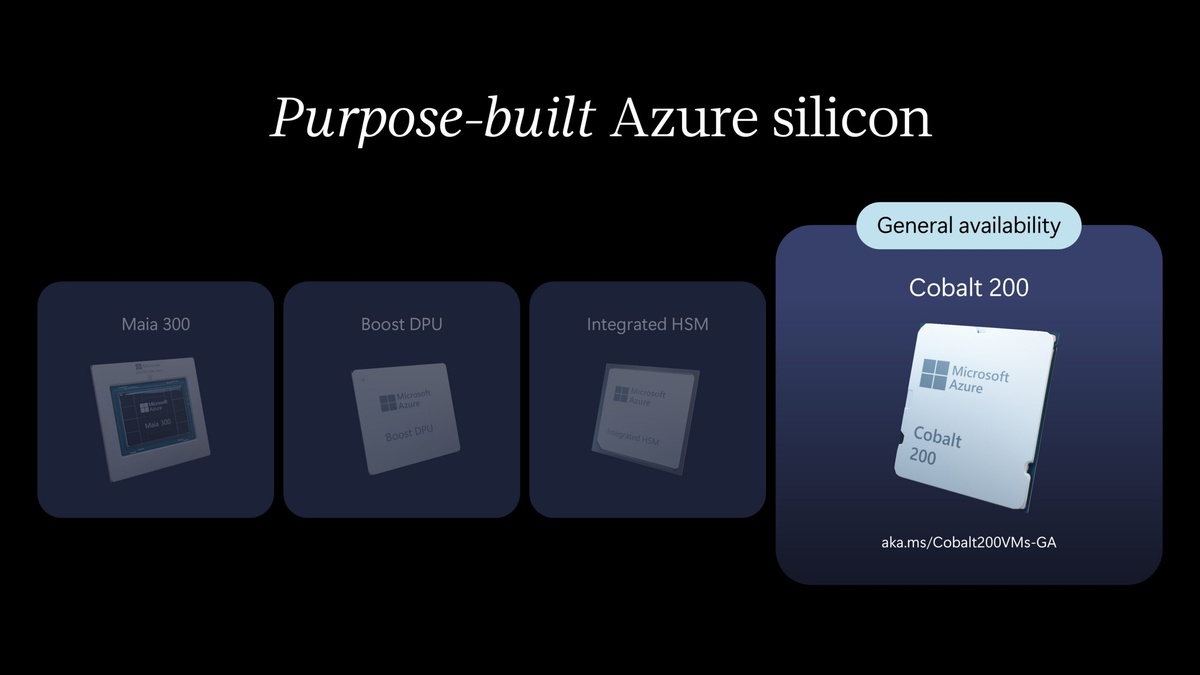
Delivering exponential artificial intelligence workloads requires underlying breakthroughs in physical cloud computing silicon. During the Microsoft Ignite 2026 Keynote, Microsoft announced the general availability of Cobalt 200 virtual machines, representing their next-generation custom general-purpose processors built on advanced ARM architecture.
Cobalt 200 delivers the highest performance and leading price-to-performance ratio across Azure’s general-purpose infrastructure fleet. The custom processor excels at high-throughput web serving, large-scale database operations, and intensive distributed microservice architectures that feed data into enterprise AI pipelines.
Alongside Cobalt 200, Microsoft highlighted progress on its custom Maia 300 datacenter AI accelerator. Maia 300 delivers forty percent higher tokens per watt compared to incumbent leading GPU architectures, significantly reducing the electrical and thermal footprints required for frontier model training and inference.
Infrastructure efficiency is further bolstered by Azure Boost and Azure Integrated Hardware Security Modules. These specialized silicon components offload storage virtualization, networking processing, and cryptographic encryption onto dedicated hardware, freeing primary CPU cores to execute business applications at peak throughput.
This relentless focus on architectural efficiency parallels advances in consumer processors like the AMD Ryzen 7 9800X3D, where dedicated silicon engineering and thermal innovations extract maximum computing throughput per watt across sustained compute-heavy workloads.
By combining Cobalt 200 general-purpose compute with Maia 300 neural accelerators, the Microsoft Ignite 2026 Keynote demonstrated an end-to-end silicon strategy that insulates Microsoft’s cloud from industry hardware bottlenecks while lowering overall total cost of ownership for global cloud clients.
Perception Agentic Security: Machine Speed Defense with Red and Blue Teams
To counter sophisticated automated threats, the Microsoft Ignite 2026 Keynote introduced Perception, an end-to-end agentic security platform designed to protect cloud environments at machine speed. The platform empowers defenders to detect anomalies and orchestrate proactive countermeasures before intrusions expand.
Perception deploys specialized agent teams organized into red, blue, and green operational squads. Red agents continuously simulate zero-day attack vectors to probe corporate defensive vulnerabilities, ensuring potential exploits are identified before malicious actors discover configuration weaknesses.
Under the security architecture detailed in the Microsoft Ignite 2026 Keynote, blue agents continuously ingest system telemetry, sensor signals, and identity verifications. When anomalous behavior is detected, green agents autonomously execute predefined security playbooks to isolate infected services within milliseconds.
Security operations teams retain complete supervisory authority through configurable policy gates. Administrators can allow green agents to resolve routine security incidents autonomously while requiring manual human sign-off before executing destructive remediation actions across mission-critical production databases.
Alongside Perception, the Microsoft Ignite 2026 Keynote introduced the Microsoft AI Transparency Initiative in collaboration with the National Institute of Standards and Technology. Working with forty industry partners, the initiative develops open governance standards to eliminate black-box opacity across frontier artificial intelligence systems.
This comprehensive security framework ensures that the innovations presented during the Microsoft Ignite 2026 Keynote remain grounded in verifiable trust. Organizations can deploy autonomous systems aggressively, confident that automated defensive squads and transparent governance standards protect corporate assets.
Frequently Asked Questions
What was the biggest product announcement at the Microsoft Ignite 2026 Keynote?
The biggest announcement at the Microsoft Ignite 2026 Keynote was Copilot Workspaces, a multiplayer collaboration canvas uniting human teams and autonomous agents. It introduces persistent context, team visibility, and shared execution loops across enterprise knowledge work, coding, and business operations.
How does Cobalt 200 custom silicon compare to existing Azure virtual machines?
Cobalt 200 is Microsoft’s next-generation custom ARM-based processor, delivering the highest performance and leading price-performance across general-purpose Azure workloads. It significantly lowers operational compute costs for web applications, databases, and data pipelines feeding enterprise AI systems.
What makes Code 2 and Code 2 Flash different from earlier coding assistants?
Code 2 is an agentic coding model capable of repo-wide reasoning, multi-file refactoring, deep debugging, and UI generation. Code 2 Flash provides ultra-fast, cost-effective syntax edits and explanations, giving software developers flexible multi-tier tooling.
How does Microsoft Perception automate enterprise cloud security?
Announced during the Microsoft Ignite 2026 Keynote, Perception is an autonomous security system employing red, blue, and green agent teams. Red teams simulate attacks, blue teams detect anomalies, and green teams automatically remediate vulnerabilities at machine speed through customizable operational playbooks.
How does Agent 365 manage enterprise artificial intelligence spending?
Agent 365 introduces Business Analytics, functioning as an ERP system for enterprise AI usage. It tracks token utilization, maps financial expenses directly to completed business outcomes, and enables administrators to enforce automated budgetary guardrails across agent swarms.
Final Verdict & Strategic Analysis: Microsoft Ignite 2026 Keynote Impact
The Microsoft Ignite 2026 Keynote established a mature, coherent blueprint for the next phase of enterprise computing. By integrating multiplayer collaboration, centralized data fabrics, specialized model hierarchies, and custom silicon, Microsoft demonstrated that enterprise AI has evolved from speculative experiments into fundamental business infrastructure.
Organizations evaluating these technologies benefit from transparent governance tools like Agent 365 and Perception security. Rather than managing disjointed point solutions, enterprise architects can now deploy autonomous agents within a single, observable ecosystem backed by predictable cloud economics and enterprise-grade identity controls.
Detailed technical documentation and session recordings are accessible through the official Microsoft Blog recap and the comprehensive Microsoft Ignite 2026 Book of News. Enterprise technology leaders should begin evaluating these tools to modernize their operational capabilities.
