


Table of Contents
Modern enterprise legal departments face escalating pressure to accelerate discovery analysis while maintaining flawless evidentiary precision. Through the official launch of Astra for Law, OpenAI introduces a domain-specialized intelligence architecture engineered specifically to automate complex statutory interpretation and multi-jurisdictional brief preparation.
Announced via the official OpenAI News index, the platform achieved first-place rankings across 24 distinct legal domains during rigorous evaluations. Enterprise teams can now request direct access through ChatGPT Enterprise, unlocking unprecedented analytical velocity without sacrificing client confidentiality boundaries.
| Core Architectural Pillar | Standard Frontier LLMs (Web Augmented) | OpenAI Astra for Law Configuration | Enterprise Practice Impact |
|---|---|---|---|
| Primary Judicial Corpus | Broad uncurated web crawl data | 230M+ Legal Search Index & CourtListener | Grounded in 99.9% of U.S. precedential case law |
| Reasoning Methodology | Generic unstructured conversational prose | Formal IRAC analysis & statutory rules | Directly matches appellate brief drafting standards |
| Citation Reliability | Variable citation accuracy with latent risks | Closed-loop docket matching & slip opinions | Material hallucinations reduced to ~0.03 per task |
| Data Governance & Privilege | Standard enterprise cloud retention rules | Zero Data Retention (ZDR) & ethical walls | Prevents model training on sensitive client matters |
| Ecosystem Connectivity | Manual copy-pasting across desktop windows | Native plugins for Relativity, iManage, Clio | Automates high-volume discovery and firm archiving |
Legal Intelligence Architecture: How Astra for Law Re-engineers Case Research
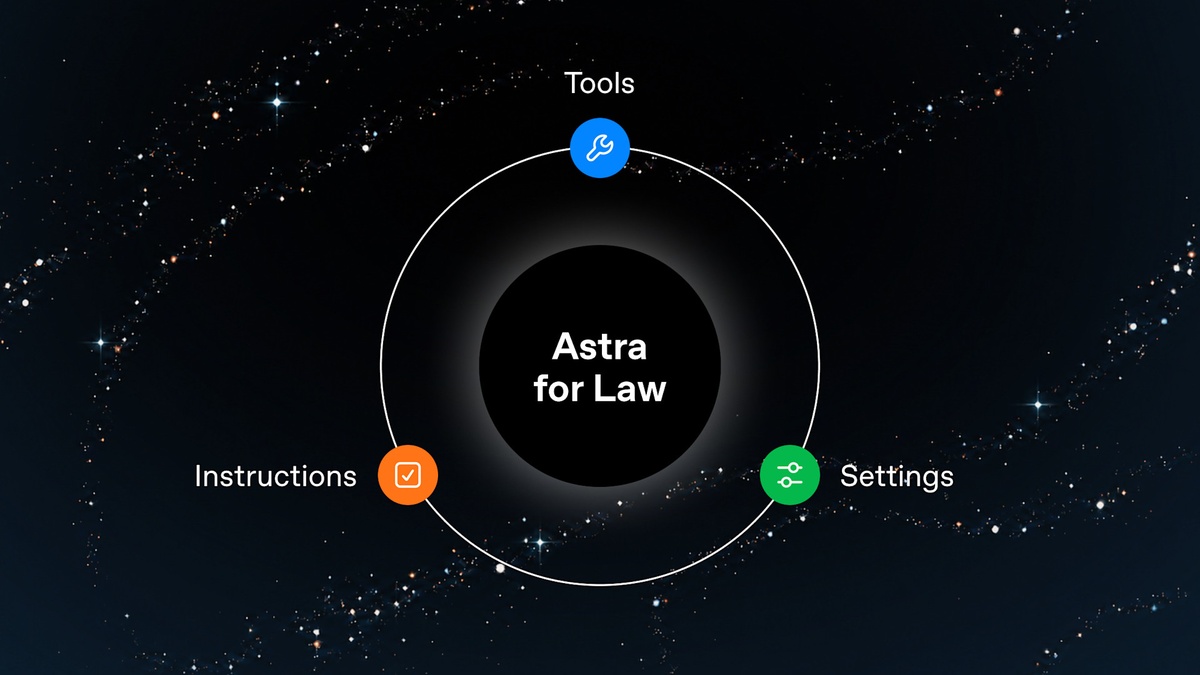
Traditional large language models often struggle when analyzing statutory nuances because generic web training data lacks structured procedural authority. In contrast, the specialized architecture of Astra for Law couples frontier neural weights with specialized legal reasoning instructions designed to emulate senior appellate counsel.
Attorneys evaluating complex commercial transactions must synthesize disparate contractual provisions, regulatory filings, and precedent decisions within hours. Deploying this dedicated system streamlines intensive reviews by isolating material liabilities and drafting counter-arguments with meticulous citation grounded directly in authoritative primary law sources.
Rather than generating generic conversational prose, the system structures legal memorandum around formal IRAC analysis frameworks. By methodically identifying relevant legal issues, stating governing rules, analyzing client facts, and formulating justifiable conclusions, the engine mirrors standard institutional litigation methodology.
Furthermore, corporate law firms testing the platform report notable productivity enhancements when reconciling ambiguous statutory exemptions across state lines. Associates can prompt the environment to examine legislative history, resolve conflicting circuit interpretations, and draft comprehensive advisory opinions in minutes.
This specialized reasoning capability represents a fundamental evolution from standard consumer chatbots to domain-grounded enterprise cognitive tooling. As corporate litigators face expanding document volumes, adopting Astra for Law establishes an indispensable research foundation that protects institutional credibility during high-stakes judicial proceedings.
The 230-Million Document Corpus: Free Law Project and CourtListener Integration
A primary structural barrier in legal artificial intelligence has been access to verified, uncorrupted primary legal authorities. OpenAI addressed this constraint by building an expansive Legal Search Index spanning over 230 million URLs covering federal, state, and administrative legal repositories.
Through a landmark data partnership with the Free Law Project, the platform directly ingests CourtListener archive records. This integration incorporates over 99.9% of published United States precedential case law, providing an exhaustive factual corpus for deep judicial precedent retrieval.
When practitioners query Astra for Law regarding rare jurisdictional doctrines, the model avoids general web search noise entirely. Instead, it interrogates verified appellate dockets, codified statutes, and administrative agency rulings to return pinpoint statutory citations with active source verification.
This closed-loop citation retrieval system eliminates the risk of fictional case law fabrications that plagued earlier generative AI experiments. Every legal proposition generated by the platform links directly to official slip opinions, docket entries, and annotated state code provisions within seconds.
Just as computing hardware requires specialized silicon pipelines like the Apple M4 Mac mini architecture, legal reasoning demands specialized corpus indexing. By anchoring reasoning within verified judicial archives, the model guarantees authoritative evidentiary support across every litigation brief and corporate advisory memo.
Harvey LAB-AA Benchmarks: Hallucination-Gated Reasoning Across 24 Practice Areas
Independent validation is crucial when evaluating mission-critical enterprise software designed for high-stakes courtroom litigation and regulatory compliance. Independent testing conducted alongside Artificial Analysis on Harvey’s LAB-AA benchmark demonstrates unprecedented domain mastery across 24 distinct legal disciplines.
The LAB-AA evaluation framework subjects models to multifaceted commercial tasks including merger agreements, antitrust investigations, and intellectual property litigation. In these stringent trials, Astra for Law captured first place overall, achieving a pioneering 20.8% hallucination-gated all-pass rate across comprehensive workflows.

Crucially, the benchmark strictly penalizes unsupported claims, requiring models to satisfy rigorous factual rubrics without introducing material hallucinations. Under these unforgiving evaluation criteria, the system demonstrated an astonishingly low material hallucination rate of approximately 0.03 fabrications per complex task.
On Vals AI’s Legal Research Bench, the configuration demonstrated comparable dominance by scoring 54.0% on full-credit statutory correctness evaluations. This represents a massive performance premium over generic frontier foundation models, which frequently fail when parsing complex multi-part regulatory standards.
Evaluating legal briefs drafted by the model revealed that experienced judicial clerks and senior partners preferred its work over legacy model outputs. The resulting legal arguments exhibited tighter statutory grounding, sharper analogical reasoning, and superior synthesis of opposing authority across diverse practice groups.
Comparative Performance Metrics: Astra for Law Versus Frontier LLM Baselines
Quantifying the performance divergence between generalized artificial intelligence models and domain-specialized legal systems reveals profound architectural differences. While base foundation models excel at broad conversational synthesis, they exhibit unacceptable variance when resolving granular state jurisdictional splits.
Benchmarking data confirms that deploying Astra for Law yields substantial accuracy advantages across contract drafting, regulatory analysis, and statutory citation validation. Legal technology teams can inspect the direct empirical comparisons below to assess how dedicated legal intelligence alters day-to-day corporate legal operations.
| Benchmark & Legal Discipline | Baseline Frontier AI (Web Augmented) | Astra for Law 6.2 Architecture | Performance Delta |
|---|---|---|---|
| Harvey LAB-AA v1.1 (All-Pass Rate) | 11.4% passing rate | 20.8% hallucination-gated pass rate | +82.5% relative accuracy gain |
| Material Hallucination Frequency | 0.24 material fabrications / task | 0.03 material fabrications / task | 87.5% reduction in false authority |
| Vals AI Legal Research Bench (Correctness) | 38.2% full-credit accuracy | 54.0% full-credit accuracy | +41.4% improvement in statutory hits |
| Brief Drafting (LAB: USCL Evaluation) | 32.0% judicial clerk preference | 68.0% judicial clerk preference | 2.1x preference margin over baselines |
| Jurisdictional Domain Mastery | Inconsistent state-level compliance | Comprehensive across 24 legal disciplines | Uniform multi-jurisdiction stability |
As shown in the comparative benchmark data, the introduction of hallucination gating radically shifts enterprise usability metrics for legal practices. Where generic models generate plausible-sounding but legally invalid citations, verified docket matching guarantees authenticated references that withstand strict judicial scrutiny.
High-performance workstations benefit from predictable hardware scaling, similar to the gains seen in AMD Ryzen 7 9800X3D benchmarks. In identical fashion, deploying Astra for Law delivers deterministic analytical performance that enterprise legal teams can rely upon during urgent corporate transactions.
By eliminating hours of manual citation verification and cite-checking drudgery, legal departments unlock profound operational leverage across routine matters. Senior counsel can shift focus toward high-level strategy and client negotiations while autonomous systems reliably handle exhaustive background statutory synthesis.
Enterprise Governance: Zero Data Retention and Ethical Wall Enforcement
Law firms handling sensitive corporate mergers, pending patent applications, and confidential litigation cannot compromise on data privacy governance. To address these absolute ethical mandates, OpenAI implemented strict Zero Data Retention protocols for all enterprise API interactions with Astra for Law.
Under these enterprise privacy terms, client matter prompts and uploaded evidentiary documents are never utilized to train future public foundation models. Furthermore, transient model inputs are automatically purged from processing memory immediately upon completion of the inference cycle.
To support multi-client law firm environments, the architecture enforces robust ethical walls and departmental role-based access permissions. Attorneys working on adverse litigation matters are prevented from accessing shared workspace context, maintaining strict compliance with state bar confidentiality rules.
Corporate legal executives can also inspect complete cryptographic audit logs detailing prompt histories, source retrieval queries, and user access patterns. These tamper-proof records provide enterprise compliance officers with total transparency when validating how the intelligence pipeline handles privileged client documentation.
Much like modern cloud gaming infrastructure requires strict multi-tenant network partitioning, as seen with Xbox Cloud Gaming pricing architectures, enterprise legal tech requires uncompromising data segmentation. The comprehensive security framework surrounding Astra for Law satisfies even the most stringent institutional risk requirements.
ChatGPT Enterprise Deployment: Administrative Onboarding for Astra for Law
Transitioning advanced artificial intelligence from experimental pilot projects to firm-wide production requires streamlined administrative deployment paths. OpenAI has made Astra for Law directly accessible to all active ChatGPT Enterprise customers through their centralized administrative management consoles.
Workspace administrators can request access with a single click, enabling immediate configuration of practice-group workspaces and domain-specific permission profiles. IT directors can selectively provision seats to litigation, corporate, and tax departments while retaining centralized oversight over monthly API token consumption.

Early deployment partners, including global law firms like Latham & Watkins and Cooley, have integrated these specialized tools directly into daily associate onboarding workflows. Junior lawyers receive structured prompt templates and verified research guidelines designed to maximize citation accuracy and procedural consistency.
Centralized administrative policies also allow IT departments to enforce strict browser environment requirements across corporate laptop fleets. As corporate organizations retire legacy operating systems following events like when NVIDIA ends Windows 10 support, modernizing workplace productivity tools around cloud intelligence has become imperative.
By embedding Astra for Law directly within the familiar ChatGPT Enterprise desktop interface, organizations eliminate the friction of training employees on complex standalone software. Attorneys can immediately begin collaborating with the legal intelligence engine using natural conversational prompts within secure corporate accounts.
Ecosystem Integrations: Connecting Relativity, Clio, and iManage Workspaces
A standalone artificial intelligence model delivers limited enterprise utility if isolated from existing corporate document management systems. To ensure seamless workflow integration, OpenAI partnered with leading legal technology providers to launch specialized ecosystem plugins for Astra for Law.
Practitioners utilizing Relativity for electronic discovery can connect workspaces directly to the model, enabling automated document classification and relevance scoring. Litigation teams can analyze millions of subpoenaed emails and corporate records in hours, identifying critical smoking-gun exhibits with verified evidentiary metadata.
Similarly, integrations with iManage and Clio allow attorneys to interrogate internal firm work product archives directly within conversational sessions. Associates can retrieve prior firm deal templates, cross-reference previous client briefs, and ensure consistent positioning across recurring commercial litigation.
Partnerships with Thomson Reuters and Harvey further extend platform reach by synchronizing proprietary legal analytics with frontier generative reasoning. This interconnected ecosystem transforms Astra for Law into a centralized intelligence hub that enhances every phase of legal service delivery.
As legal technology vendors expand automated API connectors, corporate law firms adopting these unified architectures will dramatically outperform traditional competitors. Standardizing on frontier AI tools ensures legal organizations remain agile, competitive, and technologically resilient in an increasingly automated professional landscape.
Frequently Asked Questions
What is Astra for Law and how does it differ from standard ChatGPT?
Astra for Law is a specialized legal intelligence platform built on GPT-6 Astra models. Unlike standard ChatGPT, it incorporates a 230M-document Legal Search Index, Free Law Project case law, and specialized IRAC legal reasoning instructions designed specifically for professional attorneys.
How does the platform prevent hallucinations and false case citations?
The architecture prevents hallucinations by integrating a closed-loop retrieval pipeline grounded in over 99.9% of published U.S. precedential case law. Every legal citation is verified against real CourtListener dockets, reducing material hallucinations to roughly 0.03 per task.
Can all ChatGPT Enterprise customers access Astra for Law immediately?
Yes, all active ChatGPT Enterprise customers can request access to Astra for Law directly through their administrative console. OpenAI is rolling out access via its Trusted Access Program alongside dedicated API endpoints for enterprise builders.
How does OpenAI protect client confidentiality and work product privilege?
OpenAI enforces strict Zero Data Retention on API endpoints and guarantees that enterprise prompt data is never used to train public foundation models. Workspaces feature ethical wall controls, cryptographic access logs, and complete tenant isolation.
Which third-party legal platforms integrate directly with the platform?
The platform features specialized ecosystem plugins connecting with Relativity for e-discovery, iManage and Clio for document management, and specialized research tools from Thomson Reuters, Legora, and Harvey.
Legal Intelligence Verdict: The Structural Transformation of Enterprise Counsel
The arrival of Astra for Law marks a monumental turning point in the modernization of corporate legal practice. By pairing exhaustive statutory indexing with rigorous hallucination-gated reasoning, OpenAI provides corporate legal counsel with a dependable, court-ready research assistant.
For corporate law firms and enterprise legal departments, adopting this framework delivers unmatched efficiency gains across contract review and litigation drafting. With robust Zero Data Retention guarantees and extensive ecosystem plugins, organizations can modernize workflows without compromising strict ethical obligations.
As legal workloads continue to expand globally, implementing Astra for Law will distinguish forward-thinking law practices from slower competitors. Enterprises that integrate this frontier legal intelligence framework today will establish an enduring competitive advantage in legal precision and client responsiveness.
