


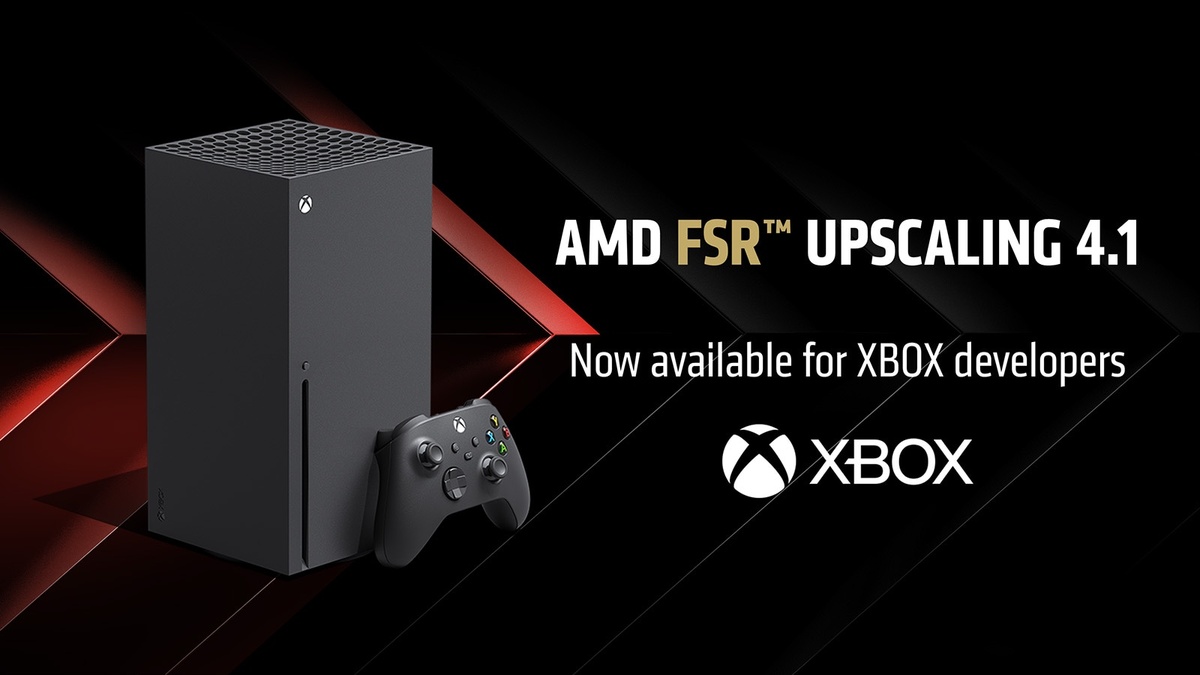
Microsoft and AMD have officially released AMD FSR 4.1 for Xbox Series X and Xbox Series S through the October 2026 Game Development Kit, bringing neural machine learning upscaling to home consoles for the first time.
As detailed by Pure Xbox, the deployment equips game studios with specialized INT8 machine learning models, allowing demanding titles to deliver enhanced resolution, cleaner edge reconstruction, and improved frametimes across existing hardware.
| Architecture Dimension | Full INT8 Model | Lite INT8 Model | Legacy Analytical FSR 3.1 | Console Gaming Advantage |
|---|---|---|---|---|
| Reconstruction Pipeline | Deep Convolutional Neural Network | Pruned INT8 Neural Network | Hand-Crafted Spatial/Temporal Heuristics | Eliminates edge shimmer and motion disocclusion ghosting |
| Target Hardware Node | Xbox Series X & Series S (RDNA 2) | Xbox Series X & Series S (RDNA 2) | All Modern DirectX 12 GPUs | Brings neural super resolution to standard console silicon |
| Inference Execution Cost | ~4.2ms at 4K Output (Series X) | ~2.74ms at 4K Output (Series X) | ~1.8ms at 4K Output (Series X) | Lite model delivers neural fidelity with minimal frametime hit |
| Upscaler VRAM Footprint | ~270 MiB at 4K Target (1440p Base) | ~270 MiB at 4K Target (1440p Base) | ~260 MiB at 4K Target (1440p Base) | Model switching creates zero memory allocation penalty |
| GDK Tooling & Distribution | Microsoft GDK October 2026 | Microsoft GDK October 2026 | Standard FidelityFX SDK | Unified AMD-signed binaries for Xbox and Windows |
| Handheld Parity Support | Supported via FSR SDK 2.4 | Supported via FSR SDK 2.4 | Supported on Handhelds | Native acceleration on ROG Xbox Ally Ryzen AI silicon |
Table of Contents
1. Machine Learning Reconstruction: Transitioning from Heuristic Math to Neural Inference
For years, console temporal upscaling relied on hand-crafted analytical heuristics that frequently introduced disorienting ghosting artifacts, edge flickering, and shimmering behind rapid movement during intense action sequences.
The arrival of AMD FSR 4.1 shifts this computational workload toward deep-learning neural models trained on high-resolution ground truth imagery, fundamentally transforming how pixel data is reconstructed.
By analyzing temporal motion vectors alongside jittered color and depth buffers, the neural inference pipeline intelligently differentiates between authentic scene movement and transient frame anomalies.
This computational leap resolves long-standing issues surrounding fine sub-pixel detail, allowing intricate wire fences, hair strands, and atmospheric dust motes to remain sharp without producing intrusive edge moire patterns.
Engineering documentation published by AMD GPUOpen highlights that replacing analytical filtering with neural models establishes a far more stable image presentation across dynamic gaming environments.
2. Dual INT8 Execution Models: Balancing Full and Lite Precision on RDNA 2
To accommodate the distinct hardware targets of Microsoft’s console family, AMD FSR 4.1 introduces two dedicated neural execution models: a Full INT8 model and a lightweight Lite INT8 architecture.
The Full INT8 model maximizes visual quality and temporal stability, dedicating deeper neural layers to resolve complex geometric intersections and high-frequency textures in heavy ray tracing environments.
Conversely, the Lite INT8 model reduces overall parameter footprint by more than fifty percent, slashing inference overhead while preserving impressive perceptual clarity on compute-constrained platforms.
Crucially, both inference variations share identical memory footprints within system GDDR6 memory, meaning developers can dynamically switch between Full and Lite models based on real-time rendering demands.
This architectural flexibility ensures that AMD FSR 4.1 extracts optimal efficiency from the custom RDNA 2 GPU silicon without demanding dedicated proprietary tensor cores.
3. Microsoft GDK Architecture: Unified Low-Level Integration Across Xbox and Windows
Microsoft and AMD engineered the integration directly within the October 2026 Game Development Kit, granting studio teams unified low-level API access across both Xbox consoles and Windows.
Instead of managing divergent upscaling forks for different platforms, programmers can utilize identical API headers and AMD-signed binaries to implement AMD FSR 4.1 across their entire multiplatform codebase.
Developers can inspect production-ready code samples within the official Microsoft Xbox GDK Samples repository on GitHub, which illustrates dynamic runtime model switching between Full and Lite execution.
The SDK ingestion pipeline accepts standard graphics buffers, including jittered screen coordinates, linear depth buffers, and motion vectors, while optional reactive masks provide fine control over alpha surfaces.
Much like the streamlined architectural breakthroughs examined in our Apple M4 Mac Mini redesign architectural review, unified engineering frameworks dramatically reduce developer integration friction.
4. Console Benchmark Analysis: Frametime Gains on Xbox Series X and Series S
Real-world rendering tests on Xbox Series X hardware demonstrate that AMD FSR 4.1 reconstructs a 4K presentation from a native 1440p quality input in just 2.74 milliseconds using Lite inference.
This lightning-fast reconstruction window allows graphics engines to preserve precious GPU frametimes, directing spare compute headroom toward advanced path tracing, volumetric lighting, and stable sixty-frames-per-second performance targets.
For the compact Xbox Series S, AMD FSR 4.1 represents a massive generational lifeline by transforming low native render resolutions like 720p and 900p into crisp 1080p and 1440p output displays.
| Target Platform | Native Display Target | Internal Render Resolution | Recommended FSR Model | Upscaler Latency | Visual Quality Impact |
|---|---|---|---|---|---|
| Xbox Series X (Performance) | 3840 x 2160 (4K 60FPS) | 2560 x 1440 (Quality, 1.5x) | Lite INT8 Architecture | 2.74 ms | Near-native 4K sharpness with high-speed frametimes |
| Xbox Series X (Fidelity) | 3840 x 2160 (4K 30FPS) | 2176 x 1224 (Balanced, 1.7x) | Full INT8 Architecture | 4.21 ms | Pristine ray-traced reflections with zero temporal ghosting |
| Xbox Series S (Quality) | 2560 x 1440 (1440p 30/60) | 1706 x 960 (Quality, 1.5x) | Lite INT8 Architecture | 2.15 ms | Resolves fine geometric edges without foliage pixel crawl |
| Xbox Series S (Esports) | 1920 x 1080 (1080p 120FPS) | 1280 x 720 (Quality, 1.5x) | Lite INT8 Architecture | 1.42 ms | Smooth competitive framerates with sharp sub-pixel text |
| ROG Xbox Ally Handheld | 1920 x 1080 (1080p Native) | 1280 x 720 (Balanced, 1.7x) | Lite INT8 via NPU | 1.85 ms | Extended battery endurance while retaining crisp handheld UI |
By eliminating the severe temporal instability of older upscalers, the machine learning upscaler allows Series S titles to maintain competitive visual fidelity alongside the flagship Series X console.
Just as enthusiast desktop builders evaluate silicon efficiency when inspecting the AMD Ryzen 7 9800X3D gaming benchmarks, console architects prioritize balanced performance per watt to sustain demanding rendering pipelines.
As developers update existing game engines to phase out legacy software constraints after NVIDIA ends Windows 10 support for PC gamers, modern neural reconstruction pipelines establish the technological baseline for future multiplatform releases.
5. Ecosystem Handheld Synergy: Scaling Across ROG Xbox Ally Hardware
The widespread rollout of AMD FSR 4.1 extends well beyond traditional living room consoles, providing direct operational synergy with upcoming portable gaming devices like the ROG Xbox Ally lineup.
Through AMD FSR SDK 2.4, the upscaler leverages the integrated neural processing units within AMD Ryzen AI Z2 Extreme processors to deliver responsive upscaling within tight battery envelopes.
Handheld players benefit from increased battery endurance because the GPU renders internal frames at lower native resolutions while AMD FSR 4.1 reconstructs rich ten-eighty-p visuals without noticeable fidelity degradation.
Furthermore, just as scalable infrastructure strategies are analyzed in our Xbox Cloud Gaming pay-as-you-go pricing guide, unified software stacks ensure cross-device parity from handhelds to cloud server blades.
By connecting PC handhelds, living room consoles, and future hardware like Project Helix into a unified upscaling ecosystem, the neural framework ensures long-term architectural longevity for developers and gamers alike.
Frequently Asked Questions
What is AMD FSR 4.1 and how does it operate on Xbox Series X|S?
AMD FSR 4.1 is an advanced machine-learning upscaling technology that replaces heuristic algorithms with neural inference models, reconstructing high-resolution 4K and 1440p frames from lower internal render resolutions on RDNA 2 console hardware.
What is the difference between Full INT8 and Lite INT8 models in AMD FSR 4.1?
The Full INT8 model delivers maximum image reconstruction quality for complex graphics, while the Lite INT8 model reduces computational overhead by over fifty percent, enabling ultra-fast execution times on both Xbox consoles.
Can existing Xbox Series X and Xbox Series S games be patched to support AMD FSR 4.1?
Yes, developers can patch existing titles by integrating the updated October 2026 GDK binaries, allowing older releases to replace analytical FSR or temporal anti-aliasing with neural reconstruction without requiring architectural rebuilds.
How does AMD FSR 4.1 compare to PlayStation 5 Pro PSSR upscaling?
While Sony’s PSSR requires dedicated custom machine learning silicon inside the PS5 Pro, the AMD upscaler executes efficient INT8 neural models on standard RDNA 2 GPU compute units across Series X and Series S.
Does AMD FSR 4.1 support Windows PC and ROG Xbox Ally handhelds?
Yes, the neural upscaler shares unified API headers across the AMD FSR SDK 2.4 ecosystem, supporting Windows desktop graphics cards, Ryzen AI Z2 processors, and upcoming ROG Xbox Ally portable gaming devices.
Final Verdict: Why AMD FSR 4.1 Redefines Console Visual Fidelity and Hardware Longevity
The arrival of AMD FSR 4.1 on Xbox Series X and Series S marks a pivotal technological milestone that democratizes modern machine-learning super resolution across millions of existing living room consoles.
By providing both Full and Lite INT8 inference models through the standardized Microsoft GDK, AMD and Xbox have engineered a practical, low-latency upscaling solution that requires zero dedicated hardware silicon upgrades.
As upcoming blockbuster titles push graphical boundaries, AMD FSR 4.1 guarantees that current-generation hardware remains visually competitive, delivering pristine image clarity and rock-solid framerates well into the future.
