


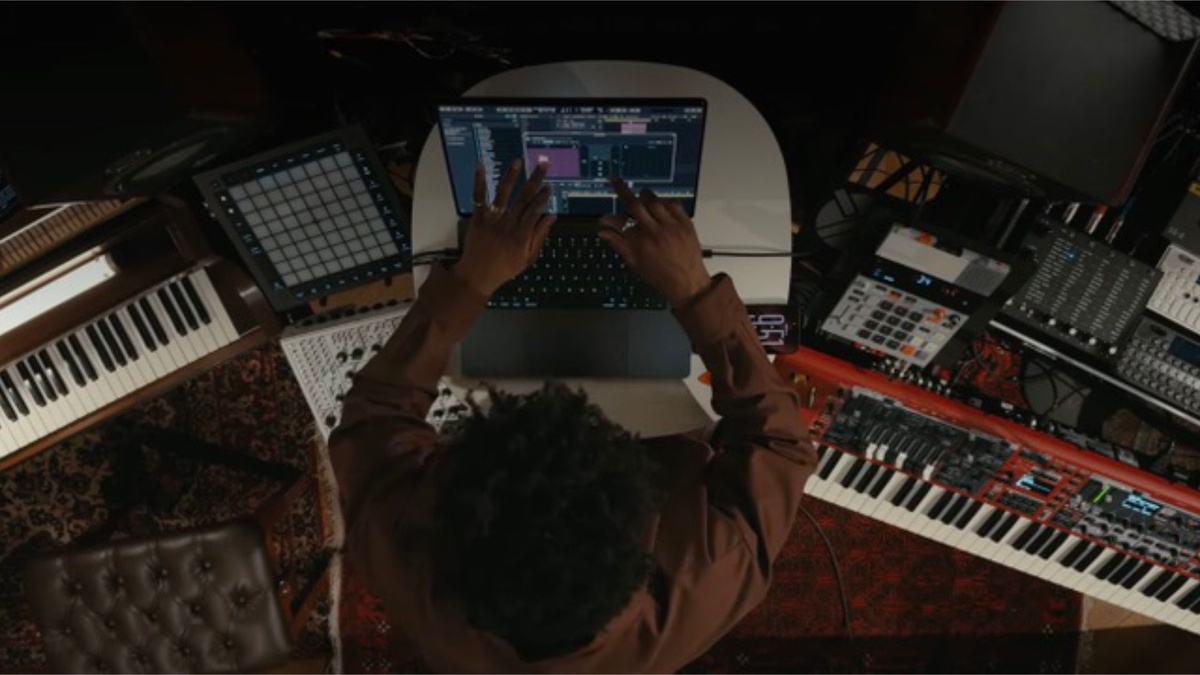
Apple has officially showcased the new Touchscreen MacBook Pro in action through a four-hour creative session with Grammy-nominated British artist Labrinth, providing the first real-world look at how direct multi-touch transforms professional studio production.
Streaming overnight from Apple Tower Theatre in downtown Los Angeles, the live demonstration highlighted how the Touchscreen MacBook Pro merges responsive tactile control with professional audio editing, settling years of debate regarding touchscreen ergonomics on macOS.
| Hardware Specification | 14-inch Model | 16-inch Model | Creator Significance |
|---|---|---|---|
| Display Architecture | 14.2-inch Tandem OLED Multi-Touch | 16.2-inch Tandem OLED Multi-Touch | Zero blooming, 2,000 nits peak, pixel-level blacks |
| Interaction Model | Capacitive Multi-Touch & Trackpad | Capacitive Multi-Touch & Trackpad | Direct fader adjustment and polyphonic instrument input |
| Mechanical Hinge | Anti-Wobble Dynamic Damper Hinge | Anti-Wobble Dynamic Damper Hinge | Eliminates display bounce during active finger taps |
| Processor Configuration | Apple M5 Pro / M5 Max (2nm) | Apple M5 Pro / M5 Max (2nm) | 600 GB/s unified bandwidth, 64-TOPS Neural Engine |
| Starting Retail Price | $2,899 | $3,399 | High-end workstation investment for pro creators |
| Global Launch Date | Friday, November 6, 2026 | Friday, November 6, 2026 | Available at Apple retail stores and authorized dealers |
Table of Contents
1. Labrinth Live on Mac: Real-Time Multi-Touch Logic Pro Workflows
During the extensive studio livestream titled ‘Labrinth Live on Mac,’ the producer built a complete multitrack arrangement from scratch, actively manipulating Logic Pro mixing faders directly on the display of the Touchscreen MacBook Pro.
Musicians frequently rely on external MIDI surfaces or secondary tablet accessories to adjust track automation, but direct capacitive touch interaction on macOS allows creators to tweak parametric equalizers and slide multi-channel gain levels instantly without breaking creative flow.
As reported by MacRumors, Logic Pro incorporates dedicated touch-optimized onscreen keyboards, drum pads, and chord strips capable of polyphonic multi-finger tracking with zero perceptible input lag.
By allowing artists to play complex chords and expressive percussion gestures directly on the glass surface, the pro Apple laptop demonstrates a functional paradigm shift that bridges the tactile freedom of an iPad with full desktop compute.
Apple confirmed that the finished track produced during the overnight broadcast will arrive on Apple Music next week, offering tangible proof of an uncompromised professional production executed entirely via touch.
2. Tandem OLED Architecture: Double-Stack Silicon Eliminates Blooming
A foundational pillar of the Touchscreen MacBook Pro is its cutting-edge Tandem OLED PROLED XDR display, which utilizes a dual-stack emissive architecture to deliver staggering dynamic contrast and eliminate backlight blooming.
Traditional mini-LED panels suffer from visible halo artifacts when high-contrast waveform meters or glowing user interface elements sit against dark timeline backgrounds, creating distracting visual glare for professional colorists and mastering engineers.
By stacking two organic light-emitting layers, Apple achieves an extraordinary two thousand nits of peak HDR brightness alongside genuine pixel-level black levels, ensuring mastering fidelity across both fourteen-inch and sixteen-inch chassis options.
Beneath the durable glass cover, custom capacitive digitizer arrays sample touch inputs at ultra-low latency, ensuring that rapid multi-finger gestures across the Touchscreen MacBook Pro feel immediate and natural.
Advanced oleophobic optical coatings minimize finger smudges and ambient room reflections, enabling digital illustrators and visual creators to work comfortably under harsh studio lighting without degrading visual calibration.
3. Anti-Wobble Mechanical Hinge: Solving Display Stability During Studio Interaction
A long-standing engineering critique of clamshell touch devices has centered on display wobble, but the Touchscreen MacBook Pro solves this mechanical challenge through a completely redesigned high-friction friction-lock hinge.
When users tap or swipe vigorously across standard laptop displays, the screen frequently bounces backward, disorienting precision input and requiring users to awkwardly brace the rear panel with an opposing hand.
Apple’s mechanical engineering team introduced dynamic internal dampeners within the aerospace-grade aluminum chassis of the pro workstation, ensuring the display panel remains rock-solid during aggressive finger taps while preserving smooth single-finger opening.
This rigid structural design provides audio engineers with the confidence to slam virtual drum pads and drag intricate automation nodes across timeline views without inducing distracting mechanical oscillation or chassis creaks.
Much like the mechanical breakthroughs documented in our Apple M4 Mac Mini redesign architectural review, Apple prioritizes specialized enclosure mechanics to elevate real-world user interaction.
4. M5 Pro and M5 Max Silicon: Thermal Headroom and Generational Faceoff
Beneath the interactive glass surface, the Touchscreen MacBook Pro draws immense computational power from Apple’s next-generation M5 Pro and M5 Max system-on-chip architectures, engineered on TSMC’s enhanced two-nanometer process node.
The updated silicon fabric integrates expanded memory controllers delivering up to six hundred gigabytes per second of unified memory bandwidth, preventing memory bottlenecks when streaming hundreds of uncompressed audio tracks simultaneously.
While PC enthusiasts celebrate raw gaming clocks on platforms like the AMD Ryzen 7 9800X3D revealed, Apple silicon emphasizes sustained performance per watt, allowing continuous four-hour rendering on battery power.
| Hardware Dimension | Previous Gen MacBook Pro | New Touchscreen Model | Studio Production Impact |
|---|---|---|---|
| Input Paradigm | Precision Trackpad & Keyboard Only | Direct Capacitive Multi-Touch Support | Simultaneous multi-fader audio mixing in Logic Pro |
| Panel Technology | Mini-LED Array (Liquid Retina XDR) | Tandem Double-Stack OLED | Zero blooming around audio waveforms and meters |
| Hinge Engineering | Standard Friction Hinge | Dynamic Anti-Wobble Stabilizer Hinge | Prevents panel bounce during forceful touch taps |
| Neural Compute | 38 TOPS Neural Engine | 64 TOPS Next-Gen Neural Engine | Real-time machine-learning stem separation in DAW |
| Peak Brightness | 1,600 nits HDR Peak | 2,000 nits Tandem OLED Peak | Unrivaled contrast for HDR mastering and outdoor work |
| Unified Memory Bandwidth | Up to 400 GB/s Unified Bandwidth | Up to 600 GB/s Unified Bandwidth | Zero latency streaming for massive sample libraries |
With up to thirty-two GPU execution cores and an upgraded 64-TOPS Neural Engine, the Touchscreen MacBook Pro accelerates machine-learning stem separation and real-time DSP acoustic modeling without triggering intrusive fan noise.
As workstation users re-evaluate legacy hardware environments after announcements confirming NVIDIA ends Windows 10 support, modern creative studios increasingly prioritize unified memory architectures that seamlessly handle dense production assets.
5. Pricing Analysis and Value Verdict: Configurations, Availability, and Creator ROI
Understanding configuration tiers and retail availability is vital for creators evaluating whether the investment in a Touchscreen MacBook Pro aligns with their commercial production demands.
The fourteen-inch model begins at an entry price of $2,899, while the sixteen-inch flagship commands a starting price of $3,399, positioning these touchscreen workstations firmly in the high-tier professional category.
While high initial pre-order volume has stretched shipping dates for select Space Black models, official announcements via Apple Newsroom confirm global retail availability starting Friday, November 6.
Much like the flexible cloud compute strategies analyzed in our Xbox Cloud Gaming pay-as-you-go analysis, investing in premium local silicon delivers long-term workflow efficiency that justifies upfront hardware expenses.
For traveling musicians, mobile audio engineers, and video editors demanding tactile manipulation, the Touchscreen MacBook Pro offers tangible workflow acceleration that rapidly offsets the initial financial outlay.
Frequently Asked Questions
How does the Touchscreen MacBook Pro improve music production in Logic Pro?
The Touchscreen MacBook Pro enables musicians to manipulate mixer faders, play multi-touch chord and drum pads, and scrub arrangement timelines directly on the display with polyphonic finger tracking and zero perceptible input latency.
Does the screen wobble when tapping the Touchscreen MacBook Pro?
No, Apple engineered a specialized high-friction dynamic mechanical hinge for the flagship pro machine that stabilizes the display during active touch taps while maintaining smooth one-finger opening and closing.
What display technology is used in the Touchscreen MacBook Pro?
The flagship Apple notebook features a Tandem OLED PROLED XDR display offering two thousand nits peak HDR brightness, true pixel-level black levels, anti-reflective oleophobic coatings, and 120Hz ProMotion adaptive refresh rates.
What processors power the new Touchscreen MacBook Pro lineup?
The pro workstation family is powered by Apple M5 Pro and M5 Max chips built on advanced 2nm silicon, featuring up to 600 GB/s unified memory bandwidth and a 64-TOPS Neural Engine for AI stem separation.
What is the starting price and release date for the Touchscreen MacBook Pro?
The new pro models launch globally on Friday, November 6, 2026, with prices starting at $2,899 for the 14-inch model and $3,399 for the 16-inch model across Apple retail and authorized dealers.
Final Verdict: Why Apple’s Touchscreen Revolution Redefines Pro Audio and Video
Apple’s dramatic livestream demonstration with Labrinth validates that the Touchscreen MacBook Pro is not a superficial novelty, but rather a profoundly capable production instrument tailored for high-end studio professionals.
By harmonizing responsive Tandem OLED touch optics, an anti-wobble dynamic hinge, and blistering M5 series silicon, macOS successfully embraces direct physical touch without sacrificing keyboard and trackpad precision.
For audio producers, video editors, and digital creators seeking maximum tactile versatility, the Touchscreen MacBook Pro redefines portable computing and establishes a brilliant new benchmark for modern creative workstations.
