


Table of Contents
International export restrictions were intended to choke off advanced artificial intelligence hardware shipments to mainland China. However, contraband Nvidia Blackwell AI Racks have officially surfaced inside an enterprise Shanghai computing facility, triggering an urgent regulatory crisis across Western semiconductor enforcement agencies.
Securing operational Nvidia Blackwell AI Racks represents an audacious breach of international export restrictions. Regulatory investigators have uncovered direct logistical ties connecting the covert installation to corporate shell entities, alleged foreign espionage operations, and blacklisted transshipment networks.
| Audit Dimension | Documented Case Record | Regulatory Legal Status | Strategic Infrastructure Impact |
|---|---|---|---|
| Facility Site | Yangtze River Delta Project, Shanghai Computing Corridor | Unlicensed Mainland China Deployment | Sovereign high-density compute cluster operating outside Western export oversight |
| Server Hardware | Nvidia GB300 NVL72 Rack & GB200 Liquid-Cooled Cabinets | Strictly Prohibited Under US BIS Export Controls | Unlocks exaflop-scale tensor throughput for frontier generative artificial intelligence |
| Bank Collateral | 96M Yuan ($14M USD) Underwritten by Shanghai Innovation Bank | Certified Commercial Debt Asset Pledging | Establishes state banking recognition of illicit enterprise semiconductor collateral |
| Secondary Lease | 90M Yuan Equipment Financing via Shanghai Municipal District Agency | Government-Owned Capital Entity Transaction | Confirms regional state involvement underwriting unauthorized compute capacity leases |
| Corporate Network | Megaspeed Distribution Syndicate & Chinese Intermediary Firms | Subject to Federal Criminal Indictment & Entity List Sanctions | Exposes two billion dollar international silicon diversion and transshipment network |
Yangtze River Delta Infrastructure: How Nvidia Blackwell AI Racks Infiltrated Shanghai Data Centers
The facility housing the banned hardware was identified as the Yangtze River Delta Project, situated within the high-density computing corridor of Shanghai. During initial investor presentations, corporate promoters boasted about erecting an unannounced sovereign computing cluster optimized for frontier artificial intelligence models.
According to investigative documentation disclosed by Tom’s Hardware enterprise reporting, the data center operates full server configurations. Discovering operational Nvidia Blackwell AI Racks on Chinese soil shatters previous assumptions regarding physical supply chain enforcement.
Rather than relying on older hopper silicon, technicians successfully brought online dual-die B200 accelerators. The sheer physical footprint required to support these liquid-cooled enterprise systems proves this was not an ad-hoc smuggling operation, but a fully engineered institutional deployment.
Deploying these enterprise computing platforms mirrors the massive generational infrastructure transitions observed across consumer silicon, as detailed in our analysis of AMD Ryzen 7 9800X3D gaming processor specs. Advanced packaging density requires bespoke engineering facilities.
Municipal utility registries indicate the facility drew substantial industrial power allocations beginning in late 2025. Operating high-density Nvidia Blackwell AI Racks demands specialized thermal dissipation infrastructure, liquid distribution manifolds, and dual-coolant loops rarely concealed from regional grid monitoring authorities.
Regional enterprise operators reportedly leased compute hours through obscure domestic software portals. This compartmentalized architecture shielded the underlying physical hardware from external automated software telemetry probes, allowing domestic developers to train proprietary generative networks without triggering remote vendor alarms.
GB300 NVL72 Liquid-Cooled Architecture: Enterprise Silicon Powering the Facility
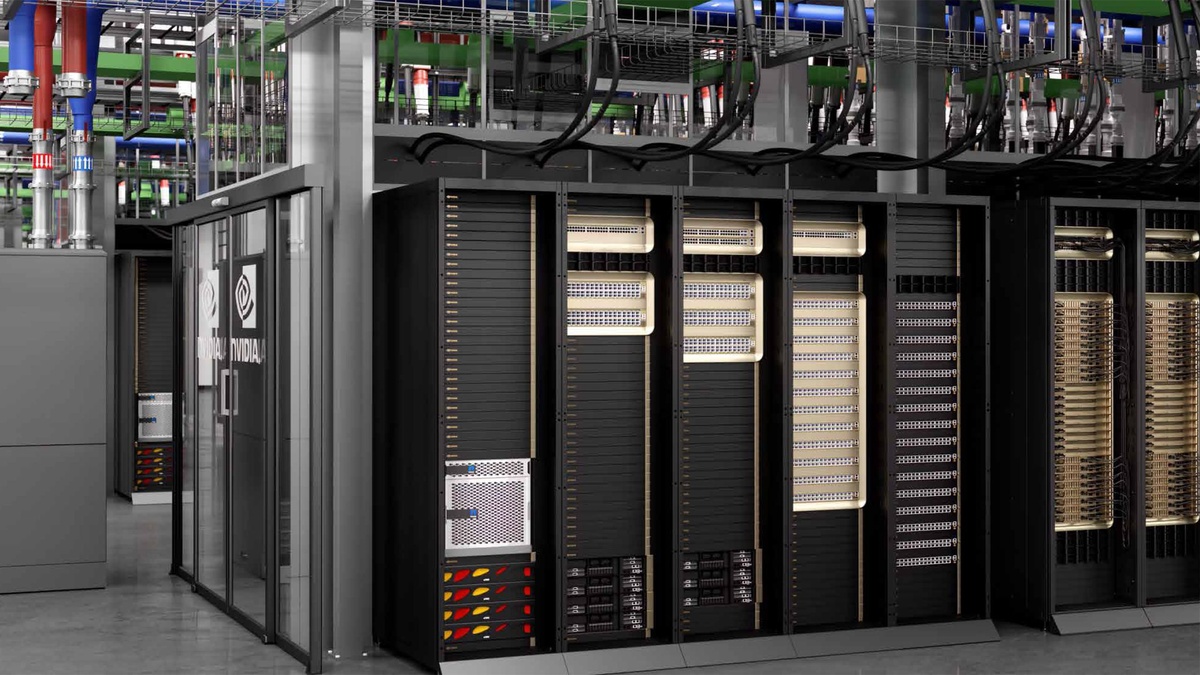
At the architectural center of the facility stand authentic Nvidia Blackwell AI Racks configured as GB300 NVL72 cabinets. These server systems integrate seventy-two Blackwell GPUs alongside thirty-six Grace processors, interlinked through fifth-generation NVLink switches capable of sustaining unprecedented bi-directional bandwidth.
Unlike conventional air-cooled rack systems, the NVL72 architecture operates as a single gigantic monolithic graphics processor. Each cabinet consumes up to one hundred and twenty kilowatts of electrical energy, relying exclusively on closed-loop liquid cooling blocks to prevent thermal throttling.
The computational throughput delivered by Nvidia Blackwell AI Racks is extraordinary. Supplying exaflop-scale FP4 floating-point inference power, the installation provides Chinese researchers with compute capabilities previously restricted to hyperscale American cloud providers like Microsoft Azure, Amazon Web Services, and Google Cloud Platform.
Procuring authentic NVLink spine cabling and cooling distribution units presents substantial logistical hurdles. Enterprise liquid couplings and heavy copper backplanes are tightly tracked industrial components, suggesting smugglers secured complete, fully assembled server cabinets rather than loose silicon packages.
Hardware forensics reveal the installed Nvidia Blackwell AI Racks maintained active telemetry jumpers designed to bypass vendor geographic fencing. By isolating network management ports from public internet gateways, the Chinese operators prevented Nvidia enterprise telemetry services from executing remote firmware lockouts.
This sophisticated hardware concealment highlights the expanding divergence between enterprise server protection and consumer software governance, mirroring changes discussed in our report on Nvidia ending Windows 10 support for PC gamers. Modern architectures require stringent firmware oversight.
Financial Collateral Mechanics: Shanghai Innovation Bank Loan and Shell Entities
The public disclosure of this illicit hardware stemmed not from military intelligence intercepts, but from mundane commercial loan paperwork. Investigative journalists scrutinizing municipal debt registrations uncovered a ninety-six million yuan loan, equivalent to fourteen million dollars, issued by Shanghai Innovation Bank.
In official bank asset filings, the borrowing corporate entity explicitly listed the smuggled Nvidia Blackwell AI Racks as tangible financial collateral. State-regulated financial institutions conducted certified asset appraisals, evaluating the restricted American hardware as legitimate high-value institutional capital to secure lending facilities.
A secondary transaction documented a ninety million yuan equipment lease arrangement finalized in late 2025. This leasing contract was underwritten by an investment firm wholly owned by a local Shanghai government district agency, establishing direct municipal state involvement.
The borrowing firm, identified in public filings as Shanghai Kezhan, operated as a compute broker leasing Nvidia Blackwell AI Racks. Rather than building proprietary models, Kezhan subleased raw hardware access to domestic research institutions unable to obtain legitimate international export licenses.
Utilizing banned computing infrastructure as audited bank collateral reveals an astonishing level of institutional acceptance. Domestic financial authorities treated the contraband Nvidia Blackwell AI Racks as premium commercial assets, completely ignoring international sanctions and intellectual property restrictions.
This financing model provided the smuggling syndicates with rapid capital liquidity. By leveraging newly arrived hardware into multimillion-dollar bank loans, the operators generated the liquid funds necessary to finance subsequent illicit hardware shipments through intermediary overseas shell corporations.
Megaspeed Corporate Network: Deploying Nvidia Blackwell AI Racks Under Export Control Bans
Central to the illicit supply chain is Megaspeed, an enterprise technology distributor that formerly maintained authorized customer standing with American chipmakers. Federal prosecutors are currently conducting expansive criminal investigations into allegations that Megaspeed orchestrated an international semiconductor diversion network.
Intelligence dossiers allege Megaspeed facilitated the unlawful diversion of approximately two billion dollars worth of high-performance accelerators into mainland China. The company established intermediary purchasing offices across Southeast Asian jurisdictions to acquire Nvidia Blackwell AI Racks on behalf of ostensible third-party cloud data centers.
Once hardware was delivered to intermediary facilities in Singapore, Malaysia, and the United Arab Emirates, freight forwarders re-manifested cargo containers. These components were subsequently rerouted to maritime ports in southern China before final assembly inside the Yangtze River Delta computing facility.
Corporate registries indicate that during investor roadshows in 2024, Megaspeed showcased the deployment of Nvidia Blackwell AI Racks. The executives deliberately obscured the physical Shanghai location, describing the multi-megawatt complex as a proprietary high-security installation situated in an undisclosed overseas territory.
Despite the United States Department of Commerce placing Megaspeed on the Entity List, enforcement loopholes persisted. By deploying unlisted subsidiary entities and layered holding companies, the syndicate successfully finalized orders for Nvidia Blackwell AI Racks prior to export verification audits.
The sophisticated evasion strategies executed by Megaspeed illustrate the profound challenges facing Western export compliance officers. International trade investigators must constantly parse opaque corporate ownership structures to prevent critical semiconductor technologies from crossing restricted geopolitical borders.
Hardware Specifications Matrix: Blackwell Silicon Versus Sanctioned Predecessors
To comprehend the strategic ramifications of this breach, one must examine the staggering performance disparities between export-controlled architectures and sanctioned legacy alternatives. While previous restrictions targeted Hopper generation accelerators, Blackwell represents a monumental generational leap in tensor processing efficiency.
The TSMC 4NP lithography process enables Nvidia to pack two hundred and eight billion transistors across a unified dual-die package. This physical density provides unprecedented numerical precision processing, rendering domestic Chinese accelerators technologically obsolete by comparison.
| Silicon Architecture | Transistors & Process | FP4 / FP8 AI Throughput | Memory Bandwidth | Interconnect Mesh | Export Regulatory Status |
|---|---|---|---|---|---|
| Blackwell GB300 NVL72 | 208B Transistors (TSMC 4NP CoWoS-L) | 1,440 TFLOPS FP4 / 720 TFLOPS FP8 | 30TB/s Aggregate, 192GB HBM3e | 1.8TB/s NVLink 5 Unified Mesh | Strictly Banned (Total Denial) |
| Blackwell GB200 NVL36 | Dual B200 GPUs + Grace CPU (TSMC 4NP) | 720 TFLOPS FP4 / 360 TFLOPS FP8 | 16TB/s Aggregate, 384GB HBM3e | 1.8TB/s Bidirectional Domain | Strictly Banned (Total Denial) |
| Hopper H100 SXM5 | 80B Transistors (TSMC 4N) | 3,958 TFLOPS FP8 (Sparse) | 3.35TB/s HBM3 (80GB Capacity) | 900GB/s NVLink 4 Fabric | Strictly Banned (October 2022) |
| Hopper H20 (Sanctioned) | TSMC 4N Throttled Derivative | 296 TFLOPS FP8 Tensor Core | 4.0TB/s HBM3 (96GB Capacity) | 900GB/s Interconnect Throttled | Compliant Export Derivative |
| Blackwell B200 Standalone | 208B Dual-Die CoWoS-L (TSMC 4NP) | 20 PFLOPS FP4 Tensor System | 8.0TB/s HBM3e (192GB Capacity) | 1.8TB/s NVLink 5 Interface | Strictly Banned (Total Denial) |
As demonstrated in the engineering matrix above, authorized Chinese-market derivatives like the H20 suffer from severe interconnect bandwidth penalties. Securing unauthorized Nvidia Blackwell AI Racks eliminates these latency bottlenecks, providing Chinese laboratories with unfiltered training performance.
High-bandwidth memory capacity represents another decisive operational advantage. Each Blackwell module integrates one hundred and ninety-two gigabytes of ultra-fast HBM3e memory, enabling entire frontier parameter weights to reside directly inside active GPU memory banks without offloading to slower host RAM.
These computing architectures reflect broader industry silicon specialization trends, similar to innovations highlighted in our review of Apple M4 Mac mini desktop neural hardware. Efficient unified memory architectures dictate modern artificial intelligence scalability.
By obtaining complete rack-scale configurations, domestic operators circumvented memory coherence limitations that crippled previous clusters. The presence of authentic Nvidia Blackwell AI Racks allows Chinese engineers to train trillion-parameter models with efficiency matching premier Western computing laboratories.
Geopolitical Intelligence Fallout: Alice Huang, Jensen Huang, and Trade Sanctions
The controversy surrounding diverted Nvidia Blackwell AI Racks escalated into an intelligence firestorm following revelations regarding former Megaspeed executive Alice Huang. United States counterintelligence officials have formally scrutinized Huang over allegations of serving as an operative connected to China’s Ministry of State Security.
According to extensive reporting from Bloomberg investigative journalism, intelligence assessments indicate Huang coordinated with Chinese state security officials while facilitating corporate hardware acquisitions. Her personal connections within the semiconductor sector triggered immediate scrutiny across federal security departments.
The geopolitical intrigue intensified when Nvidia Chief Executive Jensen Huang briefly stepped down after acknowledging a personal relationship with Alice Huang. The startling development reverberated across global financial markets, highlighting the intense vulnerability of tech leadership to counterintelligence operations.
Jensen Huang returned to helm the multinational semiconductor giant following political interventions, while investigations into smuggled Nvidia Blackwell AI Racks widened. The corporate leadership crisis underscored how enterprise computing supply chains have become the primary battleground of contemporary international espionage.
Congressional committees have initiated bipartisan inquiries into the security protocols governing enterprise client vetting. Lawmakers are demanding comprehensive accounting of how corporate affiliates maintained purchasing relationships while their leadership maintained documented ties to foreign intelligence apparatuses.
The intersection of executive relationships, state espionage, and multimillion-dollar hardware diversions illustrates the immense stakes surrounding AI supremacy. Western governments now view the physical security of advanced computing clusters through the prism of national security defense.
Supply Chain Interception Measures: Closing Hardware Divergence Loopholes With Nvidia Blackwell AI Racks
In the aftermath of the Shanghai discovery, international regulatory agencies are preparing stringent new enforcement mechanisms. United States officials plan to impose strict physical tracking mandates, requiring every manufactured enterprise accelerator to incorporate tamper-proof cryptographic telemetry identifiers.
These proposed location-auditing requirements would require server clusters to transmit cryptographically signed GPS and network telemetry coordinates back to vendor headquarters. Any severed communication link would automatically trigger silicon-level fuses, permanently bricking Nvidia Blackwell AI Racks operating in unauthorized jurisdictions.
Additionally, federal authorities are targeting intermediary transshipment hubs that facilitated the diversion. Nations in the Middle East and Southeast Asia face severe trade penalties unless they enact rigorous export licensing regimes and permit unannounced on-site verification audits by international inspectors.
Securing physical data center infrastructure increasingly mirrors broader enterprise compute ecosystems, similar to dynamics examined in our report on Xbox cloud gaming subscription infrastructure. Verifying authentic device origin is essential for maintaining operational sovereignty.
Semiconductor manufacturers are also overhauling their partner auditing procedures. Hardware vendors will no longer rely on unverified corporate self-certifications, requiring multi-layered background investigations and financial escrow verifications before dispatching high-density Nvidia Blackwell AI Racks to commercial clients.
Closing these enforcement loopholes represents a vital imperative for Western technological leadership. Unless regulators dismantle the illicit broker syndicates and hold domestic banking institutions accountable, advanced enterprise hardware will continue leaking into restricted geopolitical territories.
Frequently Asked Questions
What are Nvidia Blackwell AI racks and why are they restricted from China?
Nvidia Blackwell AI racks represent high-performance enterprise server infrastructure containing GB200 and GB300 silicon designed for frontier model training. The United States Bureau of Industry and Security strictly bans their export to China to prevent advanced artificial intelligence militarization.
How were the Nvidia Blackwell AI Racks uncovered in the Shanghai data center?
Investigative reporters analyzed Chinese legal and financial filings related to a ninety-six million yuan loan from Shanghai Innovation Bank. The loan documentation explicitly cataloged operational Nvidia Blackwell AI Racks pledged as collateral by domestic corporate entities.
Who is Alice Huang and what is her connection to Megaspeed and Nvidia?
Alice Huang is a former employee of Megaspeed, an enterprise computing customer placed under federal criminal investigation for allegedly funneling two billion dollars of hardware into China. Intelligence agencies also scrutinized her personal ties with senior semiconductor executives.
Can Chinese data centers maintain and operate Blackwell server racks without official support?
Operating liquid-cooled NVL72 racks without official enterprise firmware updates and technical support poses severe engineering hurdles. However, domestic engineering firms utilize third-party diagnostic tooling, pirated telemetry software, and component salvaging to sustain mission-critical artificial intelligence operations.
What measures will international regulators take to prevent future hardware smuggling?
Regulatory bodies are expanding end-use verifications, implementing hardware-level cryptographic location auditing, and auditing transshipment hubs across Southeast Asia and the Middle East. Authorities are penalizing intermediary shell organizations facilitating unauthorized enterprise hardware transfers.
Final Verdict: The Escalating Enforcement Crisis Facing Global AI Silicon
The emergence of illicit Nvidia Blackwell AI Racks inside a Shanghai computing facility demonstrates the inherent limits of bureaucratic trade restrictions. Despite stringent export licensing regimes, well-funded brokers and state-backed financial entities successfully penetrated global semiconductor supply chains.
By underwriting contraband hardware through municipal bank loans and leveraging shell organizations, Chinese enterprise operators established a functioning exaflop-scale AI facility. This brazen operation exposes critical vulnerabilities in international regulatory enforcement and corporate client vetting protocols.
As sovereign nations race toward artificial intelligence dominance, the battle over enterprise silicon will intensify. Securing global compute infrastructure demands aggressive regulatory reforms, hardware-level cryptographic fencing, and unwavering accountability across every link of the international semiconductor ecosystem.
