


Table of Contents
The ambitious emergence of Impossible OS Windows 11 architecture promises to disrupt modern operating systems by delivering a completely independent desktop platform. Developed entirely from scratch by Rizonesoft, this ground-up project bypasses both traditional Microsoft NT codebases and Linux foundations.
According to technical disclosures highlighted by Neowin and the project’s official repository, Impossible OS pairs modern x86-64 hardware support with a custom SMP kernel. The audacious endeavor aims for a public release milestone on August 8, 2028.
| Subsystem Architectural Layer | Impossible OS Architecture | Traditional Microsoft Windows 11 | Modern Linux Desktop (KDE/GNOME) |
|---|---|---|---|
| Kernel Heritage & Base Lineage | From-Scratch 64-bit SMP Kernel (No Linux/POSIX) | Proprietary Hybrid Windows NT Kernel (NTOSKRNL) | Monolithic Linux Kernel with C Library Userland |
| Native Application Binary Interface | Direct Win32 Subsystem via Executive SSDT | Win32, UWP, and WinUI 3 Native Frameworks | POSIX APIs with Proton and Wine Translation |
| Firmware Bootstrap Implementation | Custom Standalone UEFI PE/COFF Bootloader | Windows Boot Manager (bootmgr / winload.efi) | GNU GRUB 2, systemd-boot, or Limine Loaders |
| Display Compositor & Windowing | Dirty-Rectangle Compositor with Acrylic/Mica | Desktop Window Manager (DWM) Direct3D Pipeline | Wayland Compositors (KWin/Mutter) or Legacy X11 |
| Primary Native Filesystem Architecture | In-House Custom IXFS (with FAT32 Interop) | Proprietary New Technology File System (NTFS) | ext4, Btrfs, XFS, OpenZFS, or F2FS Filesystems |
| Memory Management & Concurrency | 4-Level Paging with SMP Clock Replacement | Virtual Memory Manager with Working Sets | Linux Virtual Memory System with zRAM / swap |
Impossible OS Windows 11 Alternative: From-Scratch 64-Bit Kernel Architecture
Evaluating the core Impossible OS Windows 11 proposal begins with its complete rejection of borrowed foundational code. Rather than re-skinning an existing Linux kernel distribution or modifying FreeBSD modules, the software engineering team authored every single line of kernel logic.
The underlying 64-bit Symmetric Multiprocessing kernel operates natively in x86-64 Long Mode, leveraging advanced APIC timers and structured per-CPU storage architectures. It incorporates robust guard-paged execution stacks alongside structured exception handling directly within ring zero privileges to ensure system reliability.
Unlike vintage hobbyist projects that rely on crude Cooperative Multitasking loops, Impossible OS Windows 11 incorporates a preemptive flat round-robin thread scheduler. The kernel controls concurrency using finely tuned mutexes, counting semaphores, and reader-writer seqlocks without resorting to an archaic monolithic Big Kernel Lock.
This symmetrical multicore foundation permits threads to scale smoothly across high-core desktop architectures, delivering predictable latency under demanding system loads. Modern processors such as the AMD Ryzen 7 9800X3D desktop gaming CPU thrive when operating system dispatchers eliminate global resource serialization locks.
Furthermore, the kernel enforces memory protection through a comprehensive four-level paging virtual memory manager. Physical page allocators handle underlying frame allocations, while higher-level paging subsystems manage disk-backed swap spaces, dedicated pagefiles, and standard memory-mapped file access primitives.
Small memory allocations rely on a specialized kernel allocator handling buffers up to four kilobytes, while larger contiguous allocations leverage physical page managers. This layered memory hierarchy ensures that Impossible OS Windows 11 maintains stringent isolation between privileged executive tasks and volatile user processes.
Custom UEFI Bootloader Engineering: Eliminating Legacy Boot Overhead
The bootstrap sequencing of Impossible OS Windows 11 completely bypasses dated Master Boot Record conventions in favor of a bespoke Unified Extensible Firmware Interface loader. Named BOOTX64.EFI, this hand-crafted PE/COFF binary executes immediately upon motherboard firmware initialization on modern PC hardware.
Rather than relying on bloated intermediate boot packages like GNU GRUB or systemd-boot, Impossible OS communicates directly with UEFI firmware protocols. The loader queries system memory maps, establishes the Graphics Output Protocol framebuffer, and validates hardware ACPI tables via vendored ACPICA subsystems.
Once hardware discovery concludes, the bootloader constructs a versioned boot information structure at memory address 0x10000 before jumping into the primary 64-bit kernel ELF. This standardized handoff protocol guarantees reproducible system state parameters for Impossible OS Windows 11 across diverse consumer motherboard chipsets.
The boot platform also implements dual-slot A and B rollback capabilities, allowing seamless kernel recovery following corrupted software installations. If a newly flashed kernel image fails to complete core validation thresholds, firmware automatically reverts execution to the previous verified working slot.
Secure Boot integration remains an active engineering milestone, featuring initial chain-loading shims engineered to navigate modern platform signature requirements. As the industry transitions through updated Microsoft UEFI Certificate Authority standards, the bootloader prioritizes cryptographic platform integrity without locking out independent open-source developers.
Additionally, the boot environment incorporates a responsive configuration menu supporting customizable kernel parameters, safe mode diagnostic flags, and automated hardware fallback modes. Users retain complete low-level visibility into firmware handshakes without suffering through obscured graphical loading screens.
Native Win32 Subsystem Implementation: System Service Dispatch Table Design
Perhaps the most audacious technical ambition of the project is its native implementation of the Microsoft Windows Application Programming Interface. Rather than emulating system calls through POSIX translation layers, Impossible OS Windows 11 architecture implements an internal System Service Dispatch Table.
Analyzing this Impossible OS Windows 11 architecture reveals how it mirrors the internal mechanics of the Windows NT executive services plane. When applications issue native system calls, the kernel captures processor interrupts, validates argument buffers, and dispatches requests through structured system service routines.

Sitting directly above the executive dispatch layer is an authentic user-mode dynamic link library architecture headlined by a native ntdll implementation. This architectural layer provides standard C runtime routines, string manipulation utilities, structured exception handling dispatchers, and core process lifetime management.
Above the native runtime sits the broader Win32 subsystem, designed to expose standard application interfaces required by legacy and modern software. Under Impossible OS Windows 11, developers can execute compiled binaries expecting standard Windows environment variables, standard handles, and hierarchical object namespaces.
The operating system also implements a fully persistent Win32 Registry, storing system settings, file associations, and application configurations across hierarchical key-value hives. This registry engine features transaction logging, disk persistence, and fast in-memory caching to prevent filesystem read stalls during registry queries.
By pairing this native dispatch surface with future planned Linux binary compatibility, the developers aim to deliver unprecedented cross-ecosystem flexibility. Users could theoretically run beloved enterprise productivity applications alongside specialized developer toolchains without managing disparate virtual machines.
Impossible OS Windows 11 Desktop Shell: Acrylic Compositor and Taskbar Interface
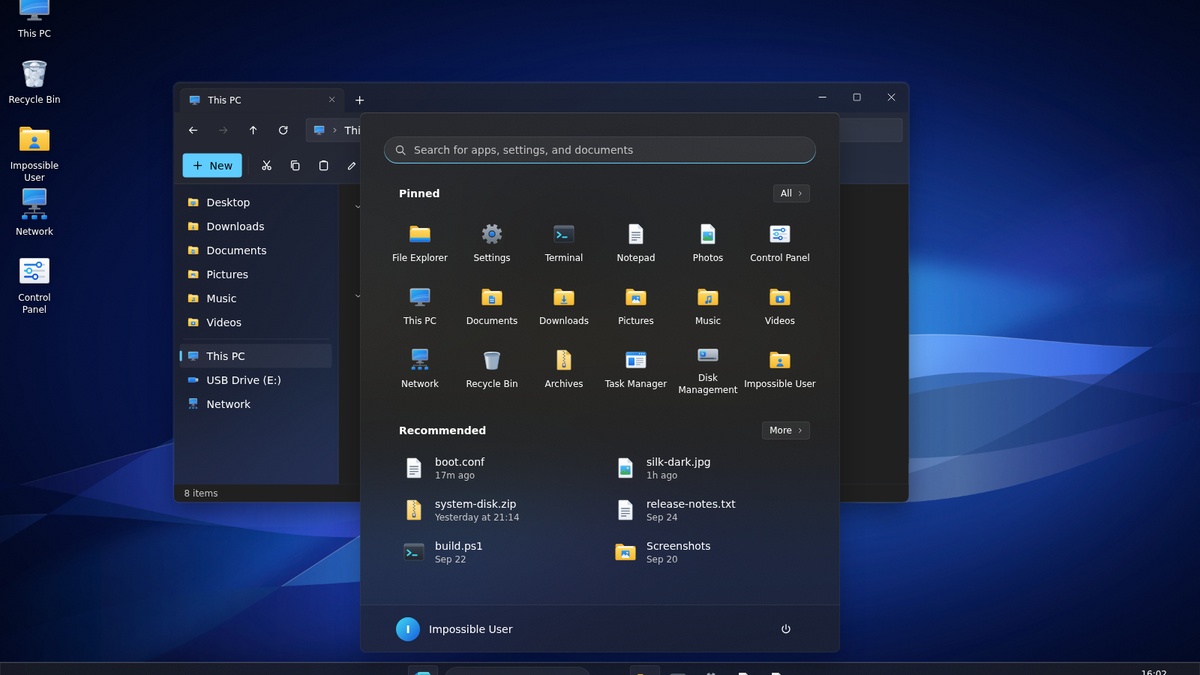
Visual presentation across the Impossible OS Windows 11 interface draws clear inspiration from contemporary Microsoft design languages while refining desktop responsiveness. The user experience centers upon a centered taskbar, a streamlined Start menu, and intuitive system tray integration.
Powering the entire graphical presentation is a lightweight, custom software compositor operating on an intelligent dirty-rectangle redrawing architecture. Instead of redrawing the entire screen buffer on every display cycle, the compositor tracks damaged screen regions to minimize memory bandwidth consumption.
The compositor natively generates frosted-glass translucent materials, replicating authentic acrylic and mica styling without relying on bloated external rendering frameworks. Drop shadows, smooth window transitions, and antialiased TrueType font rasterization combine to produce an unmistakably modern, polished visual environment.
| Operating Architecture Platform | Minimum Hardware Resource Floor | Idle Desktop Memory Footprint | Win32 API Execution Penalty | Foundational Kernel Code Dependency |
|---|---|---|---|---|
| Impossible OS Workstation Core | Modern 64-bit x86 UEFI with 2GB RAM | Sub-250MB active memory consumption | Zero translation penalty (Native SSDT) | 100% Independent (Zero Linux/NT Code) |
| Microsoft Windows 11 Enterprise | TPM 2.0, Secure Boot, 4GB+ System RAM | 3.5GB to 4.5GB baseline idle memory | Native baseline execution pipeline | Proprietary closed-source Microsoft NT |
| Linux Desktop (KDE / GNOME) | Broad legacy and modern 64-bit PC hardware | 1.2GB to 2.5GB typical desktop memory | System call translation overhead (Proton) | Monolithic Linux Kernel (GPL-2.0-only) |
| ReactOS Experimental Community | Legacy BIOS and rudimentary ACPI hardware | Under 128MB baseline memory footprint | Native NT architecture clone (partial) | Reverse-engineered 32-bit NT codebase |
Desktop ergonomics in Impossible OS Windows 11 emphasize immediate familiarity, featuring standard system icons for This PC and the Recycle Bin. Power users will appreciate the integrated terminal and responsive file explorer, offering fluid directory browsing without laggy webview containers.
This desktop shell achieves remarkable efficiency, demanding a fraction of the memory footprint of rival platforms. Efficient desktop management in Impossible OS Windows 11 mirrors lightweight workstation optimizations seen on the Apple M4 Mac Mini workstation, proving elegance need not sacrifice system speed.
Future development milestones for the desktop shell include advanced window snapping grids, virtual desktop workspaces, and comprehensive display scaling for high-DPI panels. The design system documents every UI element through precise token specifications, ensuring visual consistency across all first-party utilities.
Storage Subsystem and IXFS: High-Throughput Virtual File System Integration
Underneath the graphical shell, the operating system incorporates an advanced storage architecture engineered to support high-throughput modern drive controllers. In Impossible OS Windows 11, the kernel integrates native drivers for Advanced Host Controller Interface SATA buses alongside VirtIO block devices with full Direct Memory Access.
Storage media can be partitioned using either legacy Master Boot Record schemes or modern Globally Unique Identifier Partition Tables. A sophisticated Virtual File System abstraction layer mediates all input and output operations, exposing consistent drive letter namespaces like standard C drive paths.

While FAT32 is supported for boot interoperability, the flagship Impossible OS Windows 11 storage engine is IXFS, an in-house custom filesystem designed by Rizonesoft. IXFS introduces efficient inode allocation tables, extents-based block addressing, and robust metadata journaling to protect against unexpected power disruptions.
The roadmap also prioritizes native support for Microsoft New Technology File System volumes, enabling seamless multi-boot data sharing with existing Windows installations. Users will eventually be able to access existing internal hard drives without formatting storage partitions or relying on slow network shares.
Furthermore, the storage subsystem integrates a resilient asynchronous I/O scheduling pipeline that prioritizes foreground application requests over background indexing tasks. This intelligent prioritization eliminates the notorious disk freezing and taskbar lockups that frequently plague mainstream operating systems during heavy updates.
By implementing clean abstraction boundaries across the storage stack, Impossible OS Windows 11 ensures that future controller drivers can plug directly into the VFS. Emerging Non-Volatile Memory Express solid-state storage drivers are currently being architected to unleash extreme transfer speeds on high-end NVMe drives.
Hardware Verification Testing: Bare-Metal Prototyping Across Real Silicon
One defining characteristic of Impossible OS Windows 11 is its strict bare-metal engineering philosophy, prioritizing execution on physical motherboards over synthetic hypervisors. While QEMU and VirtualBox serve as rapid local testing environments, features are only considered complete once verified on authentic x86-64 silicon.
To ensure rock-solid stability across diverse PC configurations, the development pipeline employs an astonishingly comprehensive automated testing infrastructure. After every single Git commit, 3,760 kernel test suites execute across 17,663 distinct assertion sites, instantly detecting memory regressions and concurrency deadlocks.
Testing encompasses memory allocation edge cases, preemptive scheduling jitter under multi-threaded stress, and complex interrupt handler timing loops. Analyzing Impossible OS Windows 11 serial port telemetry outputs directly to host systems allows engineers to diagnose subtle race conditions that could destabilize bare-metal workstations.
Hardware verification also extends to platform security components, including Trusted Platform Module transport drivers and Platform Configuration Register measurements. Impossible OS Windows 11 communicates with TPM 2.0 cryptoprocessors to facilitate measured boot verification, cryptographic key sealing, and platform attestation routines.
Network testing leverages RTL8139 network interface controller drivers to validate foundational transport layer protocols, including Ethernet framing, ARP, IPv4, UDP, and DHCP handshakes. Reliable networking ensures the platform can fetch IP configurations automatically upon booting into home and enterprise local area networks.
In the event of a catastrophic kernel panic, the operating system activates an embedded BlackBox logging engine that serializes system states into persistent diagnostic logs. This detailed crash telemetry provides developers with exact register dumps and stack backtraces to debug kernel panics with surgical accuracy.
Long-Term Impossible OS Windows 11 Roadmap: Navigating the 2028 Public Debut
The development journey ahead for Impossible OS Windows 11 remains monumentally ambitious, spanning 235 detailed planning files across 18 specialized technical domains. The engineering team has established August 8, 2028, as the official target date for its first comprehensive public release.
Between today’s pre-alpha status and that future debut, developers face immense hurdles implementing complete Win32 subsystem parity and advanced graphics acceleration. Microsoft Windows represents over three decades of accumulated platform APIs, backward compatibility quirks, and undocumented internal system behaviors.
Consumer interest in sovereign desktop alternatives has surged following controversial corporate policy decisions, including Nvidia ending Windows 10 support for PC gamers and aggressive telemetry pushes. Monitoring Impossible OS Windows 11 progress highlights how enthusiasts increasingly crave lightweight desktop operating systems prioritizing user agency.
Unlike closed ecosystem models that tether users to subscription services, such as Xbox Cloud Gaming pay-as-you-go bundles, Impossible OS Windows 11 is released under the open-source GPL-3.0 license. The entire codebase is publicly auditable on the project’s official Impossible OS GitHub repository.
Over 1.4 million lines of code have already been committed to the project, demonstrating serious engineering dedication from Rizonesoft. While building a competitive desktop operating system from scratch seems practically impossible, the project’s relentless daily progress continues to challenge conventional software development assumptions.
Whether Impossible OS Windows 11 can achieve daily-driver reliability by 2028 remains to be proven, but its bold ambition is undeniably refreshing. In an era dominated by corporate operating system duopolies, grassroots systems engineering represents the beating heart of genuine computing innovation.
Frequently Asked Questions
What is Impossible OS Windows 11 and how does it differ from Linux?
The Impossible OS Windows 11 project is an independent 64-bit operating system written completely from scratch by Rizonesoft. Unlike Linux distributions that package the Linux kernel with GNU userlands, this system features a bespoke SMP kernel, custom UEFI bootloader, and native Win32 subsystem.
Why does Impossible OS use a custom UEFI bootloader instead of GRUB?
The developers engineered BOOTX64.EFI as a standalone PE/COFF loader to eliminate dependencies on third-party bootloaders like GRUB. This custom loader directly communicates with UEFI firmware, provides A and B slot rollback capabilities, and passes clean boot information structures to the kernel.
When will Impossible OS receive its first official public release?
Rizonesoft has scheduled the first official public release milestone for August 8, 2028. While pre-alpha builds currently boot on virtual machines and real hardware, the long development horizon allows engineers to complete Win32 APIs, native filesystems, and automated testing.
Can Impossible OS Windows 11 architecture run commercial Windows games?
In its current pre-alpha stage, Impossible OS Windows 11 cannot yet execute complex commercial Windows games or heavyweight software suites. The project is actively building its native Win32 subsystem, memory management, and graphics compositors to achieve progressive application compatibility toward its 2028 debut.
Is Impossible OS open source and where can I view the code?
Impossible OS is licensed under the open-source GNU General Public License v3.0. The complete source code, documentation, and roadmap files are freely accessible to the public on the official Rizonesoft GitHub repository and at the official project website.
Final Verdict: The Audacious Quest for Independent Desktop Computing
The development of Impossible OS Windows 11 represents one of the most audacious independent software projects in recent computing history. By building a custom 64-bit SMP kernel, bespoke UEFI bootloader, and native Win32 subsystem from scratch, Rizonesoft is boldly challenging conventional operating system paradigms.
While achieving total parity with decades of Microsoft enterprise engineering remains a colossal challenge, the project’s disciplined architecture is genuinely impressive. With over 1.4 million lines of code and transparent roadmap planning, Impossible OS proves that grassroots systems engineering remains vibrantly alive.
For enthusiasts weary of bloated desktop ecosystems and telemetry, Impossible OS Windows 11 is well worth monitoring closely. Whether it becomes a viable daily-driver desktop or serves as an educational tour de force, its ambition redefines modern systems software.
