



Table of Contents
Rockstar Games has fundamentally reimagined vehicle crime across Leonida, introducing intricate GTA 6 Car Theft Mechanics that replace arcade joyriding with simulated criminal realism. Rather than casually pulling motorists through open windows, players confront modern electronic security systems and active law enforcement telemetry.
Following widespread community debate surrounding gameplay difficulty during launch week, veteran critics have praised this deliberate mechanical evolution. By forcing players to acquire specialized burglary tools, GTA 6 Car Theft Mechanics transform every vehicular hijacking into a calculated operational decision.
To help enthusiasts understand how contemporary automotive engineering reshapes open-world exploration, our technical team mapped the generational changes between legacy titles and modern systems. The comparison matrix below contrasts traditional franchise conventions against the new GTA 6 Car Theft Mechanics.
| Vehicle Classification | Legacy GTA 5 Hijacking Method | GTA 6 Car Theft Mechanics | Required Infiltration Equipment | Law Enforcement Response |
|---|---|---|---|---|
| Clunker / Budget Utility | Instant door opening or elbow window smash | Physical lock manipulation or force entry | Unassisted elbow jab or crowbar | Negligible unless witnessed by active patrol |
| Standard Civilian Sedan | Rapid hotwiring sequence in passenger seat | Mechanical tumbler bypass without glass damage | Chapter 2 mechanical slim jim tool | Local perimeter acoustic alarm triggers police |
| Modern Keyless Coupé | Single-button carjack with instant engine start | Digital key fob frequency cloning required | RF signal cloner and relay transceiver | Instant cellular emergency beacon dispatched |
| High-End Exotic Supercar | Drive away immediately without restriction | Active telemetry evasion and GPS scrambler | Electronic bypass rig and frequency jammer | Persistent high-speed pursuit via tracking ping |
| Armored Security Courier | Explosive rear door blast or driver assault | Heavy structural breaching and security hack | Thermal drill, EMP charge, or security cipher | Maximum three-star felony dispatch response |
Examining this architectural progression demonstrates how thoroughly Rockstar has gamified car theft across ninth-generation consoles. Instead of treating vehicles as disposable stage props, modern GTA 6 Car Theft Mechanics integrate authentic security architectures that demand strategic planning and specialized equipment.
Evolution of Grand Theft Auto: How GTA 6 Car Theft Mechanics Shift Toward Realism
For over twenty-five years, Grand Theft Auto centered on frictionless vehicular theft across Liberty City and Los Santos. Players approached idling cars, yanked terrified drivers onto asphalt, and sped away without facing mechanical resistance or electronic security barriers.
That legacy philosophy has vanished in Vice City, replaced by sophisticated GTA 6 Car Theft Mechanics that mirror automotive security. As documented in Eurogamer reporting on GTA 6 car theft gamification, Rockstar transformed routine street carjacking into a tactical simulation.
Modern vehicles manufactured in 2026 incorporate complex electronic control units, rolling cryptographic transponders, and automated cellular emergency uplinks. By incorporating these technological systems into the core loop, GTA 6 Car Theft Mechanics bridge the gap between open-world freedom and gritty criminal roleplaying.
This design shift mirrors broader movements toward physical simulation across contemporary games. Just as architectures explored in our breakdown of AMD Ryzen 7 9800X3D gaming processor specs prioritize real-time processing depth, Rockstar created an interactive world where criminal actions carry organic weight.
Consequently, players who treat Vice City like an arcade sandbox quickly find their plans derailed by shrieking perimeter alarms and immobilized engines. Understanding how these GTA 6 Car Theft Mechanics operate across various vehicle classes is essential for navigating the criminal underworld of Leonida.
Early Game Protection and Personal Utility: Bonding With Jason’s Vapid Creado
During the opening ten hours of the campaign, developers restrict player access to advanced burglary gadgets to foster emotional attachment to personal transportation. Protagonist Jason receives a reliable two-door coupé utility truck, the Vapid Creado, which serves as your primary operational lifeline.
Rockstar actively tutorializes vehicle maintenance, encouraging players to repair physical fender damage, install mechanical engine tunes, and wash road grime away. Through this narrative scaffolding, GTA 6 Car Theft Mechanics establish your personal vehicle as a valuable home base rather than a temporary ride.
Keeping the Vapid Creado in pristine mechanical condition proves crucial when preparing for pivotal story sequences, such as picking up Lucia following narrative milestones. Players develop genuine respect for their vehicle’s handling quirks, engine notes, and cargo capacity across the winding highways of Leonida.
Furthermore, safehouses throughout Vice City feature functional garages that disperse persistent police heat and safeguard valuable customized rides. Rather than abandoning rides haphazardly across sidewalks, players learn to preserve their assets, appreciating the stability offered by an established getaway vehicle.
This deliberate pacing prevents players from trivializing the open world during early chapters, ensuring that subsequent mechanical upgrades feel earned and transformative. The grounded foundation established by GTA 6 Car Theft Mechanics turns vehicle ownership into a central pillar of narrative progression.
Unpredictable Passenger Encounters: Deterring Reckless Street Robberies
To discourage indiscriminate carjacking during early free-roam exploration, Rockstar implemented organic behavioral encounters inside civilian vehicles. Tearing open an unsuspecting motorist’s door in downtown Vice City no longer guarantees an effortless getaway, as procedural interior encounters frequently trigger catastrophic surprises.
During early testing documented by Eurogamer, players attempting to hijack routine civilian rides discovered panicked household pets, including defensive housecats that lunged directly at Jason’s face. The resulting chaos caused violent steering loss and immediate collisions, alerting nearby police patrols.
Other organic encounters feature muffled cries emanating from sealed vehicle boots where kidnapping victims are being illicitly transported across municipal boundaries. Alternatively, repeatedly targeting the same civilian motorist in public squares triggers emotional breakdowns, drawing crowds of recording pedestrians who upload footage to social feeds.
These dynamic narrative events function as behavioral deterrents within GTA 6 Car Theft Mechanics, teaching newcomers that reckless street robbery carries unpredictable liabilities. Indiscriminate theft carries physical, legal, and operational risks that force criminals to observe targets carefully before committing felonies.
Advanced artificial intelligence routines also monitor civilian panic reactions, causing armed motorists in Florida suburbs to draw concealed handguns in self-defense. Navigating these unpredictable GTA 6 Car Theft Mechanics requires tactical discretion, situational awareness, and thorough reconnaissance before striking.
Mechanical Infiltration: Unlocking the Slim Jim Lockpick in Chapter 2
During early missions, characters lacking professional burglary tools must shatter side window glass using a forceful elbow strike to access locked vehicle cabins. While effective in life-or-death shootouts, breaking automotive glass immediately triggers acoustic perimeter alarms and severely degrades vehicle resale value at chop shops.
Reaching Chapter 2 marks a major milestone in criminal progression, granting players access to the iconic mechanical slim jim lockpick tool. Sliding this thin spring-steel strip between exterior weather stripping and door glass allows characters to manipulate internal mechanical latch linkages silently.
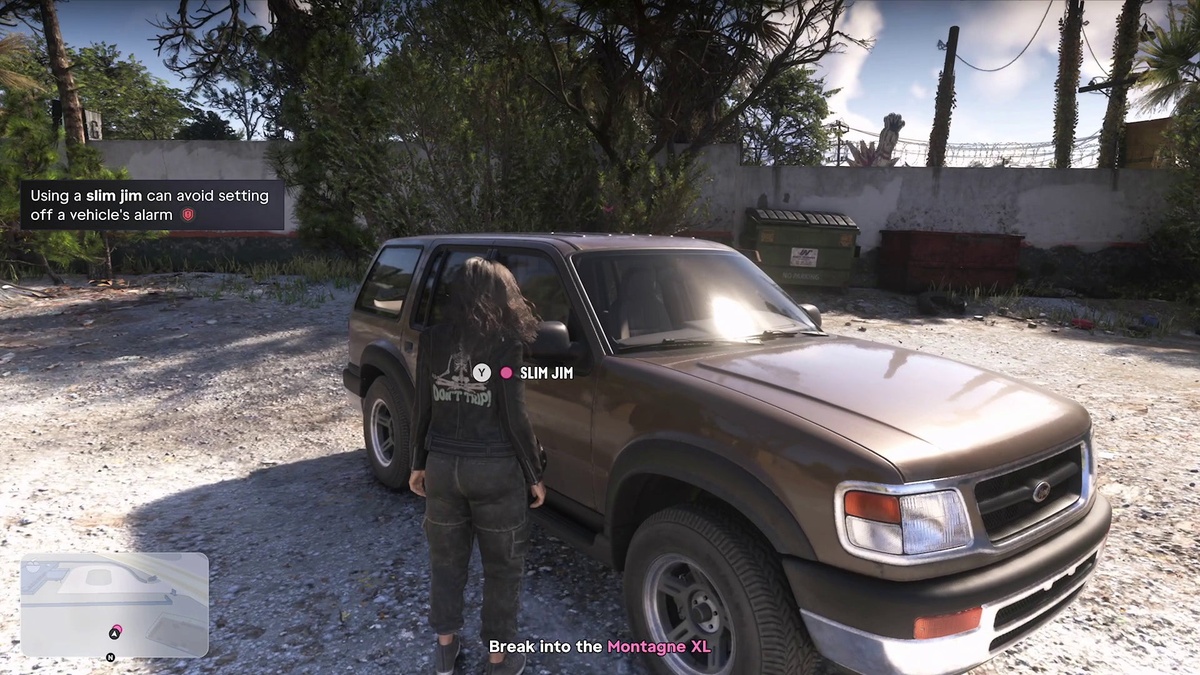
Operating the slim jim unlocks parked automobiles without triggering piercing horn sirens or shattering tempered safety glass across the roadway. Preserving structural integrity is vital when delivering stolen luxury inventory to underground chop shops, where pristine bodywork commands substantial black-market cash premiums.
Mastering this tool introduces an engaging tactile interaction that rewards patient timing over frantic button mashing during tense nighttime burglaries. As players refine their infiltration techniques, GTA 6 Car Theft Mechanics elevate routine vehicle acquisition into an artful criminal specialty.
However, mechanical lockpicks remain completely ineffective against modern electronic vehicles that utilize solenoid deadbolts rather than physical linkages. To breach contemporary sedans and exotic sports coupes, aspiring car thieves must upgrade their arsenal with digital electronic hacking transceivers.
Modern Vehicle Countermeasures: How GTA 6 Car Theft Mechanics Handle Electronic Fobs
Because Grand Theft Auto 6 takes place in modern 2026, the automotive landscape of Vice City reflects widespread adoption of passive keyless entry systems. High-performance sports cars like the Pegassi Zorruso feature rolling cryptographic transponders that communicate wirelessly with key fobs carried by registered owners.
Mechanical tools cannot bypass encrypted engine immobilizers or actuate digital solenoid latches without authentic cryptographic tokens. Consequently, GTA 6 Car Theft Mechanics require specialized radio-frequency scanners and signal relay amplifiers to capture transmission packets from nearby vehicle owners.
Players must tail luxury vehicle owners into convenience stores or upscale nightclubs, maintaining close physical proximity while digital scanning hardware intercepts key fob frequencies. Once cloned, the handheld device transmits authorized handshake protocols, disarming security perimeters and starting high-output twin-turbocharged engines silently.
The technical complexity of modern automotive electronics mirrors advances detailed in our technical analysis of Apple M4 Mac Mini redesign hardware specs, where miniaturized silicon coordinates complex cryptographic handshakes. High-tier vehicle theft demands sophisticated electronic warfare rather than brute physical force.
To clarify the technological spectrum governing vehicle infiltration across Vice City, our research team synthesized every security countermeasure into an engineering reference matrix. The comparative analysis below outlines the technical specifications governing modern GTA 6 Car Theft Mechanics.
| Security Subsystem | Sensor Architecture | Criminal Countermeasure | Unlock Progression Requirement | Black Market Resale Penalty |
|---|---|---|---|---|
| Mechanical Tumbler Lock | Physical cylinder and mechanical linkage | Precision slim jim lockpicking tool | Unlocked early in Chapter 2 campaign | Zero penalty if executed without glass damage |
| Acoustic Perimeter Alarm | Inertial vibration and glass-break sensor | Silent latch release or horn wire snipping | Requires stealth approach and lockpick | 15% payout deduction if siren attracts damage |
| Rolling Code Keyless Fob | Encrypted 315/433 MHz RF transponder | Digital RF frequency cloner and relay rig | Acquired from mid-game black market dealer | Zero penalty; pristine electronic bypass achieved |
| Active Telemetry GPS Tracker | Cellular uplink with satellite positioning | High-speed radio ping evasion or RF jammer | Requires tactical driving or late-game jammer | Unsellable until satellite ping is neutralized |
| Engine Immobilizer Kill Switch | Cryptographic ECU starter motor handshake | OBD-II port diagnostic hacking tablet | Requires high-tier hacker contact in Vice City | Full payout unlocked once ECU firmware flashed |
Understanding these interlocking security subsystems enables players to evaluate target vehicles before committing illicit resources during free exploration. Modern GTA 6 Car Theft Mechanics transform every vehicle into a distinct security puzzle requiring tailored physical or electronic tools.
Active GPS Law Enforcement Trackers: Evading High-Speed Police Dispatch Pings
Beyond digital keyless transponders, high-end commercial couriers and luxury supercars in Leonida come factory-equipped with active satellite telemetry trackers. Stealing an automobile fitted with an active tracker immediately broadcasts real-time GPS coordinates directly to Vice City Police Department dispatchers.
Unlike traditional wanted systems where breaking line of sight allows stars to dissipate, active trackers pulse continuous locator beacons on police radars. The only tactical response available to players lacking radio jammers is flooring the accelerator to outrun the signal ping radius.
Fleeing high-speed tracker zones requires flawless driving precision through highway traffic, as sudden collisions incur catastrophic body damage. Severe chassis deformation significantly devalues black-market payouts, rendering the stolen vehicle unprofitable for demanding underground chop shop operators.
Underground fences across Vice City refuse to accept automobiles emitting active satellite telemetry beacons, fearing law enforcement raids on their facilities. Players must maintain clean escape velocity until the tracker batteries drain or locate specialized underground signal-shielded chop garages.
This high-stakes cat-and-mouse dynamic reinforces the roleplaying depth introduced by GTA 6 Car Theft Mechanics across sprawling urban environments. Evading police requires acute spatial awareness, knowledge of coastal alleyways, and disciplined throttle management under extreme pursuit pressure.
Strategic Getaway Planning: The Long-Term Impact of GTA 6 Car Theft Mechanics
The cumulative impact of these refined systems profoundly reshapes mission execution and criminal preparation throughout the sprawling state of Leonida. In previous franchise iterations, players completed complex robberies and casually commandeered the first civilian car idling at nearby traffic lights.
Attempting that reckless maneuver in GTA 6 frequently results in locked passenger doors, shrieking perimeter alarms, or armed civilian resistance that attracts instant police backup. Consequently, heist planning requires players to pre-stage clean getaway vehicles in designated garages near raid objectives.
Managing vehicle heat, rotating license plates, and maintaining safehouse transportation become mandatory operational routines. Just as cloud ecosystems in our coverage of Xbox Cloud Gaming flexible pricing structures rely on infrastructure, criminal success in Vice City demands comprehensive logistical planning.
Furthermore, hardware driver updates discussed in our report on Nvidia driver support lifecycles mirror how Rockstar continually refines underlying physics engines to support complex vehicular simulations. Every steering input, tire skid, and collision impulse reflects rigorous physical modeling.
By transforming vehicle theft into a multi-tiered tactical discipline, Rockstar created an engaging criminal simulation that elevates narrative storytelling. GTA 6 Car Theft Mechanics prove that grounding open-world mechanics in realistic consequences yields far richer gameplay than unearned convenience.
Frequently Asked Questions
What are the core innovations introduced in GTA 6 Car Theft Mechanics?
GTA 6 Car Theft Mechanics introduce authentic modern automotive security systems, including slim jim lockpicks, encrypted keyless fob cloners, and active satellite GPS trackers. Indiscriminate carjacking is replaced by tactical reconnaissance, tool progression, and realistic law enforcement responses across Leonida.
How do players obtain the slim jim lockpick tool in GTA 6?
Players receive the mechanical slim jim tool during Chapter 2 story progression. This essential burglary device enables silent entry into locked vehicles without shattering door glass or activating loud acoustic perimeter sirens, preserving black-market resale value at Vice City chop shops.
Can players steal luxury supercars immediately during the early game?
Early-game characters cannot steal luxury supercars because modern high-performance vehicles utilize encrypted keyless transponders and engine immobilizers. Bypassing these electronic systems requires digital RF signal cloners and diagnostic bypass rigs acquired through mid-game black-market criminal progression.
How do active GPS satellite trackers function during vehicle theft in GTA 6?
Active GPS trackers immediately alert Vice City police units, broadcasting live locator pings to patrol cars. To evade arrest, players must outrun the signal triangulation radius through high-speed driving or navigate into specialized underground radio-shielded garages to neutralize telemetry.
Why did Rockstar include unpredictable passenger encounters during car thefts?
Rockstar designed unpredictable passenger encounters, such as attacking pets and hostage surprises, to discourage mindless street carjacking. These organic gameplay events teach players to treat vehicle theft as a calculated criminal enterprise requiring observation and tactical discretion.
Final Verdict: Thoughtful Felonies Replace Mindless Car Jacking
Rockstar’s bold decision to overhaul vehicular crime represents one of the most rewarding mechanical evolutions in open-world gaming history. Rather than diluting the franchise identity, modern GTA 6 Car Theft Mechanics inject authentic tension and strategic consequence into every criminal enterprise.
By requiring players to progress from unassisted physical force to sophisticated digital radio cloning, developers crafted a satisfying technological progression curve. Navigating complex automotive security perimeters elevates grand theft auto from a mundane transit shortcut into a masterclass in tactical execution.
While casual players may lament the loss of frictionless carjacking, the resulting depth establishes an unmatched standard for sandbox roleplaying across ninth-generation consoles. GTA 6 Car Theft Mechanics prove that embracing realism and friction can make virtual crime infinitely more compelling.
