


Table of Contents
Product analytics pioneer Amplitude has revealed architectural details behind the Amplitude Wave product agent, an autonomous platform built on OpenAI models. The system identifies high-impact user friction, drafts technical specifications, coordinates coding agents, and deploys features in under forty-eight hours.
By transforming passive telemetry into proactive development workflows, the Amplitude Wave product agent addresses a fundamental software bottleneck. Rather than waiting weeks for manual discovery, product organizations can continuously ship targeted updates that resolve verified user drop-off points.
| Architecture Dimension | Traditional Product Management | Generative Coding Assistants | Closed-Loop Intelligence (Amplitude Wave) |
|---|---|---|---|
| Primary Focus & Discovery | Manual dashboard queries and user interviews | Zero discovery; requires human prompt input | Autonomous friction detection across replays and funnels |
| Feature Delivery Sprints | 4 to 6 weeks per release cycle | 1 to 2 weeks for code generation and review | 1 to 2 days from anomaly discovery to deployment |
| Codebase Synchronization | Disconnected Jira tickets and sprint backlogs | Direct IDE context via manual file indexing | Maps behavioral user friction directly to Git repositories |
| Implementation Workflow | Engineers manually author PRs from PRDs | Generates raw code without product context | Coordinates autonomous coding agents to open pull requests |
| Downstream Impact Loop | Quarterly retrospectives and manual surveys | No native impact tracking or analytics loop | Automated experiment verification and model reinforcement |
Signal Sifting Architecture: Ingesting Behavioral Analytics and Code Repositories
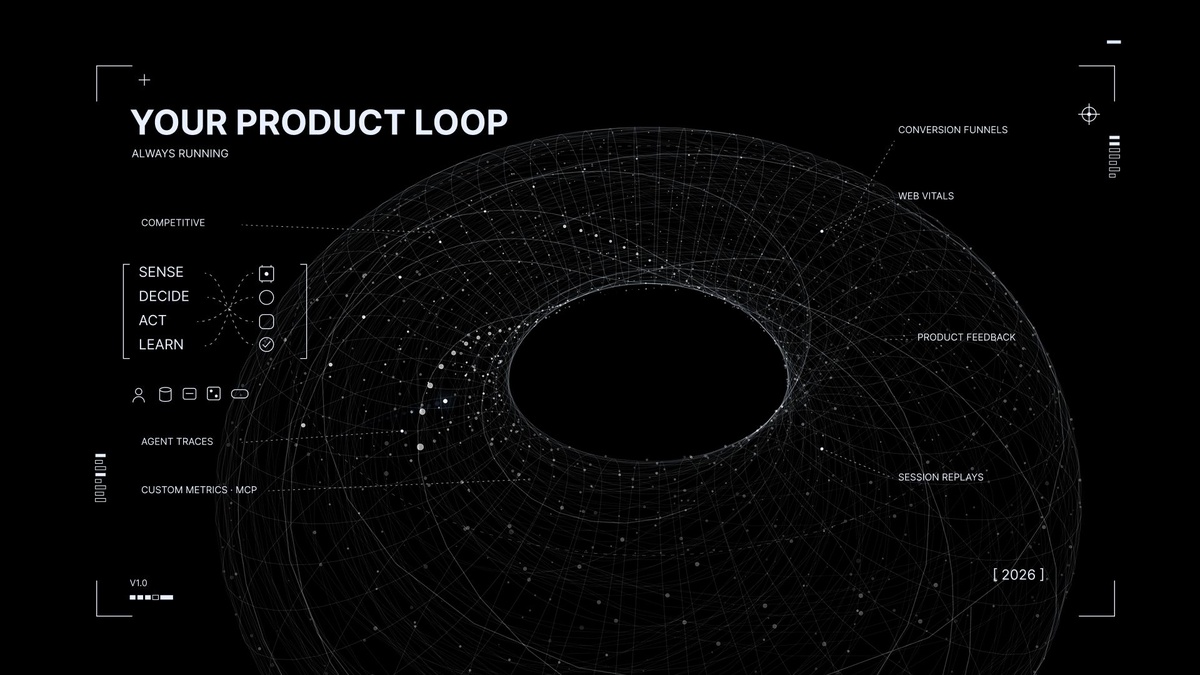
Traditional enterprise software development relies heavily on fragmented telemetry streams, forcing product managers to manually cross-reference disparate analytics dashboards. The Amplitude Wave product agent eliminates this operational friction by continuously uniting behavioral events, session replays, and customer feedback into unified data graphs.
Rather than treating telemetry as passive reporting, the system actively queries event funnels to uncover hidden drop-off patterns. When users repeatedly struggle with user interface elements or abandon onboarding stages, the proactive agent flags those anomalies as prioritized product opportunities.
Crucially, the ingestion engine does not examine user metrics in isolation from underlying technical implementations. The Amplitude Wave product agent indexes production repositories alongside behavioral telemetry, allowing autonomous models to map specific friction points directly to relevant front-end components and back-end endpoints.
By bridging user friction with concrete code locations, product teams eliminate ambiguous exploratory investigations. Using the Amplitude Wave product agent, engineers link session traces directly to relevant application files across active version branches without manual reproduction delays.
This multi-source data synthesis establishes a resilient real-time foundation for autonomous decision-making. As outlined in the primary customer analysis on OpenAI News, modern product organizations require deep contextual awareness before authorizing autonomous agents to modify mission-critical enterprise services.
Tri-Model Orchestration: Balancing Deep Reasoning With High-Frequency Execution
Powering the intelligence behind the Amplitude Wave product agent is an optimized tri-model architecture built primarily upon OpenAI infrastructure. Recognizing that complex software lifecycle tasks demand distinct computational trade-offs, Amplitude routes different workload stages to specialized foundation models to balance speed and accuracy.
For deep investigative tasks and opportunity prioritization, the platform deploys frontier reasoning models such as GPT-6.1 Sol. These high-capacity engines analyze statistical variance across millions of events, allowing the platform to verify whether funnel drop-offs represent statistically significant business friction.
Conversely, routine background operations and rapid code scans rely on lightweight models such as GPT-6 Luna. These low-latency models monitor active branches and parse schema updates continuously, ensuring the Amplitude Wave product agent maintains high-throughput surveillance without incurring prohibitive inference token overheads.
To assist human stakeholders during visual review, multimodal image models generate contextual wireframes and design mockups. Similar to how scalable cloud computing architectures highlighted in our Xbox Cloud Gaming pay-as-you-go pricing bundles analysis distribute server workloads, Amplitude balances specialized models to optimize overall system throughput.
This tiered allocation ensures that resource-intensive cognitive reasoning is reserved for causal data science and strategic architectural planning. By matching operational complexity with purpose-built machine learning tiers, the Amplitude Wave product agent achieves rapid response times while preserving rigorous software engineering standards across production repositories.
Closing the Discovery Gap: How Autonomous Planning Solves Engineering Bottlenecks
AI coding assistants have drastically reduced the time required to write software syntax. However, accelerating code synthesis inadvertently shifted the enterprise bottleneck from development execution toward product discovery, underscoring the necessity of the Amplitude Wave product agent in modern tech stacks.
While tools like Cursor and Claude Code allow engineers to generate features rapidly, teams frequently build incorrect solutions. Without verified user demand data, organizations risk accelerating feature bloat rather than delivering tangible user value, an inefficiency the platform directly prevents.
The Amplitude Wave product agent resolves this strategic misalignment by acting as an autonomous discovery partner. By analyzing real customer behavior, the platform formulates actionable product requirement documents that specify the exact problem, proposed solution, and measurable success criteria.
These autonomous briefs include functional requirements, API schema contracts, and precise acceptance tests. According to software engineering research on Amplitude, providing coding models with structured behavioral intent prevents code generation hallucinations and aligns pull requests with actual end-user workflows.
Consequently, human product managers transition from drafting repetitive specification tickets to supervising strategic initiative roadmaps. Supervised by the Amplitude Wave product agent, teams shift their focus toward validating machine-generated proposals, reviewing customer sentiment, and accelerating release velocity across iterative engineering cycles without sacrificing architectural diligence.
Autonomous Execution Pipelines: Bridging Opportunity Discovery and Pull Requests
Once an opportunity receives algorithmic prioritization, the operational pipeline shifts toward automated development and code execution. Organizations leveraging the Amplitude Wave product agent connect their product analytics directly to autonomous coding agents, creating a seamless bridge between data insights and GitHub repositories.
Specialized coding models consume the structured technical requirements generated by the discovery engine. Governed by the system, the agents generate isolated Git branches, author front-end components, write unit tests, and submit fully documented pull requests ready for immediate review.
| Operational AI Tier | Underlying Model Engine | Primary System Responsibility | Performance Impact & Metrics |
|---|---|---|---|
| Deep Reasoning & Analytics | OpenAI GPT-6.1 Sol (Reasoning Tier) | Causal analysis, anomaly detection, and opportunity scoring | Eliminates 90% of manual data discovery latency |
| High-Throughput Surveillance | OpenAI GPT-6 Luna (Lightweight Tier) | Continuous event parsing and branch schema monitoring | Sub-second event processing with minimal inference cost |
| Multimodal Interface Design | OpenAI GPT-Image-2.5 Flare (Vision) | Automated UI wireframes and visual design mockups | Reduces design iteration cycles to minutes |
| Autonomous Code Execution | OpenAI Codex & Coding Agents | Authors front-end code, unit tests, and GitHub branches | Deploys production pull requests in 24 to 48 hours |
Enterprise governance remains paramount throughout this automated execution lifecycle. High-throughput computing environments, like the silicon designs evaluated in our AMD Ryzen 7 9800X3D gaming CPU specs deep dive, require strict control boundaries, and Amplitude enforces customizable human-in-the-loop gates before pull requests merge.
While minor stylistic adjustments and verified bug fixes can deploy autonomously through continuous delivery pipelines, major architectural features require human sign-off. This hybrid governance posture empowers the Amplitude Wave product agent to operate at maximum velocity while preserving enterprise reliability.
During real-world enterprise beta cohorts, teams experienced dramatic reductions in overall release latency. Operating with the Amplitude Wave product agent, twenty-five percent of production experiments shipped on the very same day an opportunity was surfaced, with two-thirds deploying within a work week.
Closed-Loop Impact Measurement: Automating Downstream Experimentation Analytics
The defining architectural strength of the Amplitude Wave product agent is its ability to close the developmental feedback loop after deployment. In conventional software organizations, engineering teams frequently ship features and immediately move to new tickets without evaluating long-term user reception.
Amplitude solves this accountability void by embedding automated experimentation metrics into every generated pull request. Once code reaches production, the platform automatically tracks target conversion funnels, retention cohorts, and user engagement, comparing real-world telemetry against the initial hypothesis.
A notable demonstration occurred on Amplitude’s own platform homepage, where telemetry indicated users routinely skipped generic suggestion cards. The Amplitude Wave product agent diagnosed the user friction, proposed personalized suggestion cards based on recent context, and generated the necessary front-end changes.
Following live deployment, downstream analytics revealed a remarkable one hundred and sixty percent increase in card-driven user actions within twenty-four hours. This rapid success validated the hypothesis while demonstrating how autonomous iteration drives measurable business growth without prolonged human debate.
Furthermore, post-deployment metrics feed directly back into the platform’s reasoning memory bank to refine future feature recommendations. Over successive release iterations, the Amplitude Wave product agent learns organizational design patterns and user preferences, progressively increasing the accuracy of subsequent product suggestions.
Frequently Asked Questions
What is the primary function of the Amplitude Wave product agent?
The Amplitude Wave product agent is an autonomous platform that ingests behavioral telemetry and codebases, identifies friction points, drafts technical specifications, coordinates coding agents to build pull requests, and measures downstream business impact.
How does Amplitude Wave compress feature delivery to 48 hours?
By automating both discovery and implementation planning, the system eliminates weeks of manual data analysis and ticket writing. Teams can review machine-generated specifications and pull requests almost immediately after user friction is detected.
Which OpenAI models power the underlying architecture?
The architecture balances multiple models, using deep reasoning engines like GPT-6.1 Sol for data science, lightweight models like GPT-6 Luna for high-frequency code scanning, and multimodal models for generating visual wireframes.
Does Amplitude Wave replace human product managers and engineers?
No, the system acts as an autonomous co-pilot that handles tedious discovery and specification tasks. Human engineers and product leaders retain full administrative governance, reviewing and approving major pull requests before production deployment.
What real-world results has Amplitude observed during beta testing?
Beta teams deployed twenty-five percent of experiments on the same day opportunities were surfaced. On Amplitude’s own homepage, a Wave-generated personalized card update produced a one hundred and sixty percent lift in engagement within twenty-four hours.
Final Verdict: The Shift From Generative Coding to Autonomous Product Direction
The emergence of the Amplitude Wave product agent signifies a fundamental paradigm shift in enterprise software engineering philosophy. As generative coding tools eliminate the difficulty of authoring syntax, the primary competitive advantage for technology firms rests on identifying exactly what to build next.
By synthesizing behavioral analytics, session replays, and source code into proactive development workflows, Amplitude has established an autonomous blueprint for modern product management. Organizations deploying the Amplitude Wave product agent will outpace competitors relying on fragmented, manual sprint rituals.
Ultimately, the combination of multi-tiered foundation models, autonomous coding execution, and automated impact measurement marks the beginning of self-improving software. The future belongs to adaptive platforms that listen continuously to user behavior and ship meaningful improvements in hours rather than months.
