


Table of Contents
Microsoft has initiated a massive infrastructure expansion by scaling its custom Azure Maia AI accelerator family into multi-gigawatt datacenter clusters, establishing in-house silicon as the primary inference engine powering Microsoft Copilot, OpenAI reasoning models, and global enterprise workloads.
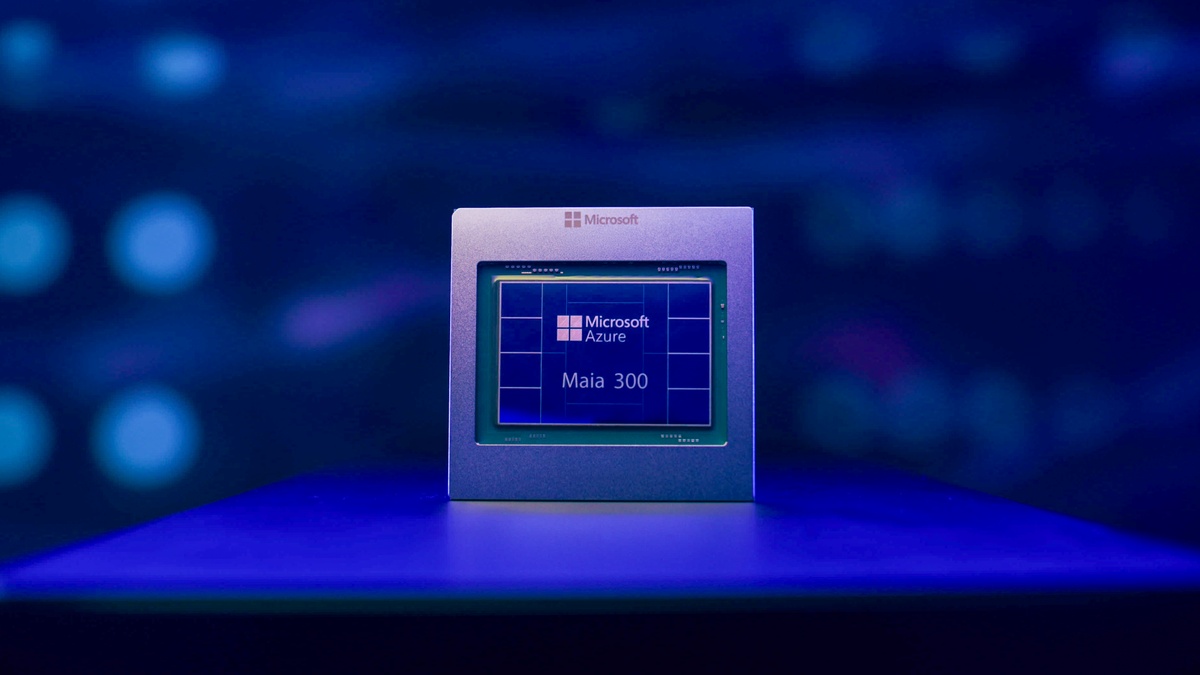
According to the official announcement published on the Microsoft Blog, the second-generation Maia 200 is already active in worldwide production clusters, while the forthcoming Maia 300 delivers groundbreaking generational leaps in memory bandwidth and rack throughput.
| Hardware Specification | Azure Maia 100 | Azure Maia 200 | Azure Maia 300 | Generational Improvement |
|---|---|---|---|---|
| Fabrication Process Node | TSMC 5nm FinFET | TSMC 4nm Optimized | TSMC N2P Multi-Chiplet | Next-gen N2P architectural jump |
| High Bandwidth Memory (HBM) | 64 GB HBM2E | 216 GB HBM3E | 288 GB HBM4 | 33% capacity increase over Maia 200 |
| Peak Memory Bandwidth | 1.8 TB/s | 7.2 TB/s | 18.0 TB/s | 2.5x bandwidth expansion |
| Thermal Design Power (TDP) | 500 Watts | 750 Watts | 950 Watts | 2x HBM bandwidth per watt |
| Rack-Scale Density | Custom Closed-Loop | 48 Accelerators / Rack | 96 Accelerators / Rack | 7x rack token throughput gain |
| Primary Target Workloads | LLM Prototype Inference | Teams, Copilot & MAI Models | Multi-Step Agents & Reasoning | 40% more tokens per megawatt |
TSMC N2P Chiplet Architecture: Disaggregating Compute and Packaging
At the foundation of the Azure Maia AI accelerator redesign lies a sophisticated multi-chiplet packaging strategy that separates compute engines, memory controllers, and high-speed I/O functions into specialized silicon dies connected across ultra-dense interconnect bridges.
Detailed in Microsoft’s technical paper, the compute tiles are manufactured on TSMC’s bleeding-edge N2P process node, ensuring optimal transistor density, lower leakage current, and superior performance-per-watt metrics under sustained enterprise inference stresses.
By isolating the memory interfaces and networking routing logic onto cost-effective companion dies, Microsoft engineers maximized the physical die surface dedicated exclusively to matrix multiplication, tensor calculations, and low-precision mathematical acceleration.
This modular layout increases total compute FLOPs by 36 percent, granting Microsoft’s custom silicon architecture significant headroom when processing deep transformer decodes and complex multi-token attention matrices.
Similar to modern modular consumer processors like the AMD Ryzen 7 9800X3D, disaggregating silicon functional blocks enables superior manufacturing yields while reducing overall thermal hotspots across high-density datacenter packages.
Advanced packaging allows the customized processor to operate with uniform thermal dissipation, preventing severe throttling when thousands of accelerator packages run simultaneous reasoning queries across cloud nodes.
HBM4 Memory Subsystem: 18 Terabytes per Second at 950 Watts
Memory bandwidth represents the most critical bottleneck in modern generative AI inference, and the Azure Maia AI accelerator tackles memory pressure directly through an unprecedented integration of eight stacked HBM4 modules.
These high-bandwidth memory stacks deliver an astounding 18.0 terabytes per second of aggregate throughput across 288 gigabytes of total memory capacity, directly matching the rigorous demands of next-generation trillion-parameter language models.
Compared to earlier designs, the Azure Maia AI accelerator yields two and a half times the raw memory bandwidth while expanding total on-package capacity by 33 percent within a manageable 950-watt thermal envelope.
To further curb off-chip data movement, Microsoft embedded extensive software-managed SRAM blocks directly on the compute dies to serve as an ultrafast scratchpad for intermediate KV-cache allocations and model weights.
By treating memory with a non-uniform memory architecture across compute regions, the specialized processor reduces data travel distances, preserving electrical power and doubling HBM bandwidth efficiency per watt.
This memory supremacy ensures the Azure Maia AI accelerator sustains lightning-fast conversational decode latencies, preventing request queuing even when thousands of users submit extensive document summarization prompts concurrently.
Software-Defined Dataflow Architecture: Eliminating Inference Latency Bottlenecks
Raw floating-point performance matters little if processing cores sit starved of instructions, prompting engineers to build the Azure Maia AI accelerator around an advanced Software-Defined Dataflow Architecture that manages data movement deterministically.
Instead of relying on hardware-controlled caches that introduce unpredictable cache misses, the software compiler explicitly orchestrates direct memory access engines, localized scratchpads, and on-chip networks to pre-fetch tensors precisely when needed.
AI-assisted compiler kernel optimizations analyze customer workload patterns, matching mathematical operations to specialized hardware pipelines to maximize active execution unit utilization across the Azure Maia AI accelerator.
The architecture introduces native hardware acceleration for emerging microscopic low-precision numerical formats, specifically enhanced MXFP4, which slashes memory footprint requirements for weights and KV-caches without sacrificing numerical precision.
By compressing key-value context states into compact four-bit representations, the Maia 300 system sustains massive context windows spanning hundreds of thousands of tokens without overflowing high-bandwidth memory pools.
This deterministic dataflow execution guarantees the Azure Maia AI accelerator processes latency-sensitive reasoning chains with predictable response times, enabling real-time agentic workflows across enterprise platforms.
Rack-Scale Density and Liquid Cooling: 96 Accelerators Across 167 Kilowatts
Translating individual silicon prowess into hyperscale cloud capacity requires revolutionary rack infrastructure, where the Azure Maia AI accelerator shines through an ultra-dense 96-accelerator rack assembly engineered for multi-gigawatt facilities.
Each production rack integrates 96 accelerators inside a compact footprint consuming 167 kilowatts, delivering an astounding 27.6 terabytes of HBM capacity and 1.7 petabytes per second of aggregate bandwidth across the unified enclosure.
To safely manage this extreme thermal concentration, Microsoft developed closed-loop liquid cooling manifolds that circulate coolant directly over accelerator vapor chambers, shedding heat far more effectively than air cooling.
| Datacenter Metric | Maia 200 Rack System | Maia 300 Rack System | Commercial GPU Server Baseline |
|---|---|---|---|
| Accelerators per Rack Unit | 48 Custom Packages | 96 Custom Packages | 64 Industry Standard GPUs |
| Rack Thermal Footprint | 110 Kilowatts | 167 Kilowatts | 140 Kilowatts |
| Aggregate HBM Memory Pool | 10.3 Terabytes | 27.6 Terabytes | 12.2 Terabytes |
| Aggregate Rack Bandwidth | 345 Terabytes / sec | 1.7 Petabytes / sec | 512 Terabytes / sec |
| Scale-Up Interconnect Fabric | Dual-Tier Ethernet | Custom AI Transport | InfiniBand / NVLink |
| Energy Efficiency Advantage | 1.7x Tokens / Watt | 40% Tokens / Megawatt vs GPUs | Baseline Standard Reference |
The rack architecture treats networking as an integral extension of silicon dataflow, interconnecting each Azure Maia AI accelerator via a custom Ethernet-based scale-up transport optimized specifically for distributed tensor parallelism.
Just as compact engineering redefined workstation computing on the Apple M4 Mac mini, Microsoft’s dense rack packaging maximizes spatial and power utilization inside modern datacenters.
In full rack testing, the Azure Maia AI accelerator delivers up to seven times the token throughput of previous generations while achieving 40 percent more tokens per megawatt than commercial GPU clusters.
Azure Maia AI Accelerator Roadmap: Hyperscale Multi-Gigawatt Deployment
Microsoft’s bold declaration to scale the Azure Maia AI accelerator across multi-gigawatt facilities signals a profound transformation in cloud economics, reducing dependence on third-party silicon suppliers while optimizing service operating margins.
With the earlier Maia 200 already active across North America, Europe, and Australia, custom hardware forms the bedrock of Microsoft’s autonomous software roadmap, powering GitHub Copilot and internal model training.
By designing bespoke silicon optimized for inference rather than general-purpose rasterization, Microsoft circumvents the legacy constraints that influence commercial hardware, much like recent shifts documented in NVIDIA Windows support transitions.
Furthermore, integrating proprietary accelerators directly into global services strengthens enterprise cloud platforms, echoing multi-platform infrastructure strategies seen in Xbox cloud gaming bundles.
Hyperscale multi-gigawatt deployments beginning in 2027 will cement the Azure Maia AI accelerator as the primary inference workhorse for enterprise applications, processing billions of daily prompt decodes efficiently.
This strategic silicon autonomy ensures Microsoft can scale autonomous agent swarms, medical transcription engines, and multimodal assistants without facing severe supply chain bottlenecks or exorbitant hardware licensing expenses.
Frequently Asked Questions
What is the Microsoft Azure Maia system?
The Azure Maia family represents Microsoft’s proprietary in-house AI silicon program, custom-engineered to deliver high-throughput, energy-efficient inference for Microsoft Copilot, OpenAI reasoning models, and global enterprise cloud applications.
When will Azure Maia 300 deploy in production?
Microsoft confirmed that the Azure Maia AI accelerator family is currently operating Maia 200 in production datacenters, while the advanced Maia 300 system will begin hyperscale multi-gigawatt deployments in 2027.
What manufacturing process node does Maia 300 utilize?
The compute chiplets within the Azure Maia AI accelerator are fabricated on TSMC’s advanced N2P process node, delivering optimal transistor density, thermal dissipation, and power efficiency for enterprise inference workloads.
How does Maia 300 compare to commercial GPU clusters?
Maia 300 delivers 40 percent more tokens per megawatt compared to leading commercial GPU servers, leveraging 96 accelerators per rack to generate seven times the rack token throughput of Maia 200.
How much memory bandwidth does Maia 300 provide?
Equipped with eight HBM4 stacks, the Azure Maia AI accelerator delivers 18.0 terabytes per second of memory bandwidth and 288 gigabytes of capacity within an efficient 950-watt thermal design envelope.
Final Verdict: Custom Silicon Economics and the Future of Hyperscale AI
Microsoft’s multi-gigawatt expansion of the Azure Maia AI accelerator represents a watershed moment for datacenter infrastructure, proving that custom silicon co-design is essential for sustaining the astronomical computational demands of generative artificial intelligence.
By harmonizing TSMC N2P silicon, 18 terabytes per second of HBM4 memory, and intelligent software-directed dataflow compilers, Microsoft has crafted an inference architecture capable of outperforming standard graphics processors across enterprise scale.
As multi-gigawatt clusters come online in 2027, the Azure Maia AI accelerator will solidify Microsoft’s technological independence, driving down the unit economics of machine intelligence for organizations around the globe.
