


Table of Contents
In an unprecedented disruption across global enterprise infrastructure, a massive Microsoft 365 outage has rendered core services inaccessible, locking millions of remote workers and corporate teams out of critical communication suites.
According to live telemetry from Windows Central, service degradation began impacting tenants worldwide, knocking out Exchange Online, Microsoft Teams, OneDrive storage, Copilot artificial intelligence tools, and several essential Azure portal management functions.
| Impacted Platform | Reported Operational Symptoms | Underlying Architecture Tier | Primary Disruption Impact | Recommended Workaround |
|---|---|---|---|---|
| Microsoft Teams | Unable to establish calls or load chats | Azure Communication Services & Graph API | Real-time collaboration paralyzed | Shift to cellular SMS or alternative VoIP |
| Exchange & Outlook | 504 Gateway Timeouts, disconnected status | Exchange Online Mailbox Infrastructure | Inbound and outbound corporate mail frozen | Monitor mobile ActiveSync or queue drafts |
| OneDrive & SharePoint | HTTP 503 Service Unavailable, sync stalls | Azure Blob Storage & Office Graph | Cloud document libraries unreachable | Enable offline cache files locally |
| Microsoft Copilot | Generation prompts fail, API timeouts | Azure OpenAI Service Endpoints | Enterprise AI assistance offline | Rely on local reasoning workflows |
| Azure Management Portal | Authentication loops, tenant load drops | Microsoft Entra ID & Azure Front Door | Cloud infrastructure administration delayed | Utilize Azure CLI via independent networks |
Incident EX1550543: Tracking Global Enterprise Service Failures
Corporate IT departments scrambled this morning as alerts multiplied across enterprise dashboards, identifying an escalating Microsoft 365 outage that paralyzed standard business communication channels across North America, Europe, and Asian commercial markets.
The disruption surfaced abruptly without scheduled maintenance notifications, leaving system administrators unable to access tenant health portals while end users faced recurring authentication timeouts and connection rejections across both desktop and web applications.
Microsoft quickly acknowledged the unfolding crisis via its official administrative support feeds on social media, cataloging the broad connectivity breakdown under service advisory tracking identifier Incident EX1550543 for enterprise tenant reviews.
Initial diagnostic telemetry associated with the enterprise breakdown suggests that centralized identity validation and session state management endpoints stopped responding to incoming authorization tokens, creating widespread cascading session drops.
Corporate executives and frontline knowledge workers found themselves abruptly severed from scheduled videoconferences, cloud-hosted presentation decks, and shared project repositories, illustrating how thoroughly day-to-day operations depend on continuous uptime from Redmond.
As service tickets flooded helpdesk queues globally, the Microsoft 365 outage underscored the precarious reality that even redundant multi-tenant cloud architectures remain vulnerable to centralized configuration faults and routing bottlenecks.
Azure Front Door and DNS Routing: Dissecting the Core Failure Points
Network engineers analyzing traffic during the Microsoft 365 outage identified severe packet anomalies originating at the edge, pointing toward potential routing irregularities within Azure Front Door global load balancing fabrics.
Azure Front Door operates as Microsoft’s content delivery network and anycast routing gateway, distributing user requests across thousands of edge point-of-presence facilities to ensure lowest-latency connectivity into private datacenter backbones.
When core domain name resolution records or border gateway protocol routes encounter corrupted configuration pushes, incoming requests cannot traverse edge proxies, mimicking the symptoms of a full cloud infrastructure outage.
Similar architectural vulnerabilities previously impacted distributed systems, demonstrating that when edge ingress gateways malfunction during a service collapse, healthy backend compute instances become effectively invisible to client applications.
DNS inspection tools reported substantial increases in server failure responses and packet loss across core Microsoft endpoints, preventing local desktop clients from completing secure Transport Layer Security handshakes with regional hosting clusters.
Engineers investigating the root cause of the Microsoft 365 outage focused heavily on recent policy changes, evaluating whether automated software-defined networking deployments triggered recursive loop states across global transit hubs.
DownDetector Telemetry: Cascading Spikes Across Cloud Platforms
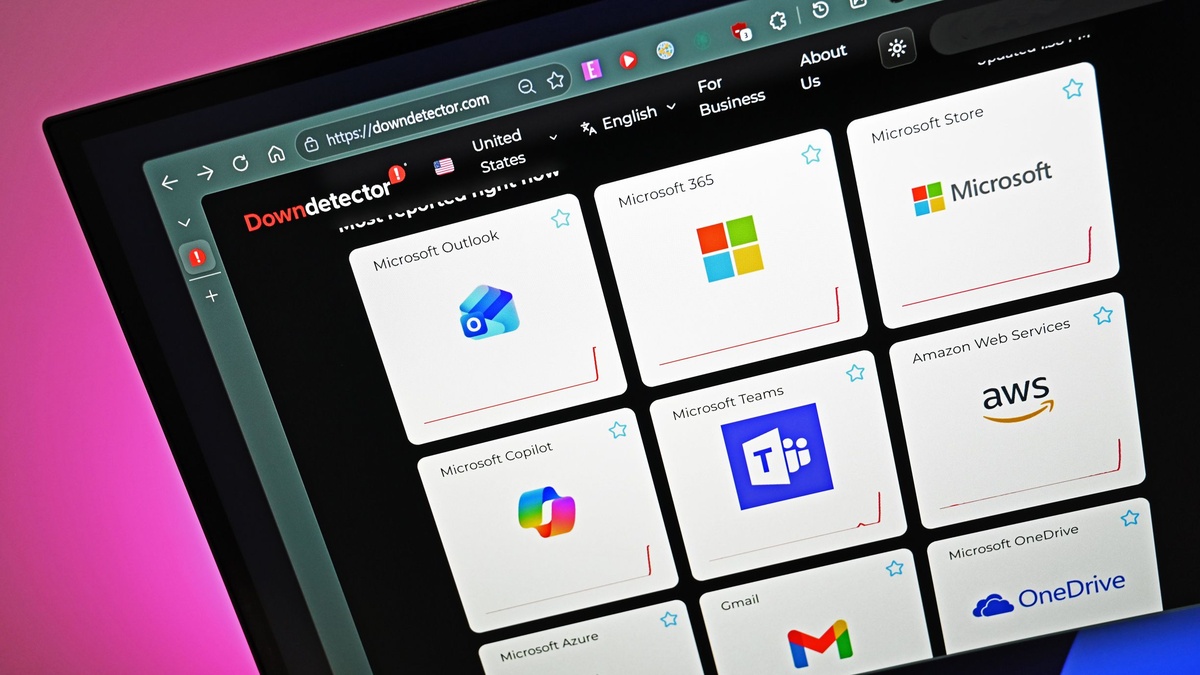
Simultaneously, independent web monitoring platform DownDetector recorded historic complaint surges, registering hundreds of thousands of problem reports as the Microsoft 365 outage gained international momentum.
Telemetry charts exhibited nearly vertical incident spikes for Microsoft Teams and Outlook, while ancillary reports revealed intermittent connectivity friction across secondary cloud platforms including Amazon Web Services, Cloudflare, and Google Cloud.
Network specialists from The Verge noted that while Microsoft services suffered the heaviest direct failure rates, shared transit backbones and internet exchange peering links experienced secondary congestion waves.
Whenever a critical Microsoft 365 outage takes down primary corporate communications, frantic IT administrators attempt simultaneous diagnostic queries, generating synthetic traffic floods that can temporarily saturate regional internet service provider interchanges.
Consumer services such as Steam and public web portals briefly displayed elevated response times, reflecting the interconnected nature of modern cloud peering rather than independent platform vulnerabilities.
These concurrent traffic anomalies emphasize how rapidly a localized cloud incident ripples through third-party digital supply chains, straining ancillary networking infrastructure and generating false-positive alarms across unrelated server environments.
Enterprise Continuity: Workarounds for Communication and File Sync
Faced with an active Microsoft 365 outage, system architects must immediately implement contingency protocols to preserve organizational productivity and maintain secure alternative communication avenues across distributed teams.
Organizations relying exclusively on Microsoft Entra ID authentication should verify that emergency break-glass administrator credentials remain accessible outside standard federation paths to ensure command continuity during severe cloud downtime.
| Enterprise Workload Tier | Incident Severity Level | Target Recovery Window | Immediate Administrative Action | Secondary Contingency Infrastructure |
|---|---|---|---|---|
| Mission-Critical Unified Comms | Tier 1 (Catastrophic) | Sub-60 Minutes Objective | Redirect active calls to cellular voice bridges | Self-hosted Matrix or Signal encrypted relays |
| Enterprise Email & Calendar | Tier 1 (Catastrophic) | 2 to 4 Hours Objective | Enable offline local caching on desktop clients | Secondary MX record forwarding to secure relay |
| Collaborative File Repositories | Tier 2 (High Impact) | 4 to 8 Hours Objective | Suspend background OneDrive synchronization tasks | Encrypted local NAS or cold S3 storage mirrors |
| Enterprise Generative AI | Tier 3 (Moderate Impact) | Best Effort / Non-Critical | Instruct employees to defer automated queries | Local open-source LLM instances on workstations |
| Azure Infrastructure Management | Tier 1 (Catastrophic) | Immediate Incident Priority | Execute deployment scripts via direct Cloud Shell | Out-of-band management console via direct IP |
To mitigate workflow stagnation caused by the Microsoft 365 outage, technical managers are encouraged to establish secondary voice channels and maintain local offline document caching across enterprise operating environments running modern PC hardware.
Staff members can preserve document revision tracking by working strictly within localized file copies, deferring cloud synchronization until backend health indicators confirm that the widespread disruption has achieved full remediation.
Adopting decoupled collaboration platforms alongside redundant identity providers guarantees that unforeseen incidents like this Microsoft 365 outage do not completely paralyze mission-critical business transactions.
Cloud Concentration Risk: Architecture Lessons for Mission-Critical IT
The sweeping consequences of this Microsoft 365 outage bring renewed scrutiny to enterprise cloud concentration risk, where fortune five hundred enterprises concentrate computing workloads into single vendor ecosystems.
While centralized software-as-a-service platforms deliver undeniable management conveniences and reduced operational overhead, they inherently introduce monolithic single points of catastrophic failure that transcend geographic datacenter redundancy.
Organizations that operate localized computational hardware or private datacenter clusters powered by modern high-throughput processor architectures retain crucial resiliency advantages whenever public cloud fabrics collapse unexpectedly.
Security professionals argue that the aftermath of this global incident must prompt senior leadership to reexamine multi-cloud architectures, validating that disaster recovery plans encompass full vendor outages rather than simple regional hardware failures.
Implementing vendor-neutral protocols, cross-cloud data mirroring, and distributed directory services requires meaningful financial investment, yet proved vastly less costly than hours of unmitigated global operational blackout.
Ultimately, surviving a prolonged Microsoft 365 outage requires executive decision-makers to strike a calculated balance between integrated cloud productivity suites and resilient operational sovereignty.
Frequently Asked Questions
What caused the widespread Microsoft 365 outage?
Microsoft engineers are actively investigating Incident EX1550543, with preliminary evidence pointing to DNS routing anomalies and edge gateway proxy configuration failures within Azure Front Door during the Microsoft 365 outage.
Which Microsoft services were impacted by the disruption?
The Microsoft 365 outage broadly disrupted Microsoft Teams, Exchange Online, Outlook, OneDrive storage, SharePoint collaboration spaces, Microsoft Copilot artificial intelligence tools, and Azure administration portals across global enterprise regions.
How can IT administrators track official status updates from Microsoft?
System administrators can track Incident EX1550543 through the Microsoft 365 Admin Center, or monitor real-time updates dispatched via the official Microsoft 365 Status account on social media throughout the Microsoft 365 outage.
Were other cloud platforms like AWS and Cloudflare also down?
While DownDetector logged concurrent report spikes across third-party services, other major cloud providers remained structurally operational, experiencing secondary network transit congestion triggered by diagnostic surges during the Microsoft 365 outage.
What immediate steps should businesses take during cloud outages?
Organizations should activate out-of-band communication channels, preserve local document caches, defer non-critical synchronization queues, and rely on decoupled emergency protocols until Microsoft completes remediation of the service breakdown.
Final Verdict: Resiliency Realities Behind Enterprise Cloud Monoculture
This latest Microsoft 365 outage delivers an urgent wake-up call to corporate technology executives regarding the vulnerabilities inherent in unchecked cloud centralization and shared software dependencies.
While Microsoft engineering teams will inevitably restore service integrity and publish post-incident root cause analyses, the financial and operational damages inflicted by this global breakdown demonstrate that high availability SLAs cannot substitute for architectural diversification.
Enterprise resiliency in an interconnected world demands proactive disaster planning, localized compute failovers, and robust contingency communication channels capable of outlasting any severe Microsoft 365 outage.
