


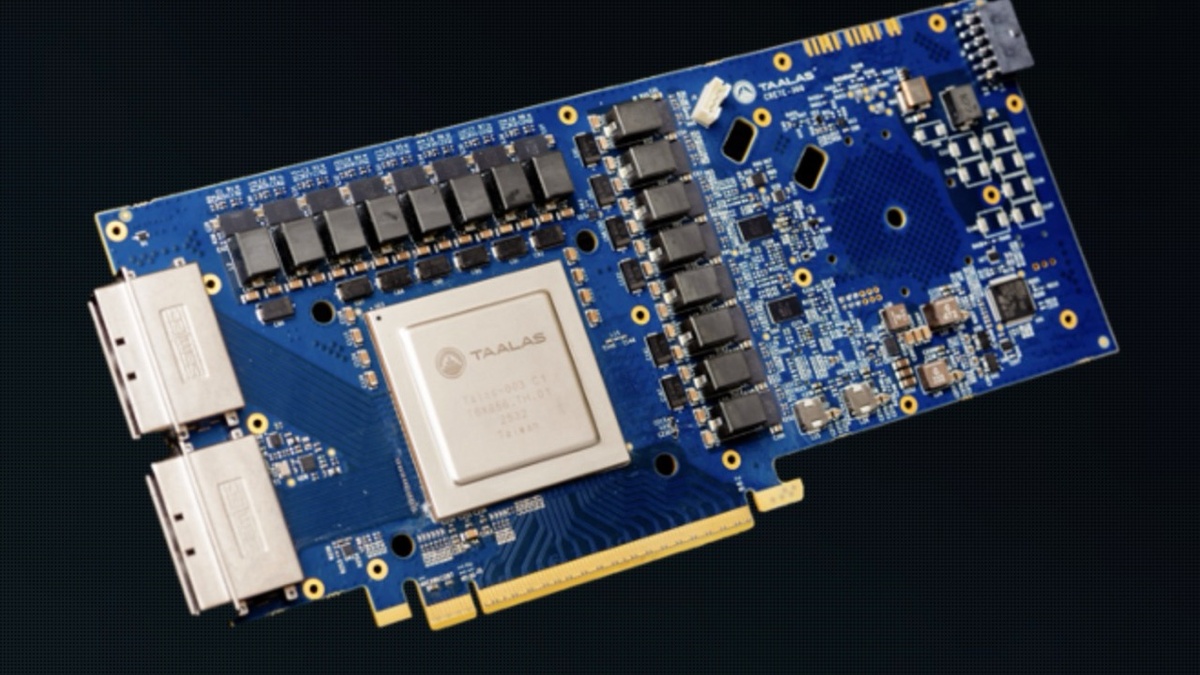
The semiconductor landscape experienced a seismic shift as AMD Acquires Taalas in an ambitious move to revolutionize neural processing, securing direct-to-silicon technology that permanently hardwires machine learning model weights directly into custom datacenter inference silicon.
According to the official AMD Newsroom announcement, the decision where AMD Acquires Taalas equips Team Red with proprietary architecture specifically engineered to conquer the memory wall, eliminating expensive high-bandwidth memory overhead during high-volume enterprise deployments.
At-a-Glance Architectural Breakdown: Direct-to-Silicon ASICs vs. Conventional AI GPUs
Analyzing the engineering implications of why AMD Acquires Taalas requires contrasting hardwired model-specific silicon against general-purpose graphics accelerators. This architectural comparison highlights the radical efficiency gains unlocked by discarding traditional high-bandwidth memory subsystems.
Below is the complete architectural specification breakdown illustrating why AMD Acquires Taalas, contrasting conventional AI accelerators against the direct-to-silicon paradigm to demonstrate how physical transistor etching eliminates critical datacenter dataflow bottlenecks.
| Architectural Metric | Conventional Datacenter GPU (Nvidia H100 / B200) | Direct-to-Silicon ASIC (Taalas HC1) |
|---|---|---|
| Model Storage Location | Off-Chip High-Bandwidth Memory (HBM3 / HBM3e) | Hardwired On-Die Transistor ROM Metal Layers |
| Memory Fetch Bandwidth | Up to 8 TB/s via Complex Interposers | Infinite On-Chip Interconnect (Zero Off-Die Bus) |
| Token Generation Latency | Variable Roundtrip Memory Latency (15-40ms) | Sub-Millisecond Direct Transistor Forward Pass |
| Single-User Generation Speed | ~100 to 300 Tokens Per Second | Over 17,000 Tokens Per Second (Llama 3.1 8B) |
| Thermal & Cooling Profile | Requires Heavy Liquid Cooling (700W – 1000W) | Standard Air-Cooled Heatsinks (~150W – 300W) |
| Packaging Complexity | Advanced 2.5D/3D Packaging (TSMC CoWoS) | Monolithic Die on Standard Substrates |
| Lithography Fabrication Node | TSMC 4NP / Leading-Edge Custom Nodes | Mature TSMC 6-Nanometer Node |
| Model Weight Upgradability | Software Flash to Memory at Runtime | Two-Mask Lithography Re-spin at Foundry |
| Deployment Economics | $30,000 – $45,000 per Accelerator Board | Significantly Lower Manufacturing & Silicon TCO |
As evidenced by our structural analysis, the transaction where AMD Acquires Taalas tackles the notorious memory wall head-on. By permanently freezing model weights within transistor masks, server clusters bypass repetitive off-chip data transfers entirely.
This fixed-silicon methodology redefines power efficiency for mature open-weights models, allowing hyperscalers to deploy high-concurrency generative services without suffering from thermal throttling or escalating power substation constraints across modern facilities.
Table of Contents
The global generative artificial intelligence surge has exposed a profound economic and physical bottleneck across modern server farms. The reality that AMD Acquires Taalas represents a bold effort to replace expensive programmable GPUs with streamlined task-specific silicon.
While PC enthusiasts celebrate raw gaming milestones like the AMD Ryzen 7 9800X3D revealed desktop processor, enterprise computing centers face entirely different operational hurdles dominated by soaring electrical bills and memory packaging shortages.
Much like how mobile SoC designs analyzed in the Apple M4 Mac mini redesign maximize shared on-chip bandwidth, eliminating off-die communication pathways provides immense benefits for continuous algorithmic execution.
Furthermore, enterprise operators navigating hardware lifecycles alongside legacy platform transitions such as Nvidia ends Windows 10 support understand that long-term stability and tailored hardware architectures inevitably trump brute-force computational power.
In this comprehensive hardware deep-dive, we investigate how AMD Acquires Taalas, exploring the revolutionary direct-to-silicon manufacturing technique, sub-millisecond token latency, Instinct accelerator cluster integration, and transformative total cost of ownership advantages.
1. Direct-to-Silicon Hardwiring: Eliminating the HBM Memory Wall
For years, artificial intelligence accelerators have adhered to the von Neumann architecture, separating memory storage from arithmetic processing units. The breakthrough behind why AMD Acquires Taalas dismantles this separation by etching weights directly into silicon metal layers.
Conventional GPUs must continuously fetch billions of parameters from adjacent High-Bandwidth Memory stacks across complex silicon interposers. This repetitive transfer consumes the vast majority of total accelerator energy, generating massive heat while stalling compute cores.
Prior to the moment AMD Acquires Taalas, former Tenstorrent chief executive Ljubisa Bajic co-founded Taalas in 2023 to solve this exact vulnerability, leveraging mask-programmable Read-Only Memory to bake neural network weights directly into physical transistor interconnects.
According to extensive hardware architectural reporting published by ServeTheHome hardware analysis, configuring a direct-to-silicon chip requires modifying only two custom metal mask layers, drastically reducing fabrication time and lithography expenses.
Because the model parameters exist permanently within physical copper wires, there is zero memory bus latency and zero external memory power consumption. The computational array accesses every required weight instantaneously during forward-pass operations.
This foundational silicon innovation explains why AMD Acquires Taalas with such urgency. Rather than continually outbidding rivals for limited global HBM supply, AMD now possesses a patented alternative that bypasses external memory dependencies entirely.
2. Sub-Millisecond Latency: Delivering 17,000 Tokens Per Second
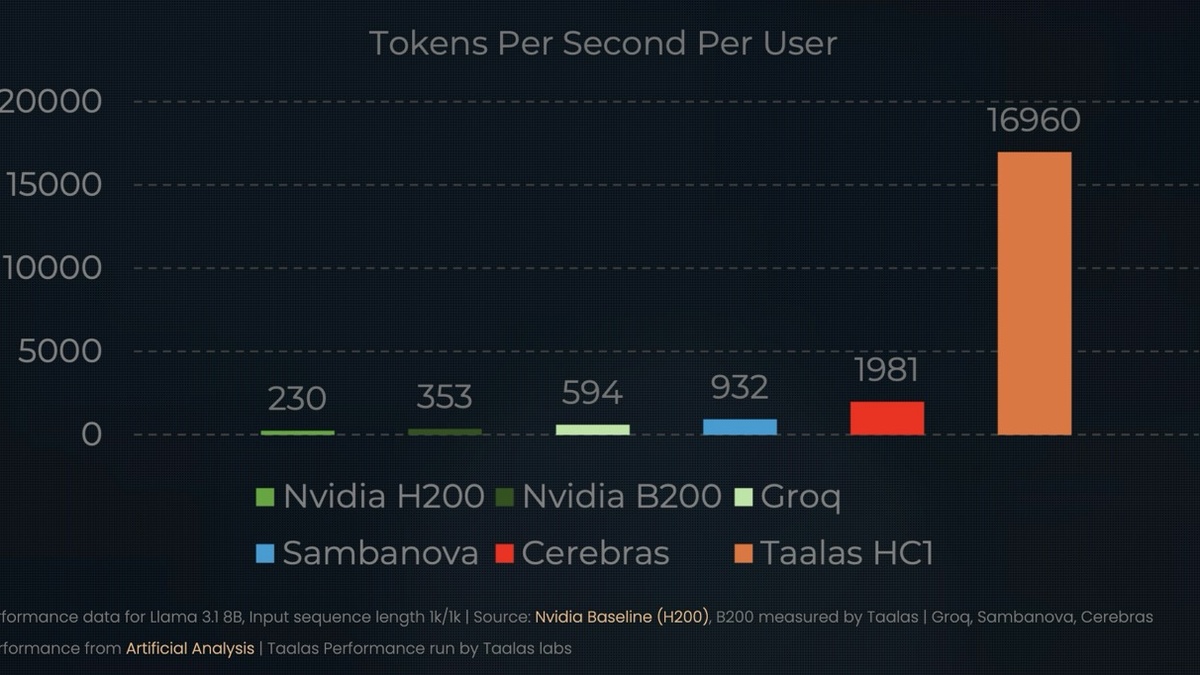
The real-world performance dividends of hardwired neural silicon are staggering. Prior to the announcement that AMD Acquires Taalas, Taalas fabricated its initial HC1 technology demonstrator, producing benchmark figures that startled the high-performance computing sector.
Built on TSMC’s proven 6-nanometer fabrication node, the monolithic Taalas HC1 die measures 815 square millimeters and packs roughly 53 billion transistors. It was engineered specifically to execute Meta’s open-source Llama 3.1 8-billion parameter language model.
Demonstrating why AMD Acquires Taalas, the HC1 delivered sustained single-user generation throughput exceeding 17,000 tokens per second, whereas premier datacenter GPUs often struggle to deliver several hundred tokens per second when servicing individual interactive enterprise sessions.
Independent silicon microarchitecture evaluations from AnandTech engineering reviews confirm that eliminating external DRAM roundtrips enables sub-millisecond response intervals, making real-time voice synthesis and autonomous reasoning loops feel truly instantaneous.
Furthermore, because the HC1 operates without boiling liquid cooling loops or high-wattage voltage regulator modules, it runs comfortably on standard air cooling, slashing server deployment complexity across dense enterprise rack installations.
Witnessing these phenomenal throughput metrics underscores why AMD Acquires Taalas at this precise juncture. Hyperscale customers operating stable AI services demand raw generation velocity that conventional graphics architectures simply cannot match economically.
3. Instinct GPU & Helios Synergy: Heterogeneous AI Cluster Architecture
A critical question raised by enterprise architects is how model-specific silicon coexists with programmable accelerators. The strategy behind why AMD Acquires Taalas centers on developing a versatile, heterogeneous datacenter platform combining Instinct GPUs with dedicated inference nodes.
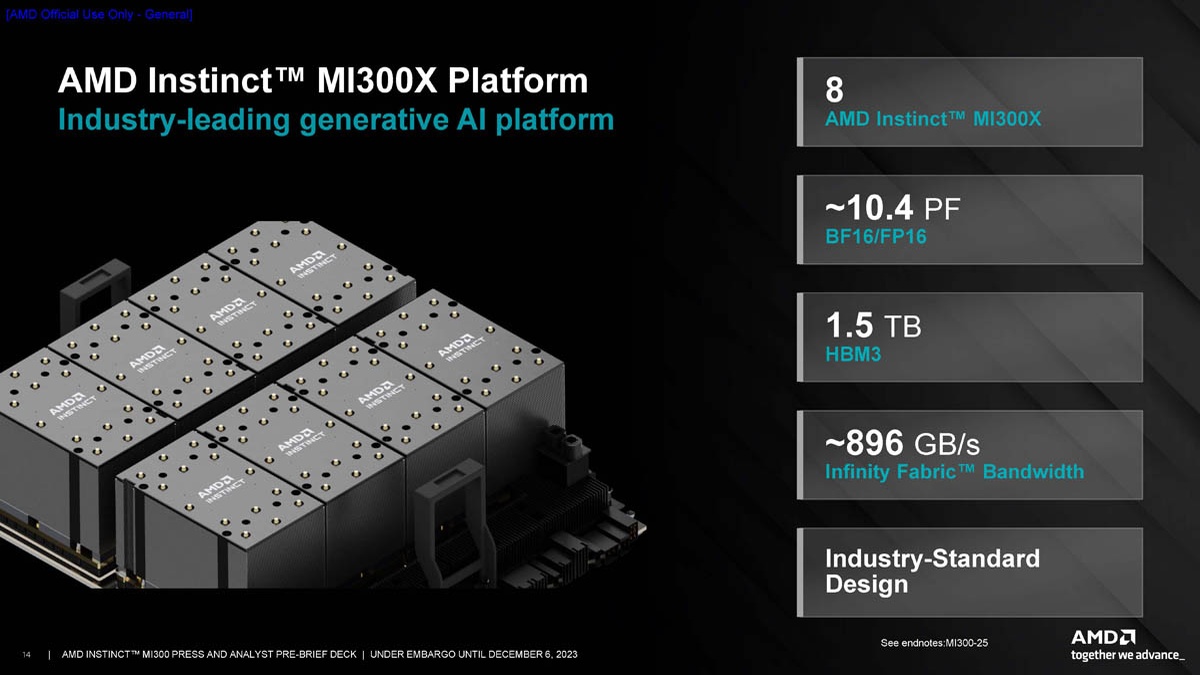
General-purpose accelerators like the AMD Instinct MI300X and next-generation MI350 series excel at training new foundational models and executing rapidly evolving neural network topologies where continuous architectural flexibility remains mandatory.
However, once a flagship model like Llama 3 reaches widespread industry adoption, its underlying weights and mathematical architecture remain stable for quarters at a time. This is where direct-to-silicon accelerators take over bulk production traffic.
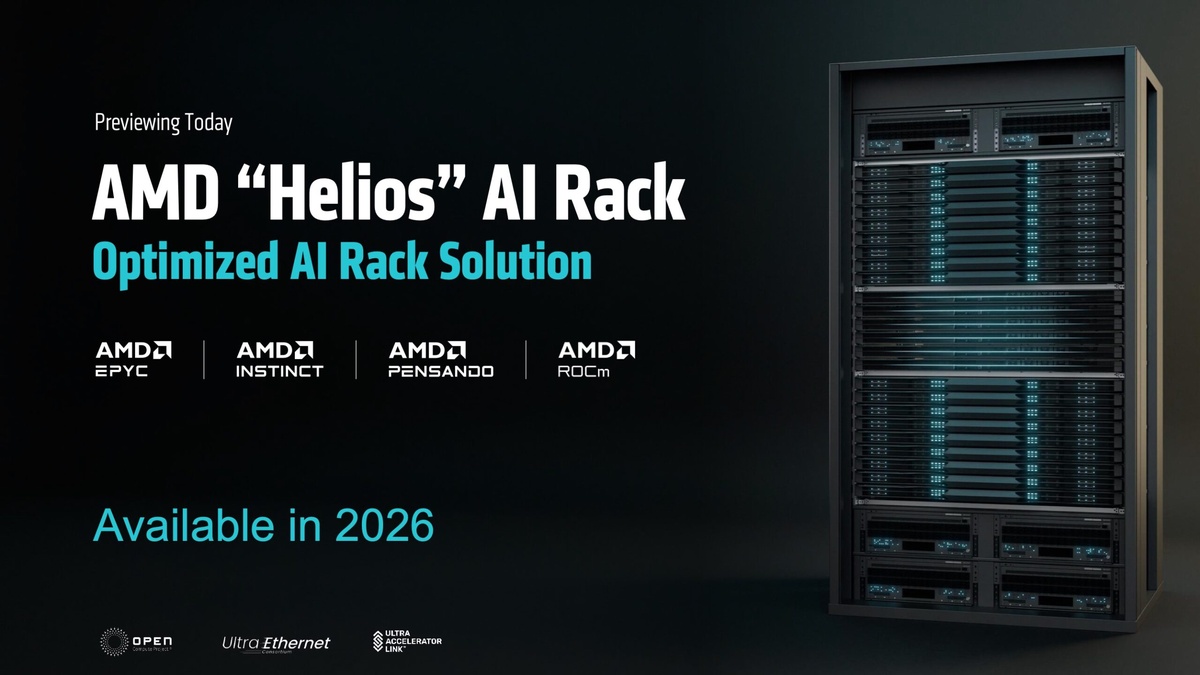
As AMD Acquires Taalas, plans call for integrating hardwired silicon into Helios rackscale infrastructure, combining high-performance EPYC processors and Instinct GPUs for dynamic routing with Taalas modules executing high-frequency base inference.
This tiered operational architecture mirrors the hybrid workload optimization seen in cloud gaming models like Xbox Cloud Gaming pay-as-you-go bundles, matching specific hardware tiers to user concurrency demands.
By establishing this balanced, two-pronged datacenter roadmap as AMD Acquires Taalas, Team Red provides corporate clients with a complete hardware spectrum spanning infinite programmability to absolute silicon efficiency.
Generational Architecture Matrix: Taalas HC1 vs. Nvidia B200 and AMD MI300X
Contrasting specialized direct-to-silicon accelerators against leading enterprise graphics processors clarifies the operational trade-offs confronting datacenter architects. The news that AMD Acquires Taalas introduces an entirely fresh hardware tier into this competitive landscape.
The hardware comparison matrix below details why AMD Acquires Taalas, contrasting memory architectures, manufacturing processes, power consumption profiles, and single-user throughput capabilities across flagship modern datacenter solutions.
| Hardware Specification | Taalas HC1 Demonstrator | Nvidia Blackwell B200 | AMD Instinct MI300X |
|---|---|---|---|
| Primary Target Function | Dedicated Model-Specific Inference | General-Purpose Training & Inference | General-Purpose Training & Inference |
| Fabrication Node | TSMC 6nm Monolithic | TSMC 4NP Dual-Die CoWoS-L | TSMC 5nm / 6nm 3D Chiplet Stack |
| Transistor Count | 53 Billion Transistors | 208 Billion Transistors | 153 Billion Transistors |
| Die Area | 815 mm² Monolithic Reticle | Two Reticle-Limit Dies Interconnected | Multiple 3D Stacked Compute Chiplets |
| Memory Architecture | Direct-to-Silicon Transistor Mask ROM | 192 GB HBM3e (8 TB/s) | 192 GB HBM3 (5.3 TB/s) |
| Target Workload Flexibility | Single Frozen Model (e.g., Llama 3.1 8B) | Universal Programmable Precision | Universal Programmable Precision |
| Single-User Inference Speed | ~17,000 Tokens/sec | ~200 – 400 Tokens/sec | ~180 – 350 Tokens/sec |
| Thermal Envelope (TDP) | ~150W – 300W Air-Cooled | 1,000W Liquid / Air Cooled | 750W Liquid / Air Cooled |
| Relative Silicon Cost | Low (Standard 6nm Lithography) | Extremely High (CoWoS-L + HBM3e) | High (3D Hybrid Bonding + HBM3) |
Evaluating the benchmark figures within our comparative breakdown proves why AMD Acquires Taalas to disrupt the server accelerator monopoly. Direct-to-silicon ASICs sacrifice broad algorithmic flexibility to deliver unmatched token throughput per watt.
For enterprises operating massive conversational agents and real-time coding assistants, adopting dedicated fixed-function silicon eliminates the astronomical capital expenses traditionally associated with high-bandwidth memory supplies.
4. ROCm Dataflow Integration: Unified Open AI Software Stack
Hardware innovation is meaningless without mature compiler and driver support. As AMD Acquires Taalas, integrating Taalas’s custom dataflow compilers into the open-source AMD ROCm software ecosystem represents the primary engineering priority.
Taalas engineers constructed a streamlined software toolchain capable of ingesting PyTorch weights, quantizing model parameters, and generating physical lithography mask layouts for TSMC foundries with unprecedented automated speed.
Validating why AMD Acquires Taalas, incorporating these proprietary compilers into ROCm allows developers to train models using standard PyTorch scripts on Instinct clusters, subsequently exporting finalized weights directly for direct-to-silicon ASIC fabrication.
Detailed semiconductor industry coverage on Tom’s Hardware underscores that software fragmentation has historically impeded specialized AI startups, making AMD’s unified ROCm runtime essential for widespread enterprise adoption.
Developers will interact with Taalas silicon through unified runtime APIs, treating hardwired inference accelerators as transparent execution endpoints alongside standard Instinct graphic accelerators and EPYC server nodes.
This software convergence ensures that the moment AMD Acquires Taalas is finalized, enterprise developers can leverage familiar open tooling without rewriting their mission-critical inference orchestration pipelines.
5. Model-Specific ASIC Economics: Slashing Datacenter Inference TCO
The financial implications of this acquisition extend far beyond laboratory benchmarks. By guaranteeing that AMD Acquires Taalas, corporate decision-makers gain a potent financial weapon to drastically slash datacenter total cost of ownership.
Premier AI accelerators currently command prices upwards of thirty thousand dollars each, driven by constrained packaging yields for CoWoS interposers and expensive Micron or SK Hynix HBM3e memory modules.
Because AMD Acquires Taalas, customers benefit from mature TSMC 6-nanometer fabrication without advanced 3D packaging, interposers, or expensive external memory stacks, reducing per-chip manufacturing expenses to a fraction of conventional GPU costs.
Because modifying weights requires altering only two lithography masks, generating custom silicon spins for updated model checkpoints costs mere millions rather than the hundreds of millions required for ground-up tapeouts.
Datacenter operators also reap massive energy savings, as eliminating high-wattage memory interfaces permits ultra-dense server racking without exceeding local electrical grid capacity or necessitating multimillion-dollar cooling overhauls.
These compelling financial dynamics demonstrate why AMD Acquires Taalas with decisive confidence, positioning AMD as the primary beneficiary as artificial intelligence transitions from expensive experimental training to cost-sensitive production inference.
Final Verdict: A Visionary Strike Against the Memory Wall
The definitive agreement where AMD Acquires Taalas represents one of the most visionary strategic gambles in recent semiconductor history. By directly targeting the memory wall, AMD challenges the prevailing assumption that general-purpose GPUs will dominate artificial intelligence forever.
While model-specific ASICs require dedicated silicon for each neural architecture, the immense efficiency and unmatched 17,000 token-per-second throughput make direct-to-silicon chips irresistible for high-volume enterprise deployments running standardized open models.
As corporate enterprises prioritize operational costs and power constraints over raw flexibility, AMD Acquires Taalas positions Team Red to lead the inference era with an unbeatable combination of Instinct GPUs and specialized hardwired silicon.
