


Table of Contents
Translating complex engineering concepts into functioning real-time simulations has historically demanded grueling months of manual modeling, physics tuning, and asset rendering. The deployment of NVIDIA Omniverse AI Agents marks a fundamental paradigm shift by coupling frontier reasoning models with GPU-accelerated computing libraries.
According to architectural disclosures released on the official NVIDIA Developer Blog, engineers are directing autonomous models like GPT-6 Astra to build full digital twins. These automated workflows eliminate traditional production bottlenecks across industrial automation, robotics manipulation, and synthetic dataset generation.
| Simulation Framework & Library | Core Architectural Function | Frontier AI Model Integration | Primary Industrial Use Case | Target GPU Hardware Tier |
|---|---|---|---|---|
| ovrtx (RTX Rendering) | GPU-Accelerated Ray Tracing & Sensor Telemetry | GPT-6 Astra & Claude Fable 5 | Camera & LiDAR Validation Digital Twins | NVIDIA RTX PRO 6000 Server GPUs |
| Newton Physics Engine | Rigid-Body Dynamic Solver & Constraint Checks | Multi-Agent Natural Language Prompts | Humanoid Robotics & Robo Olympics | High-Throughput Tensor Core Nodes |
| NVIDIA Warp Framework | Differentiable GPU Kernel Acceleration | Spatial Reasoning LLM Feedback Loops | Flexible Cable Routing Simulation | Multi-GPU Parallel Simulation Pods |
| ovstage & OpenUSD Runtime | Universal Scene Description Composition | Autonomous USD Content Agents | Facility Digital Twins (Falkor Nyhamna) | Hybrid Workstations & Azure Cloud |
| ovstream (WebRTC) | Low-Latency Remote Viewport Streaming | Single-Prompt UI Scene Assembly | In-Browser Telemetry (NASA ISS Twin) | Cloud-Native Virtual GPU Clusters |
Natural Language Simulation: How NVIDIA Omniverse AI Agents Direct Physics Solvers
Modern engineering teams orchestrating NVIDIA Omniverse AI Agents interact directly through natural-language prompts rather than writing brittle low-level scripting glue. Engineers outline operational constraints, mechanical parameters, and environmental dynamics while autonomous frontier models parse intentions into executable OpenUSD scene graphs.
Under the hood, these intelligent pipelines link directly into NVIDIA Omniverse accelerated simulation libraries like ovrtx for sensor-accurate ray tracing. The underlying framework dynamically validates rigid-body physics, fluid dynamics, and optical light paths without requiring constant manual intervention from 3D artists.
When unexpected kinematic collisions occur or physical constraints fail during runtime execution, autonomous agents review diagnostic telemetry and formulate corrective geometry adjustments. This closed feedback loop enables continuous scene self-healing, transforming hours of manual debugging into rapid iterative refinement.
By operationalizing NVIDIA Omniverse AI Agents, simulation specialists construct rich physics-accurate testbeds for autonomous equipment before cutting any physical metal. Similar to performance optimizations explored in our AMD Ryzen 7 9800X3D architectural analysis, memory bandwidth and parallel execution dictate simulation throughput.
Multi-agent reasoning loops allow specialized sub-agents to divide responsibilities between CAD parsing, surface shader assignment, and kinematic joint articulation. This modular delegation ensures that complex machinery models maintain exact industrial tolerances while rendering at responsive interactive framerates.
As developers scale up their virtual facilities, autonomous simulation agents automate the tedious process of connecting proprietary telemetry streams into live virtual assets. The resulting operational visibility empowers facility managers to preempt costly downtime through comprehensive synthetic stress testing.
Facility-Scale Digital Twins: Autonomous Industrial Modeling at Nyhamna
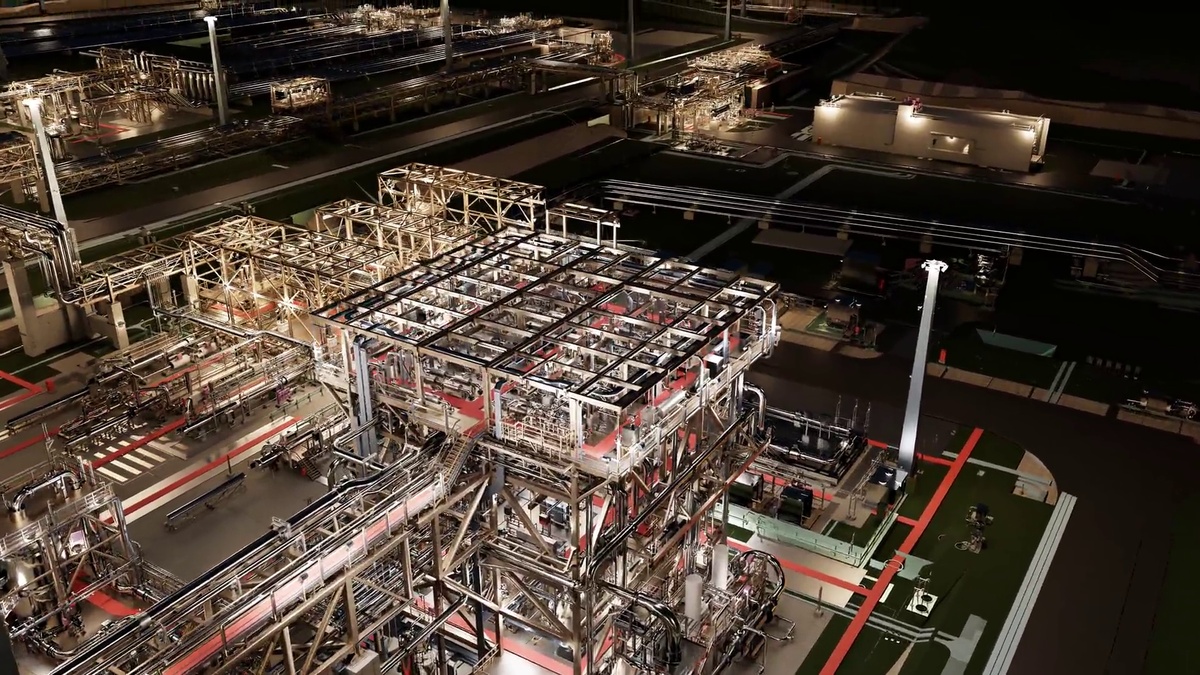
Industrial enterprise Falkor, a KONGSBERG company, has demonstrated the immense real-world value of this technology at the sprawling Nyhamna gas facility. Using the Falkor Surface platform, engineers converted massive computer-aided design repositories into fully interactive, facility-scale digital twins.
Guided by NVIDIA Omniverse AI Agents running GPT-6 Astra, Falkor processed gigabytes of engineering schematics into unified Universal Scene Description hierarchies. The system preserved structural metadata, fluid flow pathways, and safety sensor placements across thousands of industrial piping networks.
Running across high-density clusters of NVIDIA RTX PRO 6000 Server Edition GPUs hosted on Microsoft Azure, the platform simulates complex physical phenomena. Engineers evaluate operational contingencies, thermal distribution, and emergency evacuation protocols under rigorous virtual conditions.
Autonomous agents eliminated the customary multi-week turnaround times previously required to reconcile conflicting CAD revisions from disparate engineering contractor teams. Discrepancies between historical blueprints and live laser site scans are flagged and reconciled automatically within minutes.
This deployment illustrates how frontier AI agents unlock actionable predictive maintenance insights for multi-billion-dollar energy infrastructure assets worldwide. Enterprise reliability standards mirror hardware longevity strategies analyzed in our enterprise GPU hardware lifecycle report.
Plant operators can navigate the virtual Nyhamna facility in real time, inspecting stress concentrations and simulating component replacements safely. Autonomous simulation infrastructure bridges the historical divide between disconnected CAD archives and active plant telemetry.
Robo Olympics and Sensor Discrepancy: Calibrating NVIDIA Omniverse AI Agents
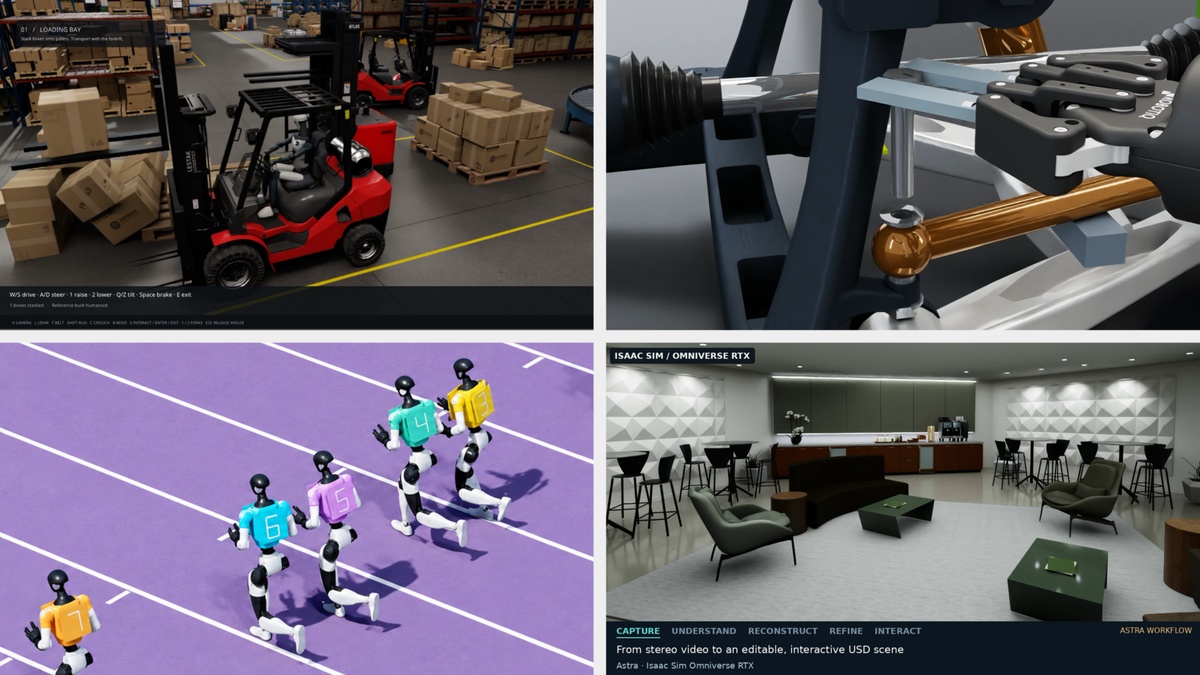
Teaching advanced robotic systems to navigate unpredictable physical environments requires rigorous calibration of NVIDIA Omniverse AI Agents against empirical ground truth. NVIDIA Omniverse engineering director Tae Kim introduced the Robo Olympics project to benchmark autonomous athletic locomotion on Unitree G1 humanoids.
Guided by natural-language instructions and reference sports footage, frontier agents designed custom kinematic controllers and refined joint torque curves iteratively. The simulation pipeline harnessed the Newton Physics Engine alongside the open-source NVIDIA Warp framework for GPU-accelerated spatial calculations.
In hurdle clearance trials, the simulated humanoid achieved successful clearance in 64 out of 100 autonomous simulation iterations. Each physical failure delivered immediate telemetry data, enabling the reasoning agent to adjust takeoff velocity and knee flexion angles.
Simultaneously, sensor validation specialist Ashley Reid utilized NVIDIA Omniverse AI Agents powered by Astra and Claude Fable 5 to reconcile synthetic camera and LiDAR feeds. By comparing simulated ovrtx sensor outputs against physical sensor logs, agents synthesized two digital twins from scratch.
The agents measured discrepancy metrics across material reflectivity, atmospheric backscatter, and geometric occlusions over three days of autonomous refinement. Whenever synthetic point clouds drifted from recorded reality, agents modified OpenUSD scene materials until sensor discrepancy thresholds were satisfied.
These rigorous calibration loops ensure that policies learned within these frontier AI pipelines transfer seamlessly into physical robotics hardware without disastrous real-world crashes. Sim-to-real transfer fidelity remains the defining metric separating practical robotics development from speculative theoretical research.
OpenUSD Content Assembly: Synthetic Data Generation and Asset Conditioning
Autonomous artificial intelligence models require massive volumes of accurately labeled synthetic training data to achieve reliable visual perception in factories. Leveraging NVIDIA Omniverse AI Agents, developers automate the generation of diverse, photorealistic training datasets containing millions of randomized permutations.
USD Content Agents dynamically condition 3D assets, automatically generating procedural variations in surface scratches, ambient lighting, and camera lens distortions. This procedural diversity prevents computer vision models from overfitting to sanitized laboratory visuals, boosting real-world detection accuracy.
Isaac engineering application researcher Chirag Majithia demonstrated how stereo camera captures transform into fully editable OpenUSD simulation environments. The pipeline integrated PyCuSFM, FoundationStereo, and nvblox volumetric mapping to reconstruct captured physical geometry into navigable digital twins.
Supervised by autonomous reasoning agents, the system converted static spatial meshes into interactable objects with functional cabinet hinges and sliding drawers. Thermal and spatial packaging efficiencies parallel thermal management breakthroughs detailed in our Apple M4 Mac Mini hardware review.
Isaac Sim collision meshes were automatically synthesized and tested against physical contact constraints, eliminating clipping errors during robot manipulation tasks. Robotic arms rehearse grasping shiny metallic components, transparent glassware, and deformable objects under endless simulated lighting variations.
By eliminating manual 3D modeling bottlenecks, synthetic data pipelines reduce AI training data acquisition costs by orders of magnitude. Enterprises deploy capable perception models weeks ahead of schedule, drastically accelerating modern industrial automation initiatives.
Turbine Telemetry and Cloud Compute: Scaling NVIDIA Omniverse AI Agents on Azure
High-fidelity industrial simulations require immense computational horsepower, making cloud infrastructure essential when scaling NVIDIA Omniverse AI Agents across enterprise teams. Microsoft Azure instances equipped with NVIDIA RTX PRO 6000 Server Edition GPUs deliver massive parallel graphics and AI compute density.
In industrial gas-turbine testing environments, engineers utilized frontier AI agents to explore complex thermodynamic and mechanical operating spaces. The autonomous agent evaluated 441 distinct operating points, visualizing parametric shifts in pressure gradients, gas velocity, and thermal strain.
| Industrial Application Domain | Traditional Engineering Pipeline | Autonomous Frontier Agent Pipeline | Iteration Velocity Gain | Verification Mechanism |
|---|---|---|---|---|
| Facility-Scale Digital Twins | Manual CAD Translation (Weeks) | Automated CAD Parsing via Astra on Azure | 14x Reduction in Twin Construction Time | Physics & Sensor Discrepancy Checks |
| Autonomous Sensor Validation | Physical Testbeds & Manual Point Cloud Tuning | Automated ovrtx LiDAR vs Real-World Data | 3-Day Multi-Twin Autonomous Convergence | Algorithmic Error Metric Delta Check |
| Humanoid Locomotion Training | Hand-Coded Kinematics & Trial-and-Error | Autonomous Controller Synthesis & Warp | 64% First-Attempt Hurdle Clearance Rate | Newton Physics Constraint Auditing |
| Industrial Turbine Exploration | Batch Finite Element Calculations Overnight | Interactive 441-Point What-If Operating Space | Real-Time Parametric Response Modeling | Reference Numerical Solver Cross-Check |
| NASA ISS Browser Streaming | Custom Web Development & 3D Shaders | Single-Prompt OpenUSD + ovstream Browser Build | Single Session Natural-Language Deployment | Live Telemetry Stream Synchrony |
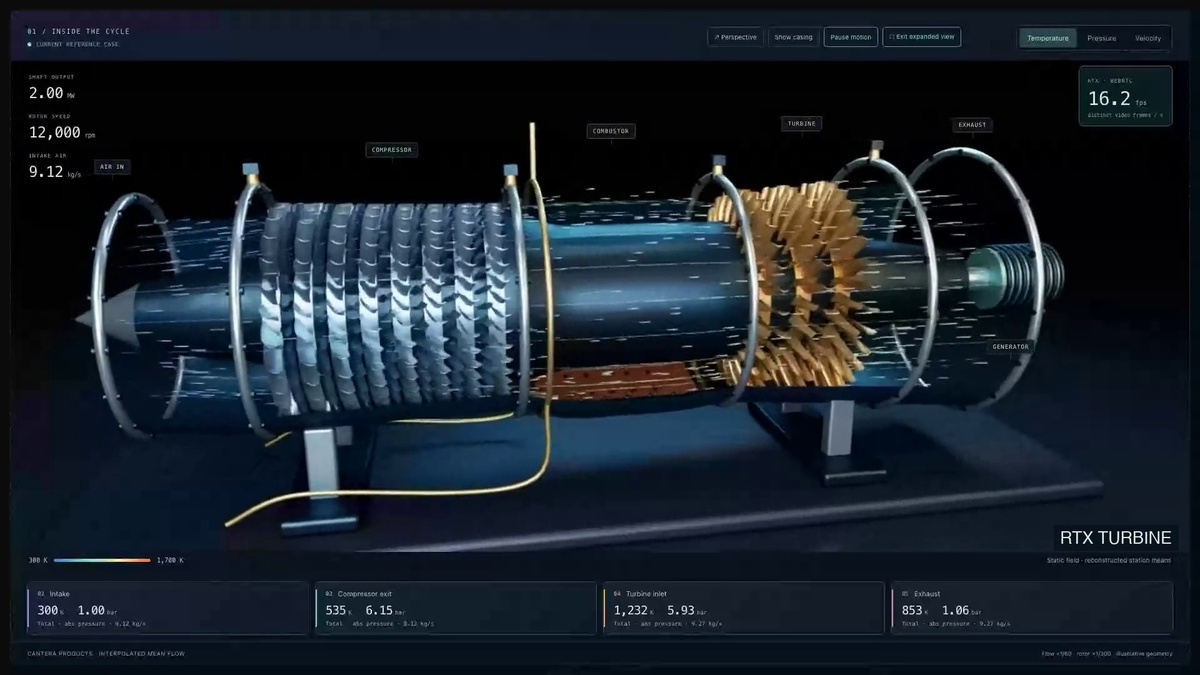
Instead of running batch finite-element calculations overnight, engineers posed conversational what-if queries to explore ambient temperature spikes and hydrogen fuel blends. The agent generated real-time volumetric flow visualizations while continually cross-checking results against reference numerical physics solvers.
Cloud provisioning ensures that NVIDIA Omniverse AI Agents scale dynamically during intensive compute bursts without burdening local client workstations. Similar cloud streaming efficiencies are examined in our Xbox cloud gaming infrastructure analysis.
Distributed multi-GPU scheduling enables simultaneous execution of hundreds of parallel physics rollouts, accelerating parametric sensitivity discovery. Engineers pinpoint critical failure modes and thermal fatigue limits long before turbine prototypes enter physical test cells.
The combination of elastic cloud clusters and frontier simulation agents establishes a new benchmark for computational fluid dynamics and mechanical stress validation. Industrial manufacturers optimize energy efficiency and reduce physical testing expenditures while meeting aggressive decarbonization mandates.
WebRTC Streaming Architecture: Delivering Interactive ISS Digital Twins to Browsers
Historically, interacting with multi-gigabyte simulation scenes required high-end desktop workstations equipped with dedicated professional workstation graphics cards. Through NVIDIA Omniverse AI Agents, NVIDIA engineering director Nic Johns demonstrated how complex 3D simulations stream directly into consumer web browsers.
Johns prompted GPT-6 Astra to assemble NASA OpenUSD assets of the International Space Station, connecting live telemetry streams in a single prompt. When initial lighting left the orbital outpost shrouded in darkness, a natural-language follow-up prompt reoriented the station toward Earth’s daytime hemisphere.
The underlying pipeline combines Blender asset preparation with core Omniverse libraries, including ovrtx for ray tracing and ovstage for scene runtime management. Interactive viewports are compressed and broadcast via the ovstream WebRTC library, achieving low latency across standard browser windows.
This streaming architecture allows non-technical stakeholders to collaborate inside complex autonomous simulation environments environments without downloading massive asset libraries locally. Field technicians inspect digital twin components on mobile tablets, receiving photorealistic pixel streams rendered on remote enterprise servers.
Centralized rendering eliminates client-side hardware fragmentation while safeguarding sensitive intellectual property by keeping source CAD files secure within private clouds. Engineers modify station payloads and verify operational clearance without risking unauthorized duplication of proprietary engineering geometries.
By democratizing access to high-fidelity spatial computing, autonomous Omniverse pipelines transform how distributed aerospace and manufacturing teams conduct collaborative design reviews. Frictionless browser access accelerates consensus across executive leadership, external contractors, and on-site maintenance crews.
Industrial Physical AI Ecosystem: Comparing Frontier Models in Simulation Workflows
The convergence of frontier artificial intelligence and physical simulation represents a foundational pillar of modern industrial autonomy. Comparing model architectures reveals distinct operational strengths when NVIDIA Omniverse AI Agents tackle diverse engineering challenges across global manufacturing ecosystems.
OpenAI GPT-6 Astra demonstrates exceptional capabilities in parsing unstructured engineering schematics, as documented on the NVIDIA Omniverse enterprise platform. Its deep spatial reasoning and syntax mastery enable seamless generation of syntactically valid OpenUSD stage hierarchies from conversational descriptions.
Meanwhile, Anthropic Claude Fable 5 excels in iterative sensor discrepancy auditing and rigorous algorithmic error checking during closed-loop calibration trials. Multi-model orchestration strategies leverage complementary reasoning strengths, pairing generative scene authoring with rigorous mathematical verification.
As hardware accelerators and neural architectures evolve, NVIDIA Omniverse AI Agents will increasingly incorporate real-time multimodal feedback from physical plant cameras. This continuous synchronization between physical assets and digital twins creates self-updating virtual replicas that mirror operational realities precisely.
Enterprises adopting these autonomous workflows gain substantial competitive advantages in product development velocity and manufacturing flexibility. Virtual prototyping minimizes physical retooling scrap, lowering capital expenditure while shielding engineering teams from unexpected production stalls.
The rapid maturation of frontier simulation agents signals a transformative era where simulation software evolves from passive visualization into active, self-directing intelligence. Developers, roboticists, and industrial architects now possess the tools to transform ambitious physical ideas into verified reality.
Frequently Asked Questions
What are NVIDIA Omniverse AI Agents and how do they function?
NVIDIA Omniverse AI Agents combine frontier large language models with NVIDIA Omniverse GPU libraries to automate 3D scene creation, physics simulation, and sensor calibration.
How do engineers communicate with NVIDIA Omniverse AI Agents?
Developers direct AI agents using conversational natural-language instructions, allowing models like GPT-6 Astra to write OpenUSD code, assign materials, and debug collisions.
What core libraries do NVIDIA Omniverse AI Agents utilize in Omniverse?
Key libraries include ovrtx for real-time ray tracing and sensor simulation, ovstage for scene runtime management, and ovstream for WebRTC browser streaming.
Can NVIDIA Omniverse AI Agents execute facility-scale simulations in the cloud?
Yes, the Falkor Surface platform runs facility-scale digital twins on Microsoft Azure using NVIDIA RTX PRO 6000 Server Edition GPUs for parallel physics compute.
How do NVIDIA Omniverse AI Agents bridge the gap between simulation and real robots?
By reconciling synthetic camera and LiDAR data against real-world logs, NVIDIA Omniverse AI Agents eliminate sim-to-real transfer gaps, allowing safe deployment to physical robots.
Final Verdict: The Frontier AI Acceleration of Industrial Digital Twins
The emergence of NVIDIA Omniverse AI Agents marks a monumental milestone in the evolution of physical artificial intelligence and industrial digital twin design. By eliminating tedious manual asset assembly and syntax debugging, frontier reasoning models empower engineering teams to focus entirely on higher-order problem-solving.
Whether training bipedal humanoids in Robo Olympics or simulating facility-scale gas processing plants at Nyhamna, GPU-accelerated simulation libraries deliver unprecedented fidelity. Tight integration with Universal Scene Description and WebRTC streaming ensures enterprise workflows remain highly collaborative, modular, and cloud-accessible.
As industrial organizations race to automate complex manufacturing and logistics pipelines, NVIDIA Omniverse AI Agents provide the definitive technological bridge to autonomy. The future of engineering belongs to teams that harness autonomous simulation agents to turn ambitious concepts into verified physical reality.
