


Table of Contents
Hospital systems worldwide are drowning under decades of unstructured medical records, forcing clinicians to spend hours sifting through dense paperwork. Deploying NVIDIA healthcare AI on local infrastructure empowers care teams to extract vital diagnostic evidence instantly while keeping sensitive patient health data completely secure.
Through partnerships with startups like Dyania Health and institutions like the Cleveland Clinic, NVIDIA healthcare AI accelerates chart analysis across clinical trials and cardiac surgery follow-ups. By running advanced reasoning engines directly on hospital hardware, clinicians reclaim crucial hours for patient consultation.
| Architectural Metric | Manual Clinical Review | Public Cloud AI SaaS | On-Premises NVIDIA Healthcare AI |
|---|---|---|---|
| Inference Location | Human Cognitive Processing | External Multi-Tenant Cloud | Local Hospital Firewall & GPU Cluster |
| Data Sovereignty & HIPAA | Strictly Internal to Hospital | Requires Cloud Data Ingestion | Zero Data Egress / 100% On-Premises |
| Cohort Analysis Timeline | Months to Multi-Year Audits | Hours (Subject to Bandwidth) | Minutes via Local Parallel Tensor Cores |
| Record Source Synthesis | Scattered Free-Text EHR Notes | Summarized API Excerpts | Comprehensive Cross-Decade EHR Reasoning |
| Software Stack Foundation | Manual Physician Checklists | Proprietary Closed API Endpoints | NVIDIA NeMo, TensorRT & TensorRT-LLM |
| Physician Oversight Model | Primary Decision Maker | Automated Opaque Output | Traceable Clinical Reasoning Assistant |
Clinical Reasoning at Scale: How NVIDIA healthcare AI Analyzes Decades of Patient History
Modern hospitals maintain petabytes of historical patient documentation spanning decades of clinical interventions. The vast majority of this invaluable clinical data remains locked within unstructured free text, including surgical operative notes, pathology analyses, bedside nursing logs, radiology interpretations, and historical discharge summaries.
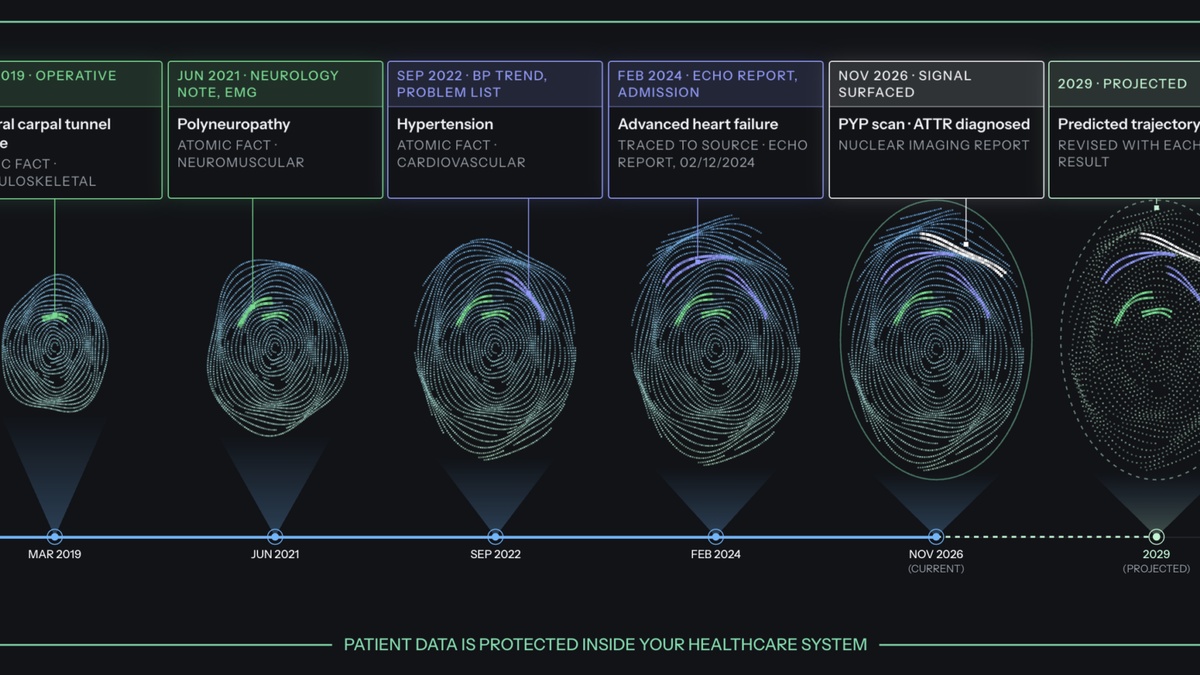
To synthesize complex patient histories, specialists historically spent hours reviewing legacy digital archives. By contrast, NVIDIA healthcare AI enables specialized reasoning architectures like Synapsis AI from Dyania Health to evaluate thousands of fragmented notes concurrently, connecting subtle diagnostic threads spanning years of clinical encounters.
Rather than providing generic generative summaries that obscure critical nuances, the platform functions as an automated clinical specialist. The underlying engine constructs a traceable chain of clinical evidence, linking every algorithmic hypothesis directly to verified timestamped entries recorded inside the primary electronic health record.
This deterministic audit trail ensures attending physicians retain diagnostic authority over all care decisions. Rather than replacing medical intuition, NVIDIA healthcare AI acts as a tireless diagnostic co-pilot, surfacing dormant risk factors that might otherwise escape human detection during rushed triage rounds.
Automating longitudinal chart review transforms how medical centers approach chronic disease management. By deploying NVIDIA healthcare AI to parse complex documentation in seconds, care teams rapidly identify progressive pathologies and schedule targeted interventions before acute deterioration occurs.
On-Premises Privacy Architecture: Protecting Patient Data Behind Hospital Firewalls
Patient privacy remains the paramount operational barrier to enterprise clinical artificial intelligence adoption. Healthcare organizations face strict penalties if protected data leaks, which is why NVIDIA healthcare AI eliminates external cloud exposure by processing sensitive records entirely behind local hospital firewalls.
To resolve this structural vulnerability, NVIDIA healthcare AI operates entirely on-premises within the hospital’s dedicated private data center. High-performance GPU servers sit directly behind institutional firewalls, ensuring confidential medical histories, genomic profiles, and diagnostic imaging scans never traverse public internet pipelines.
This air-gapped architecture eliminates data egress vulnerabilities while granting medical directors complete administrative sovereignty over their neural model weights. Hospital technical administrators control every input and output stream, guaranteeing zero third-party telemetry harvesting or unauthorized multi-tenant data pooling across remote commercial cloud platforms.
Local server execution also delivers predictable microsecond inference latency that public cloud connections cannot match. Emergency triage teams and intensive care specialists receive immediate diagnostic feedback without encountering network congestion, bandwidth throttling, or remote server downtime during regional telecommunication disruptions.
Maintaining proprietary compute on-site reinforces institutional trust among patients who remain skeptical of automated medical technologies. When healthcare systems demonstrate that NVIDIA healthcare AI never transmits personal health records off premises, patient enrollment in advanced diagnostic initiatives increases substantially.
Hardware Acceleration Stack: NeMo Libraries, TensorRT and TensorRT-LLM Optimization
Processing multi-decade patient dossiers requires massive parallel computational throughput and highly optimized runtimes. Developing NVIDIA healthcare AI models involves the NVIDIA NeMo enterprise framework, which trains neural networks on curated medical literature and specialized clinical vocabulary tokenizers.
Once neural training converges, engineers deploy NVIDIA TensorRT and TensorRT-LLM compilation libraries to maximize inference efficiency. These runtime compilers apply aggressive kernel fusion, FP8 precision quantization, and optimized key-value caching, enabling multi-billion parameter clinical reasoning models to execute seamlessly on standard hospital server racks.
Similar hardware optimization strategies have delivered remarkable efficiency gains across consumer hardware, as demonstrated in our architectural evaluation of the Apple M4 Mac mini redesign. Eliminating memory bandwidth bottlenecks ensures consistent sustained performance during intensive computational workloads.
On-premises GPU nodes running NVIDIA healthcare AI dynamically distribute transformer attention layers across unified high-speed NVLink interconnects. This distributed memory architecture allows the system to ingest massive patient dossiers containing hundreds of pages of unstructured text within a single low-latency inference context window.
Furthermore, hardware-accelerated batching enables multiple hospital departments to utilize a shared computing cluster simultaneously. Cardiology, oncology, and radiology wards can query the reasoning engine concurrently without experiencing memory starvation, guaranteeing high-throughput clinical decision support across the entire hospital campus.
Cleveland Clinic Case Study: Predicting Valve Failure Across 7,800 Patients
The real-world efficacy of this computational methodology was rigorously demonstrated in an extensive clinical research initiative conducted at the Cleveland Clinic. Researchers analyzed longitudinal health records from an immense cohort of over 7,800 patients who underwent aortic valve replacement surgery between 2005 and 2021.
Manual chart review across sixteen years of postoperative records would have consumed thousands of clinician hours. Deploying NVIDIA healthcare AI through Synapsis AI enabled researchers to automatically analyze surgical notes, postoperative lab values, and serial echocardiograms spanning more than a decade of clinical follow-ups.
The reasoning engine connected subtle hemodynamic patterns and structural valve anomalies across time, formulating accurate prognostic models. The system successfully calculated valve deterioration trajectories and reintervention probabilities at three, five, and ten-year surgical milestones, providing unprecedented prognostic precision for cardiac surgeons.
| Component Tier | Software & Architecture Role | Optimization Mechanism | Healthcare Operational Impact |
|---|---|---|---|
| NVIDIA NeMo Framework | Clinical Model Development & Training | Domain Pretraining & Medical Tokenization | Understands Unstructured Clinical Terminology |
| NVIDIA TensorRT | High-Performance Inference Compiler | Layer Fusion & Precision Quantization (FP8/INT8) | Reduces Latency by 3x on Local Hospital Servers |
| NVIDIA TensorRT-LLM | Large Language Model Acceleration Engine | In-Flight Batching & Paged KV Caching | Enables 100k+ Token Patient Context Windows |
| Enterprise GPU Clusters | On-Premises Dedicated Server Infrastructure | H100 / L40S Tensor Core Acceleration | Zero Cloud Latency & Complete HIPAA Compliance |
| Synapsis AI Reasoning | Deterministic Multi-Source Chart Extractor | Source-Linked Clinical Signal Synthesis | Eliminates Manual Chart Audits for Physicians |
Dr. Lars Svensson, chief of the Heart, Vascular and Thoracic Institute at Cleveland Clinic, highlighted that automated predictive modeling represents a crucial milestone toward personalized cardiovascular medicine. Identifying bioprosthetic valve degradation years before symptomatic collapse allows surgical teams to plan elective catheter-based interventions safely.
Long-term infrastructure shifts in corporate enterprise computing reflect this emphasis on dedicated, highly optimized hardware pipelines. We observed similar technical transitions when examining how operating system lifecycles influence mission-critical workloads in our coverage of NVIDIA ending Windows 10 support.
By transforming decades of dormant surgical charts into active predictive intelligence, NVIDIA healthcare AI provides an architectural template for modern academic medical centers. Clinical teams can systematically assess device durability and surgical outcomes without diverting vital physician hours from direct patient consultations.
Clinical Trial Matching and Operational Scaling Across Health Systems
Beyond cardiovascular studies, unstructured patient records present massive hurdles during clinical trial recruitment. By implementing NVIDIA healthcare AI, clinical trial coordinators eliminate manual chart screening bottlenecks, rapidly cross-referencing intricate inclusion criteria against thousands of electronic medical records simultaneously.
By parsing multi-decade records in seconds, NVIDIA healthcare AI scans hospital populations to match qualified candidates with ongoing experimental protocols. The engine identifies candidate cohorts based on specific genetic mutations, previous surgical interventions, and historical therapeutic responses that standard relational databases frequently miss.
Similar systematic processing efficiencies are transforming enterprise cloud distribution, as seen in our comprehensive technical analysis of Xbox cloud gaming pay-as-you-go pricing bundles. In both domains, intelligent resource allocation and localized workload management dramatically reduce systemic administrative overhead.
Furthermore, hospital networks utilize this technology to close care gaps across oncology and endocrinology departments. The automated reasoning platform continuously monitors outpatient rosters, alerting primary care physicians when routine cancer screenings, diabetic eye exams, or lipid panel tests fall overdue according to national guidelines.
Automating routine administrative surveillance frees medical professionals from burdensome clerical documentation duties. As healthcare organizations integrate NVIDIA healthcare AI into hospital workflows, clinicians spend significantly more time engaging directly with patients, ultimately elevating standard of care across diverse medical disciplines.
Frequently Asked Questions
What is NVIDIA healthcare AI and how does it assist clinical teams?
NVIDIA healthcare AI encompasses accelerated hardware and software libraries powering on-premises clinical reasoning engines. The technology automates chart reviews, analyzes unstructured health records, and extracts diagnostic evidence, allowing medical teams to spend less time on paperwork and more time with patients.
How does Synapsis AI run inside a hospital without compromising patient privacy?
Synapsis AI operates entirely behind the hospital’s private firewall using on-premises NVIDIA GPU servers. Patient records, surgical notes, and pathology reports never leave institutional premises or enter external public cloud systems, ensuring complete compliance with HIPAA regulations and strict medical data privacy laws.
Which NVIDIA technologies are used to optimize clinical reasoning models?
Clinical AI developers utilize the NVIDIA NeMo enterprise framework for training and domain specialization, alongside NVIDIA TensorRT and TensorRT-LLM for runtime compilation. These software stacks enable low-latency inference, FP8 precision quantization, and memory-efficient batching across hospital data center GPUs.
What were the key findings of the Cleveland Clinic aortic valve replacement study?
Researchers at Cleveland Clinic used NVIDIA healthcare AI to evaluate longitudinal records from over 7,800 aortic valve replacement patients between 2005 and 2021. The platform successfully predicted bioprosthetic valve deterioration and reintervention risks at three, five, and ten-year postoperative intervals.
Does clinical artificial intelligence replace human physicians and radiologists?
No, clinical AI engines function strictly as assistive reasoning co-pilots that surface traceable evidence from medical records. All diagnostic interpretations, clinical recommendations, and patient care decisions remain entirely under the supervision and final authority of licensed healthcare professionals.
Final Verdict: The Future of On-Premises Clinical Intelligence
The integration of on-premises reasoning models marks a transformative evolution in healthcare informatics. By coupling localized GPU hardware with sophisticated language models, NVIDIA healthcare AI demonstrates that healthcare systems can leverage state-of-the-art computational intelligence without compromising patient data sovereignty or violating regulatory mandates.
From Cleveland Clinic’s longitudinal cardiac research to automated clinical trial candidate matching, real-world deployments validate the tremendous clinical utility of automated chart review. Relieving healthcare professionals of exhaustive manual documentation allows clinical teams to focus their expertise on high-touch patient consultation and acute medical interventions.
As health systems adopt localized high-performance computing clusters, the divide between operational administration and clinical excellence narrows significantly. Through verified on-premises deployments, NVIDIA healthcare AI empowers care teams to deliver precision diagnostics and proactive patient care substantially sooner.
