


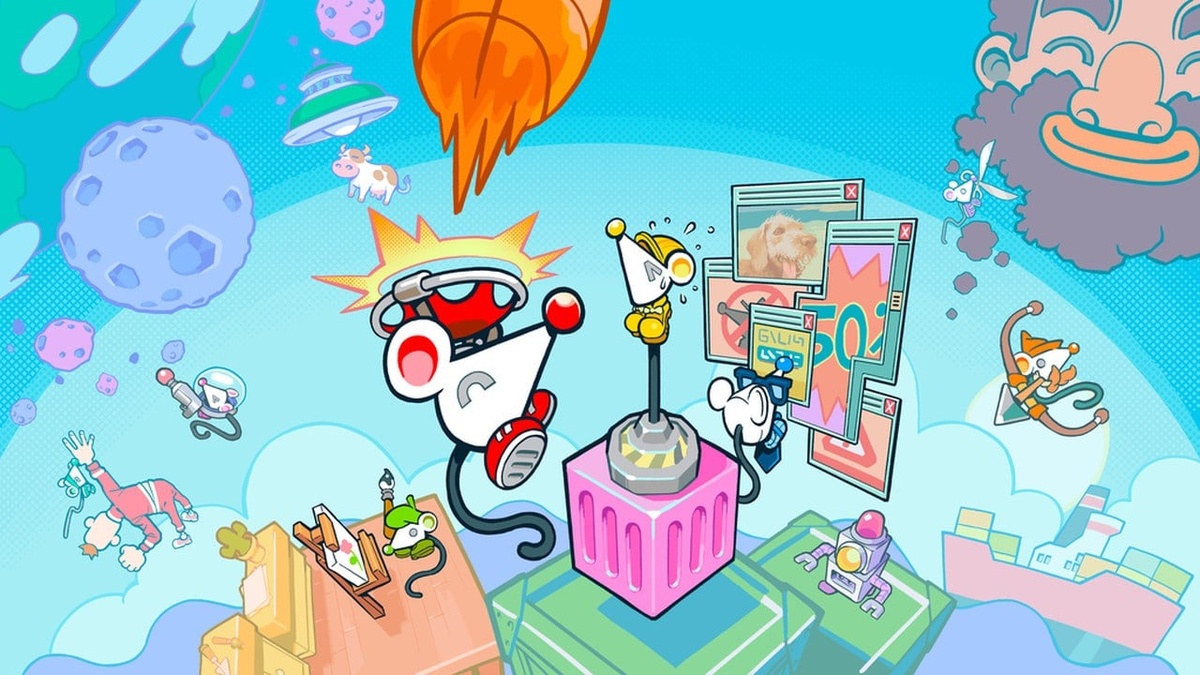
Following months of quiet anticipation across the handheld community, developer Nitrome has officially confirmed that Mouse Work Switch 2 will launch this holiday season, leveraging custom Joy-Con 2 optical tracking to introduce tactile desktop gaming mechanics.
According to a newly surfaced retail listing on the Japanese Nintendo eShop reported by Nintendo Life, the creative puzzle title debuts globally this December with expansive cooperative features and deep single-player campaigns.
| Feature Specification | Original Switch Ecosystem | Mouse Work Switch 2 Implementation | Architectural Advancement |
|---|---|---|---|
| Primary Input Mechanism | Analog Thumbsticks & Gyro | Optical Desktop Mouse Sensor | Sub-millimeter cursor tracking fidelity |
| Target Campaign Duration | Short Casual Minigames (3-4 Hrs) | Comprehensive 10+ Hour Campaign | Over 50 discrete physics-based jobs |
| Multiplayer Architecture | Split Joy-Con Local Only | Local, Online & GameShare Support | Zero-cost cooperative guest matchmaking |
| Target Framerate & Latency | 30 to 60 FPS Variable | Locked 60 FPS Low-Latency Polling | High-frequency controller RF throughput |
| Digital eShop Pricing | Premium First-Party ($49.99+) | 2,200 Yen (~$14.00 – $14.99 USD) | Accessible budget launch-window pricing |
Table of Contents
1. Joy-Con 2 Optical Mouse Hardware: Tactile Precision & Desktop Tracking
The foundational design pillar powering Mouse Work Switch 2 is Nintendo’s redesigned Joy-Con 2 controller, which embeds downward-facing optical sensors capable of transforming any flat desktop into an instantaneous cursor tracking surface.
Unlike traditional analog joystick navigation that relies on velocity curves, optical tracking registers direct planar displacement, granting console players pixel-accurate pointing precision that rivals enthusiast personal computer mouse peripherals.
Similar to the precision engineering detailed in our Apple M4 Mac mini hardware architecture breakdown, minimizing hardware latency requires tightly coupling sensor polling loops directly to internal controller microcontrollers.
Nintendo achieves this responsiveness by sampling surface texture reflections at high kilohertz intervals, streaming low-noise coordinate packets directly over upgraded wireless transceivers into the system memory.
Within Mouse Work Switch 2, this tracking architecture allows players to glide controllers naturally across desks, completing delicate mechanical tasks without suffering from drift or spatial calibration fatigue during prolonged sessions.
This hardware fusion bridges casual living room accessibility with competitive control fidelity, establishing a fresh input paradigm that distinguishes Nintendo’s next-generation console from conventional gamepad configurations.
2. Nitrome Minigame Engineering: Mouse Work Switch 2 Puzzle Stages
British indie studio Nitrome brings decades of inventive design heritage to Mouse Work Switch 2, crafting over 50 bespoke stages that test spatial coordination through quirky industrial and domestic labor simulations.
Players encounter dynamic objectives ranging from surgical computer chip assembly and mechanical gear alignment to frantic burger flipping, each demanding deliberate mouse gestures and rapid reflex adjustments.
The game engine incorporates deterministic physics calculation models, ensuring lightweight objects react convincingly to cursor velocity, impact friction, and surface collisions across every interactive puzzle workspace.
As highlighted in broader developer analysis on Eurogamer, tactile mechanics reminiscent of Snipperclips thrive when intuitive physical interactions replace abstract button combinations.
By designing modular challenges tailored to varying skill levels, the title balances approachable family party entertainment with stringent timing trials aimed at hardcore speedrunners and perfectionists.
Each level rewards inventive solutions and mechanical efficiency, encouraging users to experiment with alternative gripping postures and mouse sensitivity profiles to shave critical seconds off completion timers.
3. Campaign Scope & GameShare: 10-Hour Co-Op & Multiplayer Mechanics
While many hardware-centric showcases settle for brief tech demonstrations, Mouse Work Switch 2 delivers a substantive ten-hour single-player campaign packed with progressive difficulty curves and unlockable modifier modes.
Beyond solo employment adventures, the title emphasizes cooperative synergy, allowing two players to divide complex multi-part tasks on shared screens using dual independent optical pointer feeds.
Much like the distributed ecosystem workflows explored in our Xbox Cloud Gaming architecture and streaming analysis, modern multiplayer experiences demand flexible connectivity options across diverse household play styles.
Crucially, the package integrates Nintendo’s upcoming GameShare framework, enabling host consoles to stream full cooperative gameplay data directly to nearby secondary systems without requiring duplicate digital cartridge purchases.
Online leaderboards and timed challenge circuits round out Mouse Work Switch 2, motivating community competition through daily rotating puzzle routines that track global cursor accuracy and task completion speed.
This generous content offering ensures that the software provides lasting entertainment value well beyond its initial novelty as an optical hardware demonstration.
4. Technical Specifications & Performance: Generational Hardware Faceoff
Delivering consistent input responsiveness in Mouse Work Switch 2 mandates rigorous performance budgets, requiring the custom Nvidia Tegra silicon inside Nintendo’s hybrid console to lock internal frame times cleanly.
The title renders natively at 1080p in handheld mode and scales smoothly up to 4K on docked displays, maintaining an unwavering 60 frames per second cadence essential for optical cursor precision.
Much like the high-frequency execution bottlenecks analyzed in our AMD Ryzen 7 9800X3D gaming processor architecture, inconsistent framerates destroy pointing accuracy by introducing perceptible input stutter.
| Hardware & Performance Metric | Original Joy-Con (Switch 1) | Joy-Con 2 Optical Profile | Mouse Work Switch 2 Target | Player Experience Advantage |
|---|---|---|---|---|
| Tracking Technology | 6-Axis Gyroscope / Accel | Optical CMOS Surface Sensor | Sub-Pixel Coordinate Engine | True zero-drift desktop pointing |
| Polling Rate & Latency | 100 Hz / ~16ms Latency | 250 Hz Low-Latency Protocol | Synchronized 60 FPS Loop | Immediate tactile visual response |
| Display Output Resolution | 720p Mobile / 1080p Docked | 1080p Native / 4K DLSS Output | Dynamic 1080p – 4K Scaled | Crisp vector art on modern displays |
| Campaign Content Scale | Typical Indie Minigames (~2 Hrs) | Modular Expansion Framework | 10+ Hours (50+ Stages) | Extensive replayability & depth |
| Co-Op Connectivity Mode | Local Bluetooth Tethering | Ad-Hoc Wireless & GameShare | Dual-Cursor Simultaneous Co-Op | Frictionless shared party gameplay |
By offloading optical sensor filtering directly onto dedicated controller co-processors, the software minimizes host CPU overhead, leaving ample computational headroom for fluid particle effects and dynamic cloth physics.
As older operating system frameworks phase out in articles like our Nvidia legacy driver support breakdown, modern custom microkernels enable tighter hardware synchronization between input peripherals and render buffers.
The resultant low-latency control loop makes Mouse Work Switch 2 feel remarkably natural, transforming desk surfaces into seamless interactive extensions of the television screen.
5. Pricing Analysis & eShop Rollout: Japanese Launch & Global Window
The recent discovery on the Japanese Nintendo eShop confirms that Mouse Work Switch 2 carries an attractive launch price of 2,200 yen, equating to approximately $14.00 to $14.99 in Western territories.
This budget-friendly pricing strategy positions the title as an essential launch-window impulse purchase for early console adopters seeking software that immediately demonstrates their system’s unique optical capabilities.
Nitrome’s established reputation for premium indie quality—proven through hits like Bomb Chicken and Shovel Knight Dig—lends immense commercial credibility to this creative budget release.
Retail listings confirm an official Japanese launch date of December 7, 2026, landing squarely in the heart of the holiday retail shopping corridor.
While Nintendo has yet to publish localized North American and European product pages, worldwide digital parity is widely expected to accompany the Japanese debut of Mouse Work Switch 2.
Early adopters will therefore gain immediate access to one of the most innovative and mechanically distinctive puzzle titles of this hardware generation.
Frequently Asked Questions
What is the official release date for Mouse Work Switch 2?
According to verified listings on the Japanese Nintendo eShop, Mouse Work Switch 2 officially launches on December 7, 2026, strategically positioned for the upcoming holiday shopping corridor.
How do the optical mouse controls work in this title?
The game uses downward-facing optical sensors built into the base of the Joy-Con 2 controllers, allowing players to slide them across flat surfaces like standard computer mice.
How much content is included in Mouse Work Switch 2?
The full retail release includes an expansive single-player campaign spanning over 10 hours of gameplay across more than 50 unique physics-based job puzzles and challenge stages.
Does this release support multiplayer and GameShare?
Yes, the title features both local and online multiplayer modes, along with complete GameShare functionality that allows two players to cooperate using only a single purchased digital copy.
How much does the game cost on the Nintendo eShop?
The Japanese eShop listing confirms a retail launch price of 2,200 yen, which translates to roughly $14.00 to $14.99 USD across major international storefronts upon global availability.
Final Verdict: The Definitive Joy-Con 2 Hardware Showcase
With its charming pixel aesthetic and innovative control architecture, Mouse Work Switch 2 serves as both a joyful celebration of indie creativity and an indispensable hardware showcase for Nintendo’s next-generation console.
Nitrome has successfully transformed what could have been a gimmick into a deep, tactile puzzle adventure with substantial single-player longevity and delightful cooperative dynamics.
Priced accessibly and scheduled for launch on December 7, 2026, Mouse Work Switch 2 stands out as an essential day-one digital acquisition for every household looking to experience true optical gaming.
