


Table of Contents
The newly unveiled Kodak SlideTag Tracker brings a creative twist to the personal item tracking landscape, combining a six-color electrophoretic photo display with native Apple Find My and Google Find Hub integration for thirty-five dollars.
According to reporting by MacRumors, licensee Reto engineered the pocketable beacon to mimic vintage 1935 Kodachrome slide mounts, delivering custom photographic personalization alongside reliable crowd-sourced Bluetooth item location.
| Hardware Specification | Kodak SlideTag Tracker | Standard Bluetooth Puck | Consumer Advantage |
|---|---|---|---|
| Display Technology | 1.54-inch 6-color E-Ink (240×240) | No display screen | Zero-power photo and custom QR code rendering |
| Supported Networks | Apple Find My & Google Find Hub | Single-platform proprietary lock-in | Cross-platform household and family compatibility |
| Acoustic Locator | Integrated 75dB speaker at 10cm | Generic 60-70dB beeper | Loud high-frequency audio alerts through bags |
| Physical Mount | Molded Kodachrome frame keyring loop | Requires optional keychain case | Direct attachment without buying extra accessories |
| Dust & Water Rating | IP54 splash and dust resistant | IP67 water submersion certified | Daily splash proofing with retro mechanical styling |
| Battery Chemistry | Replaceable CR2032 lithium coin cell | Non-replaceable or CR2032 cell | 12-month longevity with simple user replacement |
Why the Kodak SlideTag Tracker Challenges Standard Item Finders
The global consumer market for Bluetooth tracking tags has remained visually homogeneous for years, dominated by featureless white plastic discs and uniform key fobs that prioritize utilitarian recovery over personal expression.
By establishing the Kodak SlideTag Tracker, Kodak licensee Reto reimagines how everyday utility accessories communicate with their owners, transforming an otherwise invisible security device into a dynamic digital canvas.
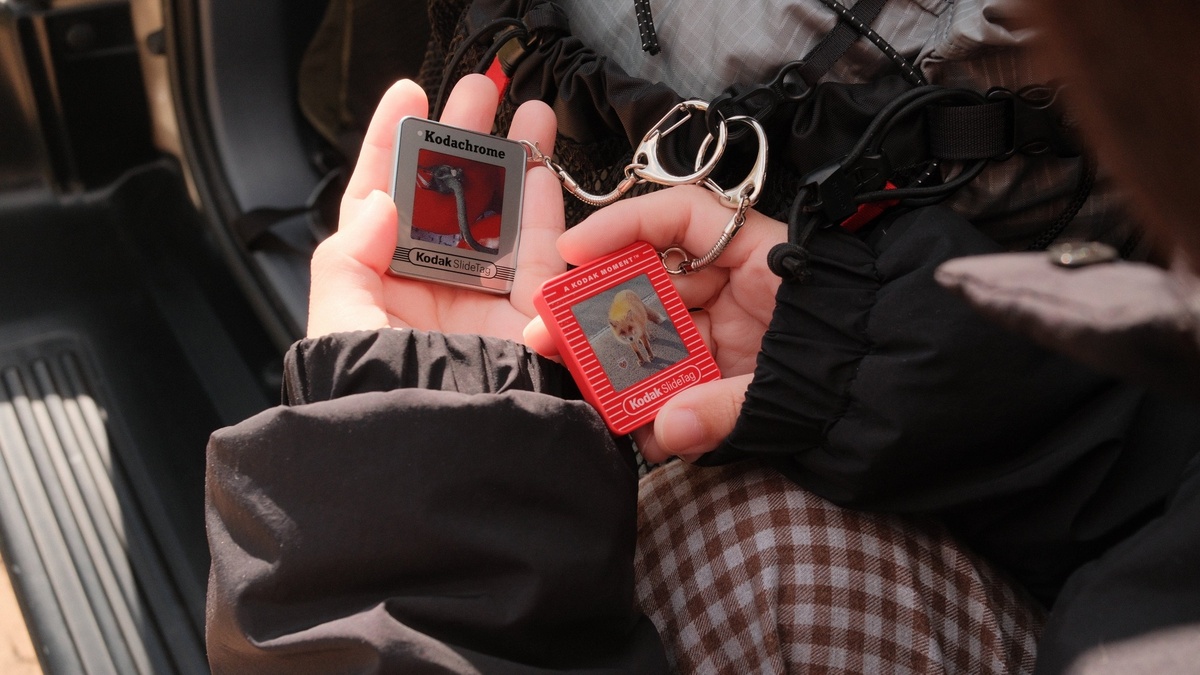
Unlike traditional trackers that hide inside luggage pockets or key organizers, this retro Kodachrome frame encourages users to clip the beacon visibly onto backpacks, cameras, and keyrings as a distinctive lifestyle statement.
The device balances nostalgic aesthetic appeal with contemporary wireless locating standards, ensuring consumers do not sacrifice tracking efficacy or search range while displaying favorite travel memories or personal artwork.
Understanding the mechanical nuances of the retro photo beacon helps consumers evaluate whether its visual versatility outweighs the specialized ultra-wideband directional navigation offered by first-party competitors.
As connected accessories continue converging across modern digital lifestyle ecosystems, combining functional item discovery with customizable electronic ink visuals represents a refreshing divergence from standard tech industry conventions.
Six-Color Electrophoretic Display Architecture and Memory Link Workflow
At the heart of the accessory sits a 1.54-inch square electrophoretic display outputting a sharp resolution of 240 by 240 pixels across an array of six distinct color pigments.
Electronic ink technology functions through micro-encapsulated electrophoretic particles that physically rearrange when stimulated by small electric pulses, creating a stable image that reflects ambient light just like physical paper.
Because bistable displays require zero continuous electrical current to maintain an image once refreshed, the screen retains your chosen photograph indefinitely without draining the internal coin cell battery.
Users manage custom visuals through the dedicated Kodak Memory Link companion application on iOS or Android, pairing directly over modern Bluetooth 5.4 wireless radios for seamless photographic synchronization.
The internal memory storage on the hybrid tracking puck holds up to twelve distinct image files, allowing owners to configure automated slideshow cycles or display static contact details.
Beyond personal family portraits, travelers can render scannable QR codes containing emergency return instructions, travel flight numbers, medical alerts, or daily task checklists on the exterior display.
Dual Apple Find My and Google Find Hub Network Architecture
Beyond its vintage exterior styling, the tracking hardware operates on encrypted crowd-sourced finding infrastructure, bridging two historically segmented mobile operating system ecosystems into a single consumer product.
When configured for iOS users, the beacon pairs natively with the Apple Find My network, leveraging hundreds of millions of worldwide Apple devices to broadcast anonymous encrypted telemetry pings.
Android owners enjoy equal utility through certified Google Find Hub integration, ensuring that misplaced luggage or backpacks remain discoverable through nearby Android devices participating in Google’s sprawling mesh network.
Operating across both major platforms gives the versatile lifestyle beacon an immediate competitive edge over proprietary single-platform trackers that force mixed-device households into buying redundant accessories.
Privacy protections adhere to modern anti-stalking specifications established jointly by Apple and Google, delivering unwanted tracking alerts to nearby smartphones if an unrecognized beacon travels with an individual.
This dual-ecosystem versatility ensures that moving between different smartphone platforms never renders your hardware investment obsolete, preserving complete long-term utility across hardware upgrades.
Kodak SlideTag Tracker Versus Apple AirTag Hardware Matrix
Directly comparing the Kodak SlideTag Tracker against industry incumbents highlights critical architectural trade-offs between visual customization, wireless tracking precision, water resistance ratings, and out-of-the-box accessory costs.
Apple AirTag remains the gold standard for close-range item discovery thanks to its proprietary U1 ultra-wideband chip, which guides users with directional arrows and centimeter-accurate distance readouts on compatible iPhones.
| Device Model | Tracking Networks | Screen Hardware | Directional Precision | Waterproofing | Retail Price |
|---|---|---|---|---|---|
| Kodak SlideTag Tracker | Apple Find My + Google Find Hub | 1.54-inch 6-Color E-Ink | 75dB Buzzer (No UWB) | IP54 Splash Resistant | $34.99 |
| Apple AirTag | Apple Find My Network | None | U1 Ultra Wideband (UWB) | IP67 Submersion (1m) | $29.00 |
| Chipolo ONE Point | Google Find My Device | None | 120dB Acoustic Ring | IPX5 Splash Resistant | $28.00 |
| Samsung Galaxy SmartTag2 | Samsung SmartThings Find | None | UWB + Compass Guidance | IP67 Submersion (1m) | $29.99 |
| Tile Pro (2024 Edition) | Tile Network & Life360 | None | Long-Range Bluetooth Buzzer | IP68 Waterproof | $34.99 |
In contrast, the compact Kodak model foregoes ultra-wideband silicon in favor of a standard Bluetooth 5.4 radio, relying on a 75-decibel acoustic buzzer to guide nearby searchers during final proximity recovery.
Much like how users evaluate specialized processors like the AMD Ryzen 7 9800X3D gaming CPU for raw compute power, choosing an item tracker requires assessing specific environmental demands.
AirTag requires third-party leather loops or plastic keychains that easily double total purchase costs, whereas the Kodak SlideTag Tracker incorporates an integrated lanyard eyelet directly inside its retro frame.
Buyers prioritizing aesthetic charm and multi-platform accessibility will appreciate the Kodak design, while outdoor adventurers needing extreme water immersion resistance may favor Apple’s sealed puck architecture.
Physical Engineering, Dust Resistance, and Acoustic Buzzer Performance
The physical chassis measures 39.3 millimeters wide by 46 millimeters tall with a slim 7.58-millimeter profile, weighing approximately 16.6 grams including the installed coin cell battery.
By comparison, Apple’s tracker measures 31.9 millimeters across and 8.0 millimeters thick at 11.8 grams, making the Kodak model slightly larger in footprint but marginally thinner overall.
Constructed from durable polycarbonate and polymethyl methacrylate thermoplastics, the housing achieves an IP54 certification, providing certified resistance against airborne dust infiltration and light rainwater splashes.
While IP54 handles outdoor rain showers and gym bag moisture effortlessly, users should note it lacks the IP67 submersion rating required for underwater recovery in deep pools or lakes.
To assist close-range discovery, the innovative pocket beacon embeds an audible 75-decibel buzzer tuned to produce distinct high-frequency audio chirps audible from ten centimeters through dense fabric layers.
This acoustic chime ensures that misplaced keys hidden between couch cushions or buried inside gym duffels can be located quickly without needing precision ultra-wideband directional guidance arrows.
Kodachrome Slide Heritage, Blind Box Mechanics, and Collectibility
The aesthetic foundation of the casing pays direct tribute to the legendary 1935 Kodachrome 35mm slide mount, which revolutionized twentieth-century color photography with archival stability.
Reto channels this rich photographic heritage by packaging the tracker as a collectible blind box, delivering eight distinct retro chassis finishes alongside an ultra-rare secret edition variant.
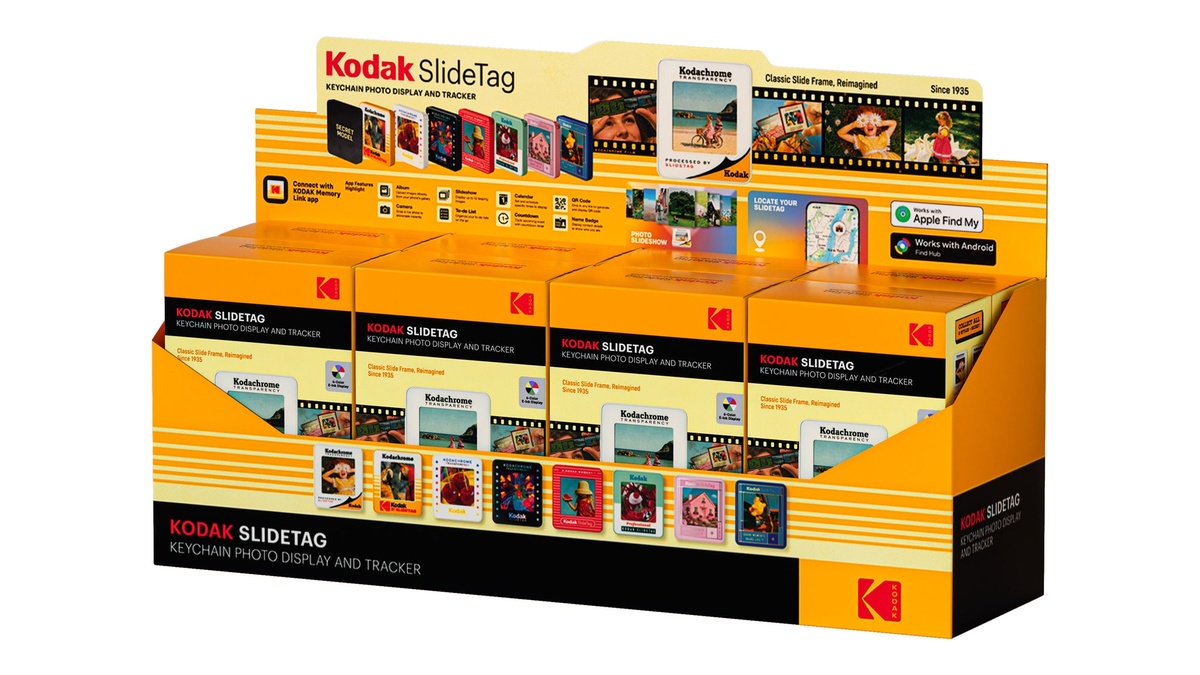
The secret edition features a one-in-sixty-four chance of appearance, creating genuine collector excitement reminiscent of vintage trading cards and limited-edition designer vinyl art toys.
Much like modern hardware redesigns exemplified by the compact Apple M4 Mac Mini redesign, creative industrial packaging transforms functional consumer tech into desirable shelf display objects.
Available directly from Reto’s official store, each package includes a collectible poster, a retro slide frame, and an authentic film strip accessory.
This clever convergence of nostalgia and functionality ensures the Kodak SlideTag Tracker appeals equally to retro camera collectors, street photographers, and mainstream tech consumers looking for unique accessories.
Battery Longevity and Kodak SlideTag Tracker Practical Usability
Powering both the smart tracking beacon and the electronic ink screen is a user-replaceable CR2032 three-volt lithium coin cell battery, readily available at grocery and convenience stores.
Because the electrophoretic screen only consumes electrical current during active image updates, regular Bluetooth beacon broadcasts and occasional buzzer activations dictate overall annual battery longevity.
Under standard everyday conditions with infrequent photo swaps, the personal tracking device delivers roughly twelve months of continuous tracking performance before requiring a standard coin cell replacement.
Replacing the depleted coin battery requires sliding open the secure rear battery compartment, avoiding the planned obsolescence and glued enclosures seen in rechargeable disposable smart accessories.
Integrating the Kodak SlideTag Tracker into daily routines provides peace of mind, pairing visual luggage identification on airport baggage carousels with reliable global crowdsourced location tracking telemetry.
With an accessible retail price point of thirty-five dollars, this hybrid device successfully merges nostalgic analog photography soul with modern digital security convenience for everyday carry.
Frequently Asked Questions
How does the Kodak SlideTag Tracker display photos without running out of battery?
The Kodak SlideTag Tracker utilizes a bistable 6-color E-Ink screen that only draws battery power when changing images. Once loaded, the photo remains clearly visible permanently without consuming any continuous electrical current.
Does the Kodak SlideTag Tracker work on both iPhone and Android devices?
Yes, the Kodak SlideTag Tracker supports both Apple Find My and Google Find Hub networks. Furthermore, the Kodak Memory Link companion app is available for iOS and Android to manage photo transfers over Bluetooth.
Can the Kodak SlideTag Tracker survive water immersion like an Apple AirTag?
No, the Kodak SlideTag Tracker features an IP54 rating for dust and splash resistance rather than full submersion. While protected against rain and spills, it cannot survive immersion in water like Apple’s IP67 AirTag.
Does the Kodak SlideTag Tracker support precision directional arrow finding?
No, the Kodak SlideTag Tracker lacks Ultra Wideband technology, so it does not support precision arrow direction finding. Instead, users locate nearby items using its loud built-in 75-decibel buzzer and Bluetooth proximity indicators.
Can you choose a specific color design when ordering the Kodak SlideTag?
Reto sells the Kodak SlideTag Tracker primarily as a collectible blind box with eight random vintage Kodachrome designs and one rare secret edition. Complete box sets containing all eight standard editions are also available.
Final Verdict
The Kodak SlideTag Tracker succeeds by challenging the sterile aesthetic of modern item trackers, marrying beloved Kodachrome slide history with responsive crowd-sourced location networks.
While it forfeits ultra-wideband directional tracking and deep water submersion protection, its zero-power color photo screen, integrated keyring hole, and dual-ecosystem support offer compelling everyday utility.
For photography lovers and design-conscious travelers seeking personality alongside reliable asset protection, the nostalgic photo beacon delivers outstanding nostalgic value at thirty-five dollars.
