



Table of Contents
Groundbreaking technical details behind GTA 6 Item Animations have surfaced, revealing that Rockstar Games engineered three distinct animation variations for every individual object interaction to support seamless dual-handed character mobility and prevent unnatural skeletal clipping.
Disclosed by gameplay animation director Mike Jones on Bluesky and reported by IGN, this intricate design ensures character rigs dynamically resolve complex physical scenarios throughout the simulated open-world streets and interiors of Vice City.
| Technical Parameter | Grand Theft Auto V (2013) | Red Dead Redemption 2 (2018) | Grand Theft Auto VI (2026) | Architectural Impact |
|---|---|---|---|---|
| Multi-Hand Carrying Support | Single-item locked rig | Contextual dual-wielding | Fully independent dual-hand rig | Eliminates item dropping or forced resets |
| Interaction Animation Branches | 1 universal static animation | 1-2 physics-blended variations | 3 dedicated interaction variations | Perfect state machine resolution |
| Kinematic Hand Permutations | Right hand dominant | Limited two-handed hold | Hands-free, right-free, left-free | Handles arbitrary simultaneous pickups |
| Door & Barrier Navigation | Hard-stop physical bump | Heavy physics body push | Contextual hip nudges & back turns | Fluid momentum preservation |
| Crouched Interaction Handling | Standard crouch reset | Manual posture align | Replicated 3-tier crouching rigs | Seamless stealth and low-cover looting |
| Engine Blending Pipeline | Basic RAGE blending | Euphoria physics priority | Next-gen RAGE kinematic solvers | Zero clipping across high-speed gameplay |
Dual-Wield Rigging: How GTA 6 Item Animations Overcome Hand Conflicts
In conventional third-person open-world engines, character interaction logic relies heavily on rigid single-hand dominance, forcing protagonists to abruptly stow equipped handheld equipment before executing context-sensitive world actions like reaching for doorknobs or grabbing small objects.
According to Mike Jones, Rockstar animation engineers refused to compromise player immersion with jarring snap transitions, choosing instead to design dedicated multi-track animation graphs that accommodate dual-handed inventory states across every interactive environmental prop.
During hectic robbery sequences or casual convenience store visits, characters frequently hold bags, beverage cans, or firearms, demanding that the underlying simulation framework resolves physical hand availability without resetting upper-body bone hierarchies or interrupting momentum.
Jones acknowledged that establishing three complete animation branches per interactable prop proved to be a massive technical headache during development, yet the rigorous engineering investment dramatically streamlined systemic game logic across emergent open-world gameplay loops.
This uncompromising dedication to computational detail mirrors high-throughput architecture observed across modern hardware, such as the AMD Ryzen 7 9800X3D, where dedicated silicon execution caches eliminate execution pipeline bottlenecks during intensive multi-threaded workloads.
Independent Kinematic States: Left and Right Arm Motion Architectures
The core architectural breakthrough underpinning this interaction model divides character upper-body kinematics into three distinct operational states: both hands completely unencumbered, only the right hand free, or exclusively the left hand available for environmental engagement.
By partitioning kinematic state machines along individual clavicle nodes, GTA 6 Item Animations dynamically evaluate which arm can reach toward target coordinates without forcing unnatural torso contortions or interrupting ongoing lower-body locomotion cycles.

If Lucia carries a smartphone in her left hand, the game engine automatically selects the right-handed branch, allowing her to pick up evidence, open cash drawers, or manipulate vehicle latches with complete physiological fidelity.
Conversely, when Jason wields a sidearm in his dominant right hand, the interaction state machine smoothly routes pickup requests through left-arm inverse kinematic solvers, preserving steady aim while gathering essential heist tools across active hostile environments.
This decoupled arm architecture prevents skeletal pop artifacts common in legacy sandbox titles, delivering fluid motion transitions that blur the boundary between pre-rendered cutscenes and responsive gameplay control across complex mission parameters.
Environmental Micro-Interactions: Hip Door Pushing and Momentum Preservation
Beyond simple pickup mechanics, Rockstar animation architects extended this multi-tiered logic to environmental navigation, creating complex contextual animations when characters encounter physical barriers while carrying items in both hands simultaneously.
Jones highlighted a prime studio example where Lucia approaches a swinging commercial doorway while holding drinks and food, prompting her character model to turn her back and push the barrier open using her hip effortlessly.
Developing such granular micro-interactions required months of cross-disciplinary iteration between physics programmers, technical riggers, and environmental artists, ensuring that dynamic door masses react realistically to character body surfaces during high-speed traversal through Vice City.
Crucially, these micro-interactions preserve player traversal momentum rather than halting movement, allowing players to navigate complex interior spaces without experiencing frustrating physical delays or awkward character stumbling across cluttered room thresholds and crowded storefronts.
This fluid movement philosophy establishes an engaging rhythmic balance, ensuring Vice City feels delightfully tactile while maintaining the rapid, player-centric pacing expected from next-generation sandbox titles in demanding competitive industry benchmarks.
Generational Comparison Matrix: GTA 6 Item Animations Versus Earlier Engines
Examining Rockstar’s proprietary character interaction systems alongside previous studio blockbusters illustrates a profound technological evolution in skeletal bone blending and physics simulation over the past two decades of ambitious studio development.
While Grand Theft Auto V revolutionized cinematic cutscene transitions, its in-game interaction routines frequently forced characters into canned, single-handed postures that required strict planar alignment before triggering context-sensitive environmental scripts during exploration.
Red Dead Redemption 2 introduced breathtaking physical weight and tactile item handling, but its deliberate pace occasionally drew criticism from players seeking immediate control responsiveness during intensive gunfights and fast-moving combat encounters.
| Skeletal Parameter | Both Hands Free | Right Hand Free Only | Left Hand Free Only |
|---|---|---|---|
| Torso Rotation Angle | Neutral 0-degree frontal vector | 15-degree leftward torso bias | 15-degree rightward torso bias |
| Reach Trajectory Path | Optimal dual-vector path | Dedicated right-arm inverse kinematics | Dedicated left-arm inverse kinematics |
| Secondary Motion Damping | Balanced bilateral spring damping | Single-arm stabilizing damper | Single-arm stabilizing damper |
| Equipped Asset Collision | Standard hip holster offset | Left-hand held object shield | Right-hand held object shield |
| Locomotion Blend Weight | 50% upper-body decoupling | 65% independent arm override | 65% independent arm override |
With official production insights from Rockstar Games, the upcoming release successfully synthesizes RDR2 tactile immersion with blistering arcade responsiveness across massive modern urban environments and densely populated commercial zones.

The generational jump in memory bandwidth and compute throughput parallels hardware advances seen in compact consumer systems like the Apple M4 Mac Mini redesign, delivering desktop-class simulation capability in thermal-constrained profiles.
Crouch Handling and Dynamic Geometry Alignment Across Vice City
Skeletal complexity expands exponentially when factoring in low-profile postures, as crouching introduces steep clearance constraints that alter reaching trajectories and joint limits across the entire spinal column during tactical gameplay scenarios.
To ensure systemic consistency, technical animators duplicated the three-tier interaction paradigm across crouched states, calculating separate reaching trajectories for low-clearance obstacles, counter surfaces, and floor-level safes across dynamic interior layouts.
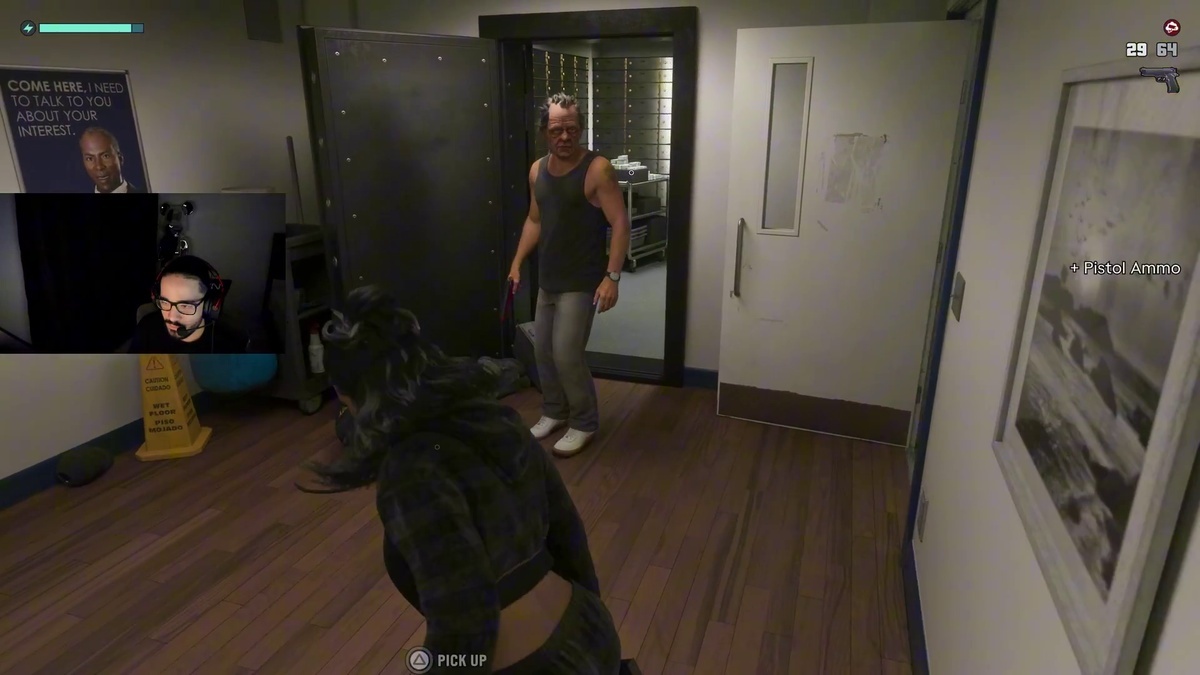
When a player crouches beneath a service counter during a heist, inverse kinematic probes scan surrounding collision surfaces to ensure reaching limbs do not penetrate solid geometry or displace lightweight items unnecessarily.
These specialized crouch variations ensure that stealth mechanics remain intuitive, empowering players to loot secure facilities without breaking cover or triggering erratic animation clipping against environment meshes during high-stakes tactical infiltrations across Vice City.
By maintaining rigorous kinematic checks across all player stances, Rockstar guarantees that mechanical execution feels dependable whether players engage in explosive open-air shootouts or quiet midnight burglaries throughout Vice City back alleys and commercial districts.
Dual-Protagonist Motion Capture: Jason and Lucia Skeletal Profiling
Implementing three separate interaction variants across the entire game world required unprecedented motion capture sessions, recording unique biomechanical mannerisms for dual protagonists Jason and Lucia across hundreds of diverse physical object categories during production.
Because each character possesses distinct physical dimensions, shoulder widths, and center-of-gravity profiles, animators could not simply share identical skeletal rigs across both playable protagonists without causing noticeable hand offset errors.
Lucia exhibits agile, centered kinetic movement with rapid hand adjustments, whereas Jason features broader shoulder kinematics and a slightly heavier reach posture that reflects his distinct physical stature and combat background.
Recording bespoke variations for each character ensured that picking up a small duffel bag or drawing a concealed weapon feels authentically tailored to their individual athletic capabilities and distinctive gait styles during intense gameplay.
This exhaustive performance capture methodology reinforces narrative immersion, ensuring that character personalities shine through even the most mundane functional interactions across Vice City convenience stores, clubhouses, and luxury marina penthouses during extended exploration.
Memory Overhead and RAGE Engine Streaming Optimization
Tripling the total volume of character animation clips per interactable object introduces significant runtime memory overhead that demands sophisticated streaming architecture within the proprietary Rockstar Advanced Game Engine infrastructure across current consoles.
To manage this massive asset library without saturating unified console RAM, the engine leverages predictive animation decompression pipelines that stream contextually relevant motion data based on character proximity and camera angles.
As the gaming sector transitions away from legacy software ecosystems, as highlighted by Nvidia ending Windows 10 support, modern console storage architectures allow instantaneous asset streaming directly into GPU memory buffers.
High-bandwidth internal solid-state drives on ninth-generation hardware, combined with scalable cloud infrastructure like Xbox Cloud Gaming pay-as-you-go pricing, provide the throughput necessary to sustain uncompressed animation fidelity without dropped frames.
By decoupling interaction asset loading from core render cycles, the RAGE engine preserves rock-solid sixty frames per second frame pacing without compromising the density or mechanical diversity of environmental interactions across vast metropolitan districts.
Frequently Asked Questions
Why did Rockstar create three separate animations for each item interaction in GTA 6?
Rockstar developed three distinct interaction branches to seamlessly support dual-handed carrying states, ensuring characters interact with objects naturally whether both hands are free, or either the left or right hand is occupied.
Who revealed the new GTA 6 item interaction animation system?
Rockstar Games gameplay animation director Mike Jones revealed the technical details on Bluesky, describing the creation of three separate interaction branches as a massive technical pain that ultimately perfected systemic gameplay logic.
How does GTA 6 handle opening doors when a character holds items in both hands?
When a protagonist carries items in both hands, such as food and drinks, the animation system triggers a contextual micro-interaction where the character turns their back and uses their hip to push the door open.
Are these three item interaction variations also applied while crouching?
Yes, Mike Jones confirmed that the animation team replicated the three-tiered interaction logic across crouching stances, ensuring precise collision detection and natural reaching motions during stealth and low-cover scenarios throughout Vice City.
How do these new interaction mechanics compare to Red Dead Redemption 2?
While Red Dead Redemption 2 emphasized heavy physical inertia and deliberate animations, Grand Theft Auto 6 combines realistic physical weight with responsive traversal speed, preserving player momentum during fast-paced urban exploration.
Final Architectural Verdict: Rockstar Animation Innovation
Rockstar Games bold decision to triple animation assets across every interactive item underscores an unprecedented standard for physical immersion, establishing a technological milestone that will influence open-world design for the next decade.
By solving complex dual-wielding hand conflicts through decoupled kinematic state machines, the studio eliminates immersion-breaking animation glitches while delivering the rapid controller responsiveness essential for modern urban action gameplay.
As Vice City prepares to welcome players worldwide, these sophisticated animation pipelines demonstrate how generational hardware power can transform subtle environmental micro-interactions into the cornerstone of emergent virtual realism.
