


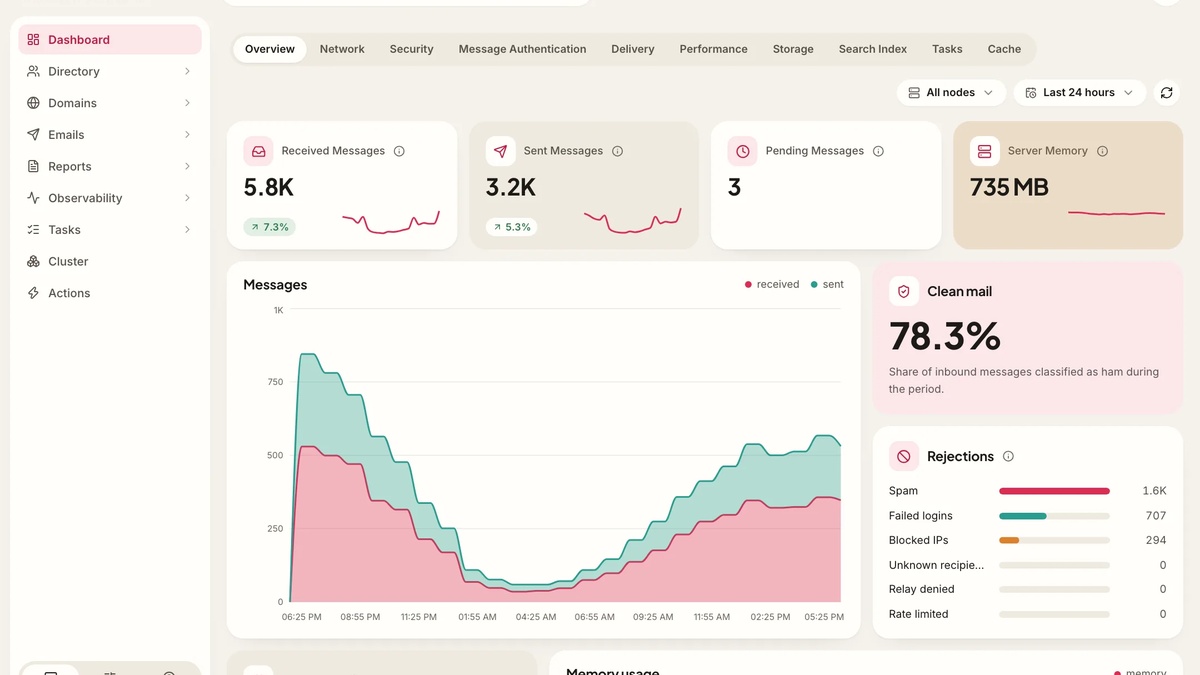
Table of Contents
Following a turbulent cycle of widespread cloud outages across Microsoft 365, the Stalwart Mail Server has emerged as an open-source breakthrough engineered to provide an authentic, drop-in replacement for legacy Microsoft Exchange infrastructure.
According to in-depth reporting by Neowin and engineering documentation from Stalwart Labs, the platform implements native MAPI over HTTP, Exchange Web Services, and ActiveSync synchronization without requiring corporate employees to surrender Microsoft Outlook.
| Feature Specification | Stalwart Mail Server | Microsoft Exchange 2019 / SE | Traditional Linux (Mailcow / Postfix) |
|---|---|---|---|
| Core Implementation Language | 100% Modern Safe Rust | C++ / C# / .NET Framework | C / Perl / Python / PHP WebUI |
| Outlook Windows Support | Native MAPI over HTTP (EMSMDB / NSPI) | Native MAPI over HTTP / RPC | IMAP / ActiveSync (Requires Add-ons) |
| macOS Client Support | Native Exchange Web Services (EWS) | Native Exchange Web Services (EWS) | IMAP / CalDAV / CardDAV |
| Mobile Sync Protocols | ActiveSync (EAS 14.1 & 16.1) | ActiveSync (EAS 14.x & 16.x) | IMAP IDLE / CalDAV / SOGo Bridge |
| Memory Usage at Idle | ~100 MB RAM (Single Process) | 8 GB to 32 GB RAM Minimum | 2 GB to 4 GB RAM (10+ Containers) |
| Licensing & Seat Costs | Open Source (AGPL-3.0 Community) | Expensive Server + CAL Licenses | Open Source (GPL / Apache 2.0) |
| Storage Backend Modularity | RocksDB, SQLite, PostgreSQL, S3 | Proprietary ESE (Extensible Storage) | MySQL / MariaDB / Dovecot Maildir |
Microsoft Exchange Outages Prompt Demand for On-Premises Control
Enterprise communications directors have faced an unusually turbulent operating environment throughout 2026, highlighted by recurrent Microsoft 365 service disruptions that paralyzed mission-critical workflows, encrypted message routing, and corporate legal compliance across international organizations.
These cascading downtime episodes have reignited fierce debates across IT leadership regarding cloud concentration risk, prompting system architects to re-examine sovereign on-premises email infrastructure that provides deterministic local network routing and autonomous disaster recovery.
Historically, corporate attempts to replace Microsoft Exchange with traditional open-source email suites collapsed under intense employee backlash, because conventional Linux platforms restricted desktop workstations to generic IMAP, POP3, and CalDAV communication channels.
Enterprise workforces accustomed to native Microsoft Outlook productivity features—such as shared calendars, centralized room scheduling, granular mailbox delegations, and server-side rules—consistently rejected webmail portals or cumbersome third-party synchronization plugins.
With legacy versions like Exchange Server 2016 and 2019 facing imminent end-of-support deadlines alongside industry-wide shifts like operating system transitions, IT departments face massive price increases and aggressive corporate pushes into proprietary cloud subscriptions.
This escalating infrastructure dilemma created urgent market demand for a modern self-hosted collaboration server capable of natively communicating with Microsoft Outlook while granting enterprises total sovereignty over their sensitive communication archives.
How Stalwart Mail Server Implements MAPI Over HTTP for Windows Outlook
The pivotal technical breakthrough that elevates Stalwart Mail Server above legacy open-source alternatives is its clean-room implementation of MAPI over HTTP, the proprietary transport protocol modern Microsoft Outlook clients utilize to communicate.
By faithfully reconstructing the EMSMDB and NSPI wire protocol specifications, Stalwart Mail Server enables classic Outlook 2016, 2019, 2021, and Microsoft 365 Apps on Windows to connect seamlessly in both cached and online synchronization modes.
Corporate desktop users maintain complete access to corporate global address lists, offline address book downloads, custom folder hierarchies, and instantaneous push notifications without realizing the backend Exchange server was swapped.
Furthermore, the open-source platform processes complex server-side rules, junk mail categorization, read receipts, and out-of-office automated replies directly within its concurrent server runtime, ensuring consistent behavior across all connected desktop clients.
Because the platform implements native Microsoft protocols at the transport layer, Windows workstations require zero third-party software connectors, proprietary bridge daemons, or security policy workarounds to achieve perfect Outlook interoperability.
System administrators can provision new mailboxes effortlessly, confident that staff can launch Outlook, complete automated profile configuration, and resume daily correspondence without experiencing disruptive workflow interruptions or desktop reconfiguration delays.
Exchange Web Services and ActiveSync Multi-Device Synchronization
Enterprise communications inevitably span diverse hardware fleets, demanding robust protocol synchronization across Apple macOS workstations, corporate laptops, mobile smartphones, and external executive tablet devices.
To address heterogeneous corporate hardware, including high-performance Apple Silicon workstations, Stalwart Mail Server incorporates native Exchange Web Services support, delivering fluid synchronization for Outlook for Mac and default Apple Mail applications.
The built-in EWS engine supports configurable schema versions spanning Exchange 2010 SP2 through Exchange 2016, providing flawless backward compatibility with specialized third-party enterprise tools, calendar booking software, and corporate archiving appliances.
For enterprise smartphone fleets running iOS and Android, Stalwart Mail Server incorporates Exchange ActiveSync versions 14.1 and 16.1, delivering direct push email delivery, shared address books, and remote device management capabilities.
Mobile professionals receive real-time notifications for incoming correspondence and calendar adjustments through native operating system daemons, eliminating the excessive battery consumption typically caused by aggressive background IMAP polling cycles.
Through automated Autodiscover endpoints supporting POX, SOAP, and JSON formats, employees configure mobile devices by entering their email address and credentials, allowing the mail server to establish secure synchronization automatically.
Unified Rust Architecture: Zero Garbage Collection and High Concurrency
Legacy Linux email stacks have long suffered from architectural fragmentation, chaining together Postfix for SMTP routing, Dovecot for IMAP storage, SpamAssassin for filtering, and various PHP scripts inside bulky container deployments.
In stark contrast, Stalwart Mail Server is written completely from scratch in modern Rust, compiling into an integrated, memory-safe executable that runs without garbage collection pauses or runtime interpreter bloat.
By utilizing asynchronous runtime primitives and non-blocking socket handling, Stalwart Mail Server maintains an idle memory footprint of approximately 100 megabytes, scaling smoothly across thousands of concurrent client connections.
| Storage Backend Engine | Target Scale Profile | Throughput Latency | Clustering Coordination | Recommended Deployment Tier |
|---|---|---|---|---|
| Embedded RocksDB | Single-Node (1 to 5,000 Users) | Sub-millisecond Local NVMe | Stand-alone Process Host | SMBs & Branch Office Gateways |
| Distributed FoundationDB | Multi-Cluster (50,000+ Users) | Predictable < 2ms ACID Latency | Leaderless Multi-Region Quorum | Global Telecom & Financial Enterprises |
| PostgreSQL / MySQL | Medium Enterprise (5,000 to 25,000) | Low Latency Relational Access | External Read Replicas & Raft | Corporate IT & Government Agencies |
| S3 / Azure Object Store | Petabyte Message & Blob Archiving | Direct Streaming Object Storage | Cloud-Native Distributed Buckets | Compliance Archives & Hybrid Clouds |
The parsing engine leverages SIMD vector operations and SWAR algorithms on modern processors, matching performance demands on systems like high-frequency computing nodes to scan message headers and MIME boundaries at wire speed.
During comprehensive stress testing on standard server hardware, a single bare-metal server instance processed more than 3,000 incoming messages per second while conducting inline DKIM verification, cryptographic analysis, and spam scoring.
This unified systems architecture proves that memory-safe compiled software can dramatically outperform legacy C mail daemons, delivering unmatched computational throughput while eliminating exploitable buffer overflow security vulnerabilities entirely.
Stalwart Mail Server Enterprise Deployment and Pluggable Storage
Enterprise storage infrastructures vary widely based on regulatory compliance standards, data retention policies, and hardware budgets, necessitating a modular storage architecture rather than rigid proprietary database containers.
To satisfy these varied demands, the modular software decouples structured account metadata, raw message blobs, and full-text search indexes into completely independent, pluggable storage interfaces.
Small organizations and branch offices can deploy embedded RocksDB or SQLite engines, while large enterprises can utilize clustered PostgreSQL, MySQL, or distributed FoundationDB backends for fault-tolerant high availability.
Large email bodies and heavy file attachments stream directly into scalable S3-compatible object storage or Azure Blob repositories, drastically reducing storage costs while simplifying routine enterprise disaster recovery snapshots.
For multi-node enterprise deployments, the communication platform utilizes Stalwart Keep, a leaderless coordination engine employing a thread-per-core design that guarantees linear horizontal scalability without inter-thread locking bottlenecks.
IT staff manage global domains, encryption keys, and protocol settings through an intuitive web administration console or the modernized Stalwart CLI, streamlining daily administration and audit logging across the entire server fleet.
Migration Pathways: Transitioning From Legacy Microsoft Exchange
Migrating an entire enterprise messaging infrastructure requires deliberate execution to ensure zero email loss, continuous directory availability, and uncorrupted historical calendar and contact repositories.
Because Stalwart Mail Server maintains a unified data backend, proprietary Microsoft Exchange protocols operate natively alongside open industry standards including modern JMAP, IMAP, POP3, CalDAV, and CardDAV.
This unified storage model guarantees that calendar items created within Microsoft Outlook synchronize instantaneously with modern JMAP webmail interfaces and mobile CalDAV endpoints without generating data duplication or synchronization conflicts.
System administrators can implement phased departmental transitions, routing trial user groups through Stalwart Mail Server while monitoring Autodiscover redirection and MAPI connection stability before initiating full infrastructure cutovers.
The server integrates natively with corporate LDAP directories and Active Directory domains, allowing employees to authenticate using their existing single sign-on credentials without requiring disruptive password resets.
Comprehensive command-line migration utilities facilitate rapid ingestion of legacy PST archives and Exchange mailboxes, enabling corporate IT teams to modernize enterprise email without compromising historical communications records.
Open Source Licensing and Total Cost of Ownership Evaluation
The total cost of ownership for commercial email suites has skyrocketed as proprietary software vendors enforce costly per-user monthly subscriptions that inflate annual operational budgets.
In a welcome shift toward software accessibility, Stalwart Mail Server includes its complete Microsoft Exchange protocol implementation under the open-source AGPL-3.0 license directly inside the Community Edition.
Organizations can deploy, audit, and scale the software stack across thousands of corporate users without paying client access licenses, saving hundreds of thousands of dollars in annual software licensing expenses.
The fully transparent open-source codebase enables corporate security teams to perform comprehensive code reviews, ensuring enterprise communications remain free from proprietary tracking telemetry, hidden backdoors, or forced vendor lock-in.
For enterprise deployments requiring guaranteed response times and dedicated implementation support, commercial service tiers and architectural consulting are available directly from the engineering team at Stalwart Labs.
This sustainable commercial open-source model provides businesses with the ideal combination of community-driven digital sovereignty and professional enterprise backing for critical collaboration infrastructure.
Frequently Asked Questions
Can Microsoft Outlook connect directly to Stalwart Mail Server without plugins?
Yes, classic Microsoft Outlook on Windows connects directly to Stalwart Mail Server using native MAPI over HTTP. Users enjoy full email, calendar, and address book functionality without installing third-party software connectors, bridge daemons, or specialized plugins.
Which mobile platforms support native Stalwart Mail Server synchronization?
Both Apple iOS and Google Android support native synchronization with Stalwart Mail Server through built-in Exchange ActiveSync protocols. Mobile devices receive instant push notifications, shared calendar updates, and global address directory searches seamlessly.
How does Stalwart Mail Server resource consumption compare to Exchange?
While Microsoft Exchange Server typically requires a minimum of 8 to 32 gigabytes of RAM, Stalwart Mail Server consumes approximately 100 megabytes at idle. The entire platform operates inside a single memory-safe Rust executable without garbage collection overhead.
Are Microsoft Exchange protocols included in the free open-source version?
Yes, complete support for MAPI over HTTP, Exchange Web Services, and ActiveSync is licensed under the open-source AGPL-3.0 license in Stalwart Mail Server Community Edition. Organizations can run full production deployments without purchasing client access licenses.
What storage databases does Stalwart Mail Server support in production?
The platform features pluggable storage tiers supporting embedded RocksDB and SQLite for small deployments, alongside PostgreSQL, MySQL, and distributed FoundationDB for high-availability clusters. Email message bodies can stream directly into S3-compatible cloud object repositories.
Final Architectural Verdict: The Future of Self-Hosted Collaboration
Stalwart Mail Server establishes a landmark achievement in open-source systems engineering, proving that modern safe programming languages like Rust can conquer Microsoft proprietary enterprise protocols with exceptional fidelity.
By delivering authentic compatibility with Microsoft Outlook while requiring a fraction of traditional server resources, the project grants organizations genuine technological independence from recurring cloud outages and escalating subscription fees.
For IT leaders seeking resilience, performance, and complete sovereign governance over corporate communications, Stalwart Mail Server stands as the most compelling self-hosted collaboration platform available in 2026.
