


Table of Contents
Federal aviation authorities have initiated formal safety inquiries after an Amazon Drone Delivery Crash occurred in suburban Michigan, where an autonomous delivery drone struck overhead utility lines before crashing into a homeowner’s residential garage roof.
The high-profile mishap occurred immediately following the successful drop-off of an online shampoo order, highlighting ongoing technical challenges surrounding low-altitude suburban flight corridors and automated obstacle detection across complex residential neighborhoods.
| Delivery Aircraft Platform | Payload Capacity | Flight Radius | Max Cruise Speed | Noise Profile Mitigation |
|---|---|---|---|---|
| Amazon Prime Air MK30 | 5.0 lbs (2.26 kg) | 7.5 miles (12 km) | 60+ MPH (96 km/h) | Shrouded props (50% reduction) |
| Alphabet Wing Delivery Drone | 2.6 lbs (1.2 kg) | 6.0 miles (9.6 km) | 65 MPH (105 km/h) | Multi-rotor tether drop system |
| Zipline Platform 2 (P2) | 8.0 lbs (3.6 kg) | 10.0 miles (16 km) | 70 MPH (112 km/h) | Autonomous acoustic damping |
| Wingcopter 198 Fleet | 11.0 lbs (5.0 kg) | 45.0 miles (72 km) | 90 MPH (145 km/h) | Tilt-rotor aerodynamic wing glide |
Huntington Woods Incident Unpacks Amazon Drone Delivery Crash Details
Detailed reporting published by Ars Technica indicates that this Amazon Drone Delivery Crash unfolded in Huntington Woods, a quiet residential suburb situated just north of Detroit, following an automated morning delivery request.
Local residents Jim Brennan and his wife placed an everyday order for a bottle of shampoo through Amazon Prime Air, receiving an automated dispatch notification stating their package would arrive via autonomous aircraft within seven minutes.
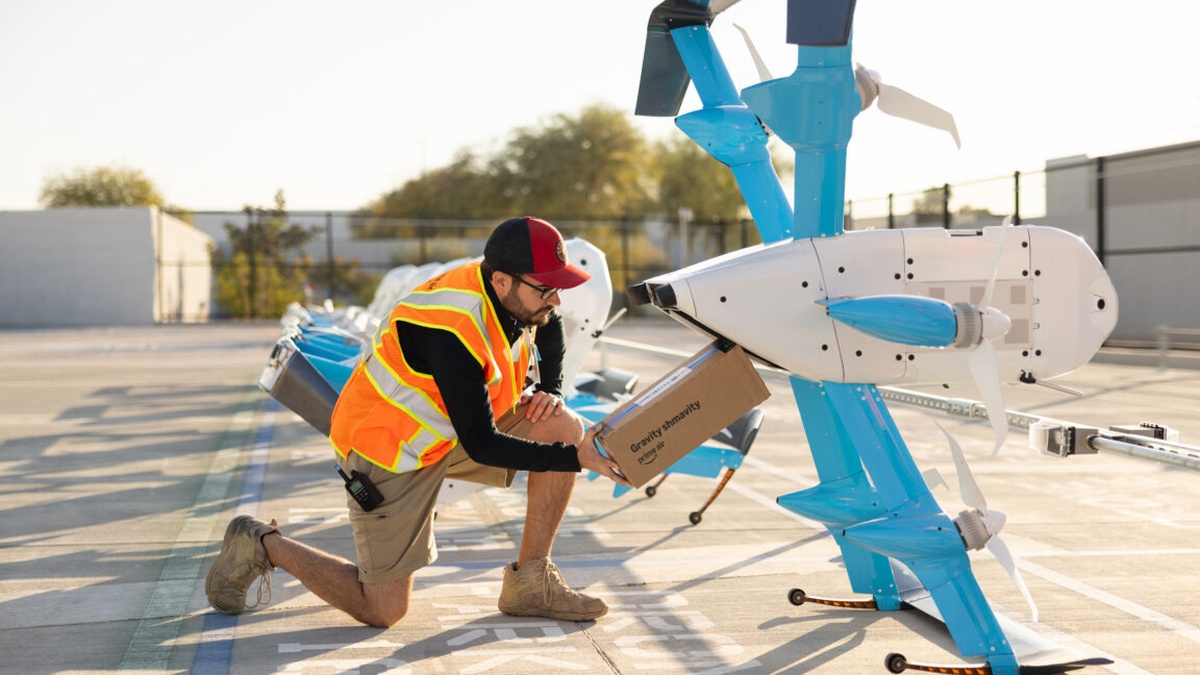
The hexarotor aircraft arrived punctually, successfully descending into Brennan’s private backyard and releasing the retail cargo safely onto the grass before initiating its automated vertical takeoff sequence to return to the distribution hub.
During the rapid climb phase, the Amazon Drone Delivery Crash occurred when the aircraft clipped an overhead fiber-optic cable, severing a propeller assembly as onboard gyroscopes struggled to compensate for aerodynamic asymmetry.
Witnesses described the disabled aircraft floundering sideways through the air like a wounded bird before slamming heavily onto the neighbor’s garage roof and becoming tightly entangled within energized overhead power distribution lines.
Ground operations crews arrived within ten minutes of the Amazon Drone Delivery Crash, coordinating with Detroit Edison utility linemen to secure electrical lines and safely remove the stranded eighty-pound autonomous aircraft.
Amazon representatives promptly compensated the affected garage owner with a gift card and full structural repair commitments, yet this recent Amazon Drone Delivery Crash triggered immediate regulatory notifications across state and federal aviation desks.
MK30 Drone Architecture: Sensor Suites and Aerodynamic Capabilities
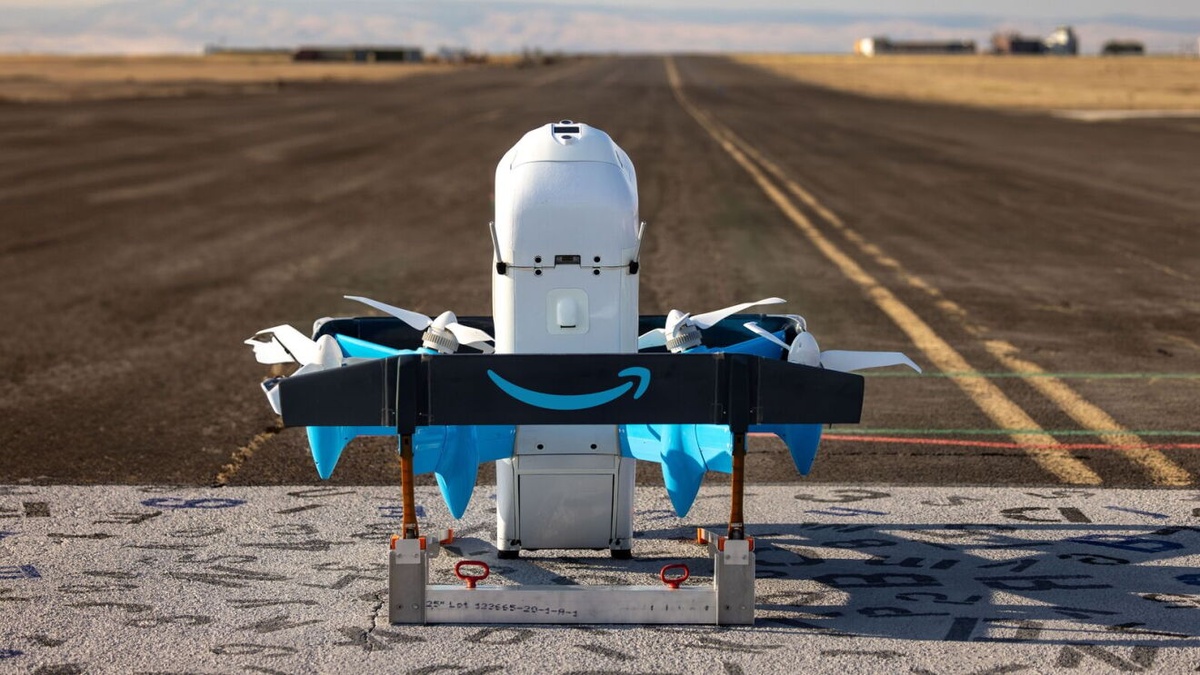
The aircraft involved in this Amazon Drone Delivery Crash represents Amazon’s flagship aerial delivery vehicle, the Prime Air MK30 drone, specifically engineered to navigate congested suburban environments with reduced acoustic signatures and enhanced all-weather reliability.
Engineered with a hexarotor vertical takeoff configuration and transitional fixed-wing efficiency, the MK30 can transport packages weighing up to five pounds across operational radii extending up to seven and a half miles.
The aircraft relies upon specialized shrouded custom propellers designed to cut perceived acoustic annoyance by fifty percent compared to earlier MK27 models, while enabling operations in light precipitation and extreme ambient temperatures.
Autonomous navigation during low-altitude delivery operations relies upon an integrated avionics compute stack executing machine vision inference, multi-spectral stereoscopic cameras, and pulse-Doppler radar arrays to map physical terrain.
During typical package drops, the aircraft descends to approximately thirteen feet above ground level, hovering autonomously while releasing cargo without requiring physical landing gear contact with residential lawns or paved driveways.
Much like thermal density challenges documented in our teardown of the Apple M4 Mac Mini, packaging high-throughput compute modules within lightweight composite airframes demands uncompromising power and thermal management.
Despite sophisticated avionics redundancy, this sudden Amazon Drone Delivery Crash exposes persistent mechanical vulnerabilities during rapid transition phases when aircraft switch between hover station-keeping and forward aerodynamic cruising flight.
Detect and Avoid Failure: Thin Cable Blind Spots in Low-Altitude Flight
The core technical question confronting investigators of this Amazon Drone Delivery Crash centers on why onboard sense-and-avoid algorithms failed to identify the suspended fiber-optic line before vertical departure.
Autonomous aircraft rely heavily upon stereoscopic optical vision and LiDAR sensors, which excel at detecting solid volumetric obstacles like rooflines, mature oak trees, parked vehicles, and residential telephone poles.
Following the Amazon Drone Delivery Crash, engineers highlighted that suspended telecommunication lines present formidable optical challenges due to narrow physical cross-sections, minimal reflective surface areas, and variable lighting conditions against overcast sky backgrounds.
When an aircraft climbs vertically, optical flow sensors and downward-facing rangefinders must rapidly hand off environmental spatial tracking to forward and upward hemispherical sensor suites with differing field-of-view overlaps.
Similar low-latency processing bottlenecks appear in high-end silicon architectures, as analyzed in our benchmark report on the AMD Ryzen 7 9800X3D, where real-time sensor interrupts require instantaneous cache throughput.
When machine perception pipelines fail during an Amazon Drone Delivery Crash, automated collision avoidance routines cannot execute necessary evasive hovering or lateral diversion maneuvers around overhead infrastructure.
Aviation engineers emphasize that eliminating thin-wire blind spots remains the single most challenging obstacle preventing truly universal autonomous flight deployments across aging suburban utility infrastructure.
| Aviation Safety Factor | Amazon Prime Air MK30 | Commercial Helicopter Standards | FAA Part 135 Delivery Mandate |
|---|---|---|---|
| Regulatory Certification | FAA Part 135 Air Carrier | FAA Part 133 / Part 135 | Comprehensive BVLOS Safety Waiver |
| Primary Sensor Stack | Stereo Vision, Radar, LiDAR | Human Pilot Visual Line of Sight | Redundant Multi-Sensor Detect & Avoid |
| Overhead Cable Detection | Automated Optical / Doppler | Human Eye / Aeronautical Charts | Mandatory Automated Collision Avoidance |
| Failsafe Redundancy | Hexarotor Motor Loss Safe Mode | Autorotation Mechanical Gearbox | Independent Ballistic Flight Termination |
| Average Flight Altitude | 150 – 400 ft AGL | 500 – 1,500 ft AGL | Below 400 ft Uncontrolled Airspace |
Federal Oversight Dynamics: FAA Investigation and NTSB Evaluation
Following the Amazon Drone Delivery Crash, the Federal Aviation Administration published an official preliminary accident notice confirming that an unmanned aircraft system struck a residential garage and utility lines during departure.
Federal regulators are examining flight telemetry logs, onboard sensor data, and automated dispatch protocols to determine whether maintenance lapses or algorithmic perception failures caused the catastrophic propeller strike.
Concurrently, the National Transportation Safety Board initiated information-gathering procedures following the Amazon Drone Delivery Crash to assess whether to launch a comprehensive independent safety investigation into commercial drone certifications.
Amazon currently operates under FAA Part 135 air carrier certification, which grants commercial authority to conduct beyond-visual-line-of-sight deliveries under strict statutory public safety operating parameters.
Federal investigators reviewing the Amazon Drone Delivery Crash are particularly focused on takeoff corridor margins, evaluating whether minimum separation distances between autonomous flight paths and civilian overhead utilities require expansion.
Paralleling digital governance transitions explored in our analysis of Nvidia Windows 10 support, legacy regulatory frameworks must modernize rapidly to manage autonomous real-world software deployments.
Depending on findings from the Amazon Drone Delivery Crash, federal oversight bodies could mandate revised obstacle detection thresholds before approving broader commercial drone expansions across metropolitan residential airspace.
Mounting Incident History: Historical Amazon Drone Delivery Crash Patterns
The Michigan garage impact does not represent an isolated mechanical failure, but rather joins a documented series of unfortunate operational mishaps spanning Amazon’s multi-year nationwide drone delivery rollout.
In October 2025, federal investigators opened inquiries after a dual Amazon Drone Delivery Crash saw two aircraft strike heavy construction cranes in Tolleson, Arizona, during routine package distribution runs.
Just one month later in November 2025, another commercial Prime Air aircraft clipped and severed a residential internet utility line in Waco, Texas, knocking out broadband connectivity for surrounding households.
Earlier in February 2026, another Amazon Drone Delivery Crash involved a collision with an occupied multi-family apartment building in Richardson, Texas, prompting an ongoing investigation by regional FAA aviation safety inspectors.
Despite each recorded Amazon Drone Delivery Crash, an Amazon spokesperson confirmed that Prime Air conducts nearly six thousand flights daily, completing hundreds of thousands of successful autonomous deliveries throughout 2026.
Much like distributed cloud infrastructure scaling analyzed in our guide to Xbox Cloud Gaming, expanding commercial networks inevitably encounters edge-case hardware failures as operational volumes increase exponentially.
Amazon maintains an ambitious corporate roadmap aiming to launch commercial drone delivery services across nearly five hundred American municipalities by the conclusion of the current calendar year.
Suburban Expansion Hurdles: Noise Backlash and Low-Altitude Utility Hazards
Beyond mechanical flight reliability, commercial delivery operators face intense community resistance stemming from persistent acoustic pollution generated by high-frequency electric drone rotors operating overhead.
Following news of the Amazon Drone Delivery Crash, residents across established test markets expressed psychological irritation and privacy concerns, as repetitive buzzing rotors disrupt quiet residential cul-de-sacs and backyards during peak hours.
Municipal leaders also express concern regarding physical property liability and civilian safety when eighty-pound autonomous aircraft navigate tightly spaced utility easements directly above suburban playgrounds.
Unlike modern master-planned developments with underground power distribution, older American suburbs feature dense tangles of telephone wires, fiber cables, and electrical transformers strung between wooden poles.
Navigating these complex physical utility corridors requires extraordinary computer vision fidelity, where a single undetected wire can cause an immediate Amazon Drone Delivery Crash resulting in substantial property damage.
Commercial drone logistics firms must demonstrate fail-safe ballistic parachute deployment and multi-rotor redundancy to satisfy wary suburban town councils demanding strict local airspace zoning protections.
The future of retail aviation hinges upon proving that automated drone convenience does not come at the expense of neighborhood safety, quiet enjoyment, and structural utility integrity.
Frequently Asked Questions
What caused the recent Amazon delivery drone crash in Michigan?
An Amazon Prime Air MK30 drone clipped a thin fiber-optic utility cable during vertical takeoff after delivering shampoo, losing a propeller and crashing into a neighboring residential garage roof.
Which federal agencies are investigating the Amazon drone crash?
The Federal Aviation Administration opened an active safety investigation, while the National Transportation Safety Board is evaluating flight data to decide whether to launch a separate independent federal probe.
What are the key technical specifications of Amazon MK30 drone?
The MK30 is an electric hexarotor weighing roughly eighty pounds that carries five-pound payloads up to 7.5 miles at 60 mph, featuring shrouded quiet propellers and automated sensor suites.
Why do autonomous delivery drones struggle to detect utility cables?
Thin telecommunication lines have narrow physical cross-sections and low optical contrast, making them difficult for onboard machine vision and radar systems to distinguish against complex suburban background clutter.
How many autonomous drone deliveries has Amazon completed in 2026?
Amazon reports that Prime Air drones conduct nearly 6,000 daily flights and have completed hundreds of thousands of commercial package deliveries in 2026 across expanding United States operational hubs.
Final Regulatory Verdict: Autonomous Aviation Faces Suburban Realities
The Michigan garage incident and subsequent Amazon Drone Delivery Crash underscore the unforgiving physical realities confronting autonomous commercial aviation, where high-speed rotors and rapid transit speeds intersect with fragile residential infrastructure.
While Amazon’s automated delivery milestones prove the logistical viability of drone commerce, solving thin-wire obstacle detection remains an urgent technical imperative for commercial flight safety.
Until sense-and-avoid sensor stacks achieve flawless utility wire perception, federal regulators and suburban communities will scrutinize every Amazon Drone Delivery Crash with heightened caution and regulatory oversight.
