


Table of Contents
South Carolina trial attorney Nick Mermiges has achieved a major milestone by upgrading his private Nvidia V100 AI server to execute DeepSeek V4.1 Flash at near-NVFP4 precision without relying on external cloud providers.
By pairing eight enterprise accelerators with custom Volta compute kernels and an enormous memory upgrade, this Nvidia V100 AI server keeps highly sensitive legal documents entirely offline while approaching frontier-grade inference fidelity.
| Architecture Subsystem | Baseline Volta sPLIt Rig | Upgraded Volta Max uPLIft Build | Engineering Impact & Operational Benefit |
|---|---|---|---|
| GPU Compute Fabric | 8x Nvidia Tesla V100 SXM2 (256GB HBM2) | 8x Nvidia Tesla V100 SXM2 + RTX 3090 24GB | Offloads draft model execution while preserving unified 256GB HBM2 tensor capacity |
| Weight Quantization Scheme | Uniform 2-Bit Quantization (248.8GB) | Hybrid 2-Bit Base + 38.7% NVFP4 Experts | Surpasses 95.1% next-token parity against official Nvidia FP4 reference weights |
| Active Decode Expert Routing | 100% Routed to 2-Bit Compressed Tensors | 78% to 86% Routed to Pure NVFP4 Tensors | Dramatically reduces KL divergence from 0.196 down to 0.079 nats |
| Host System Memory | 256GB DDR4 (8x 32GB @ DDR4-2666 ECC) | 1TB DDR4 (8x 128GB @ DDR4-2933 MT/s ECC) | Eliminates dual-NUMA host starvation and caches full 556GB Hugging Face packages |
| Client Inference Concurrency | Single Dedicated Slot (118.9 tokens/s) | Dual Concurrent Slots (159.0 tokens/s) | Enables parallel legal research queries without confidential data leaving local premises |
| Power Delivery Architecture | Faulty Multi-Rail Primary Power Supply | Isolated Redundant Server Power Distribution | Completely resolves catastrophic PCIe bus dropouts across consecutive torture sessions |
Selective Mixture-of-Experts Quantization: Achieving Near-NVFP4 Fidelity on Legacy Volta
Deploying massive mixture-of-experts architectures on constrained silicon poses formidable memory bandwidth challenges, especially when operating an older generation Nvidia V100 AI server with strict hardware boundaries.
DeepSeek V4.1 Flash distributes parameters across 384 routed experts per layer across 40 transformer layers, totaling 15,360 distinct expert modules that collectively require approximately 269 GiB at official precision.
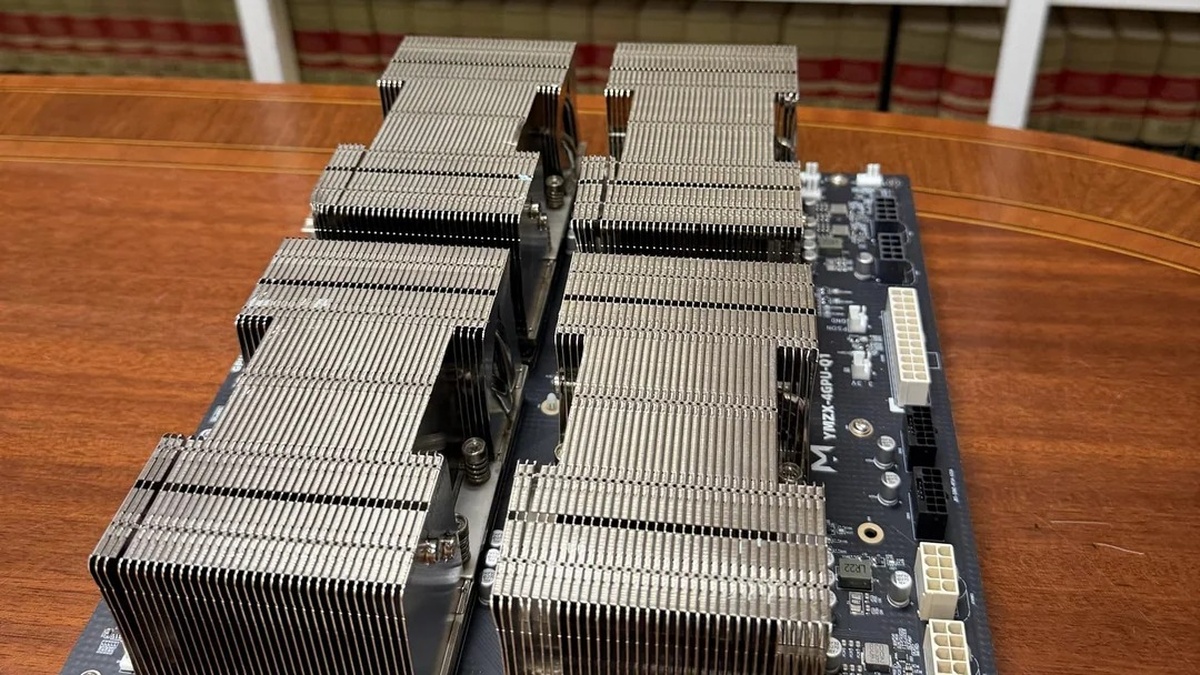
Because eight 32GB accelerators provide 256 GiB of total HBM2 capacity, hosting full 4.25-bit weights directly on an enterprise Volta hardware rig was physically impossible without severe quantization compromises.
Rather than subjecting the entire architecture to destructive 2-bit quantization, Mermiges engineered a selective hybrid quantization scheme that keeps every expert resident in VRAM while promoting heavily utilized modules.
Detailed reporting published by Tom’s Hardware confirms that 5,949 active experts, representing roughly 38.7 percent of the model, run at authentic four-bit NVFP4 precision.
Because expert routing exhibits a heavy power-law distribution, between 78 and 86 percent of all token decode operations route directly into these high-precision modules on this Nvidia V100 AI server.
Hardware Architecture of the Nvidia V100 AI Server: 1TB System Memory and NUMA Balancing
Expanding the computational headroom of this Nvidia V100 AI server necessitated substantial upgrades across the underlying host motherboard, transitioning from 256GB to a full 1TB of system memory.
The host machine received eight 128GB DDR4 registered ECC memory modules clocked at 2,933 MT/s, replacing older 32GB sticks that previously suffered downclocking penalties to avoid memory bus errors.

Integrating 1TB of system memory exposed complex dual-socket Non-Uniform Memory Access boundaries, causing early system boots to freeze during initial cross-socket bus transfers before software card reordering resolved the conflict.
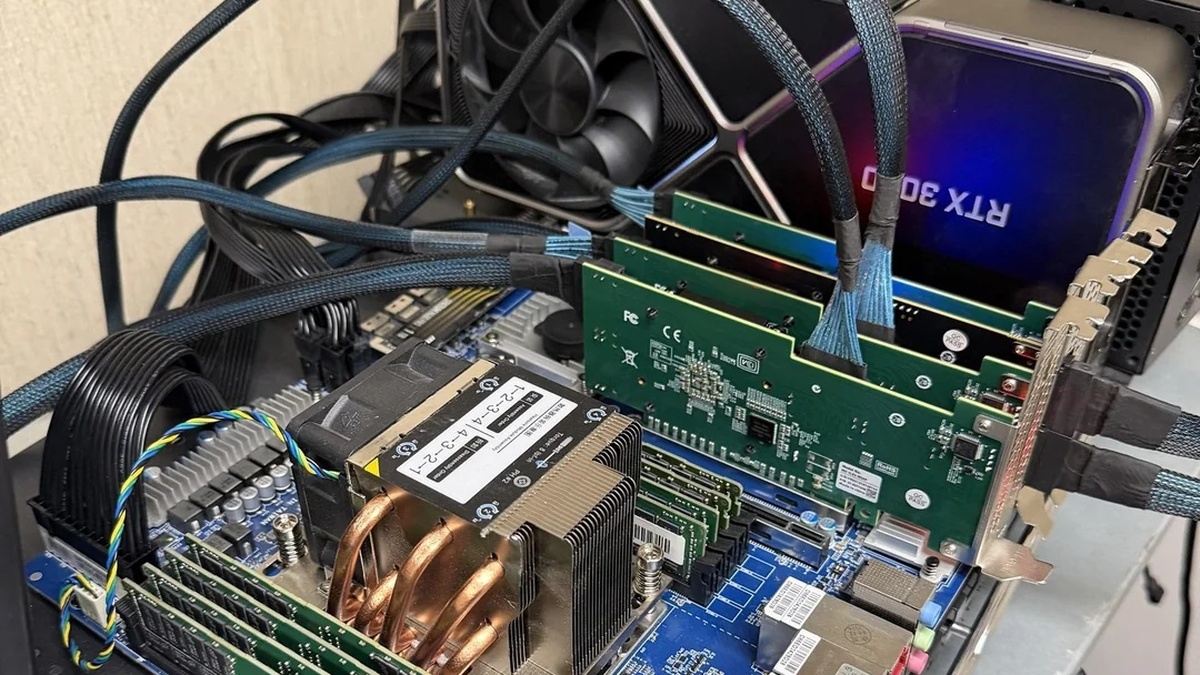
To accelerate speculative decoding passes, Mermiges integrated an auxiliary GeForce RTX 3090, establishing an asymmetric hybrid setup designed to relieve primary tensor cores across the primary Volta compute cluster.
This layered memory hierarchy echoes desktop silicon modularity detailed in our Apple M4 Mac Mini redesign analysis, orchestrating unified high-speed memory pools alongside dedicated hardware compute blocks.
By keeping 556GB of model weights, kv-caches, and active context windows locally cached, the Nvidia V100 AI server processes expansive legal discovery documents without incurring storage paging stalls.
Custom Volta Kernel Synthesis: Claude Code Compiles sm_70 Mixed-Precision Shards
Because modern artificial intelligence libraries increasingly deprecate older GPU architectures, compiling efficient sm_70 execution routines for this Nvidia V100 AI server required bespoke low-level CUDA programming.
To bridge this architectural gap, Mermiges utilized Claude Code driven by frontier reasoning models, directing automated agents to author customized CUDA kernels tailored specifically to legacy Volta tensor units.
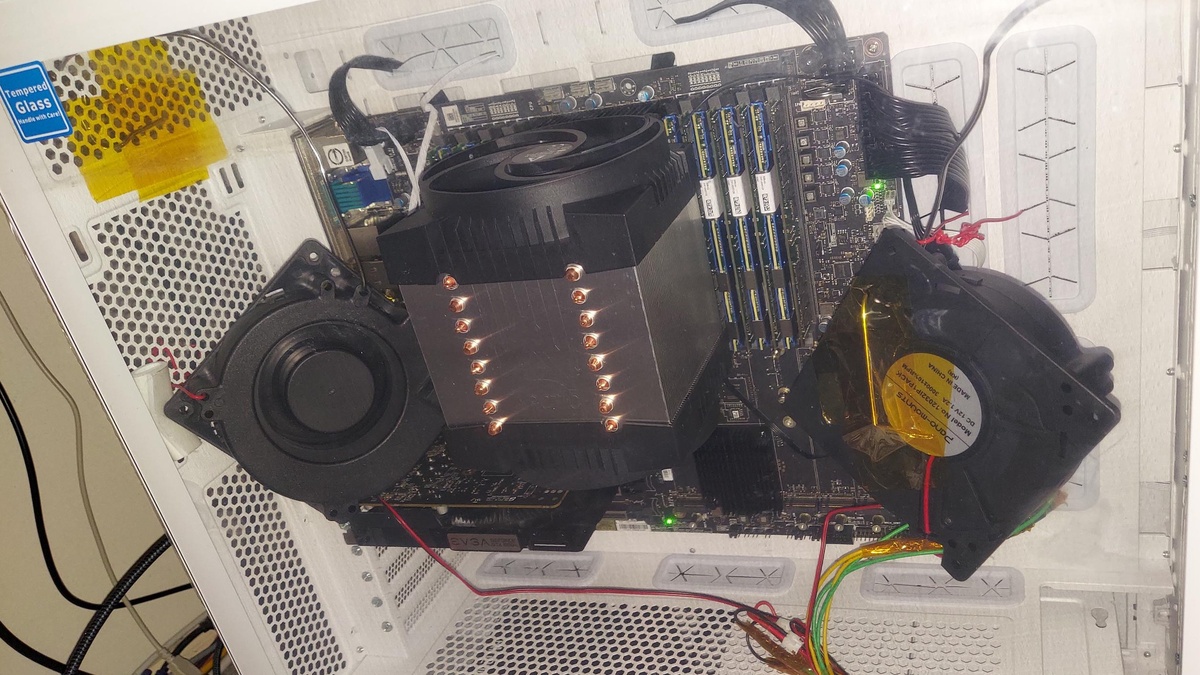
These specialized kernels handle dynamic weight unpacking and mixed-precision matrix multiplication, seamlessly transitioning between 2-bit storage structures and 4-bit NVFP4 execution pipelines within the on-premise Volta accelerator cluster.
Operating on the Nvidia R580 driver release, which marks the final official branch supporting Volta, the system extracts maximum floating-point performance from silicon operating on borrowed driver time.
The strategic deprecation of mature enterprise silicon mirrors broader graphics driver transitions documented in our Nvidia Windows 10 support retirement report, emphasizing the necessity of community-driven firmware adaptations.
Through autonomous agent compilation, the custom sm_70 kernels lock the V100 clock frequencies at a stable 1,522 MHz, sustaining deterministic execution throughput across this enterprise Nvidia V100 AI server.
Inference Throughput and Decode Latency: Benchmarking Token Generation Against NVFP4 Baselines
Transitioning from uniform low-bit quantization to selective near-NVFP4 precision delivers undeniable fidelity gains, though it introduces measurable throughput trade-offs across the active Nvidia V100 AI server.
Direct token matching against Nvidia’s official reference implementation surged from 92.2 percent to 95.1 percent, proving that prioritizing frequently routed experts restores authentic model behavior.
Furthermore, Kullback-Leibler divergence dropped precipitously from 0.196 nats down to 0.079 nats, while multiple-choice test discrepancies collapsed from 79 errors to just 8 on this Nvidia V100 AI server.
Inference speed naturally contracted under higher precision, with code generation dropping from 215 tokens per second to 150.1 tokens per second across compact 1,024-token prompt windows.
However, time-to-first-token latencies improved noticeably across extensive context lengths, decreasing from 118.7 seconds to 108.4 seconds when digesting gargantuan 256K-token legal briefs on the Nvidia V100 AI server.
When configured for dual concurrent user slots, aggregate system output expands to 159.0 tokens per second, outperforming single-request baselines while maintaining strict air-gapped data sovereignty.
| Prompt Context Window | Time-to-First-Token (2-Bit) | Time-to-First-Token (Near-NVFP4) | Code Generation Rate | Legal Drafting Throughput |
|---|---|---|---|---|
| 1,024 Tokens (1K Context) | 1.2 Seconds | 1.0 Seconds (-16.7% Latency) | 150.1 Tokens / Sec | 105.5 Tokens / Sec |
| 32,768 Tokens (32K Context) | 17.2 Seconds | 16.0 Seconds (-7.0% Latency) | 165.1 Tokens / Sec | 93.4 Tokens / Sec |
| 131,072 Tokens (128K Context) | 59.2 Seconds | 54.3 Seconds (-8.3% Latency) | 151.4 Tokens / Sec | 87.3 Tokens / Sec |
| 262,144 Tokens (256K Context) | 118.7 Seconds | 108.4 Seconds (-8.7% Latency) | 154.6 Tokens / Sec | 93.5 Tokens / Sec |
| Dual-Slot Aggregate (256K Context) | N/A (Single Slot Baseline) | N/A (Parallel Slot Concurrency) | 159.0 Tokens / Sec Combined | High-Concurrency Legal Workflow |
Power Delivery Diagnostics and Hardware Stability: Isolating Catastrophic Bus Dropouts
Early deployment stages of the upgraded rig suffered from sudden system lockups, creating substantial debugging friction during prolonged inference runs across the complex Nvidia V100 AI server.
System diagnostics initially pointed toward PCIe bus communication failures, prompting exhaustive reseating of interconnect switch risers, high-speed ribbon cables, and individual SXM2 baseboard sockets.
Community discussions documented on Reddit’s r/homelab reveal that the elusive crashes stemmed from transient voltage sags caused by a degrading primary power supply unit.
Replacing compromised power delivery hardware eliminated erratic voltage fluctuations, enabling the enterprise Nvidia V100 AI server to complete nine consecutive multi-hour torture tests without a single kernel fault.
Rigorous thermal and power testing mirrors high-performance consumer hardware validation covered in our AMD Ryzen 7 9800X3D analysis, where sustained power delivery dictates overall silicon reliability.
Eliminating recurrent cloud subscription overhead provides immense economic efficiency, echoing cost analyses presented in our Xbox Cloud Gaming pricing report by amortizing capital expenditure over prolonged enterprise lifecycles.
Frequently Asked Questions
Why did Nick Mermiges choose an eight-GPU Nvidia V100 AI server over modern hardware?
Used enterprise Volta hardware provides 256GB of ultra-fast HBM2 memory at a fraction of modern GPU costs, making this refurbished enterprise hardware platform exceptionally cost-effective for confidential local LLM execution.
What is near-NVFP4 precision and how does it function?
Near-NVFP4 keeps all 15,360 DeepSeek experts in VRAM at 2-bit, while elevating the top 38.7 percent most-frequently routed experts to 4-bit NVFP4, capturing up to 86 percent of active decode queries.
How does this private server protect client legal confidentiality?
Because all tensor computation runs entirely on-premise within this Nvidia V100 AI server, zero document text, telemetry data, or client work products are ever transmitted across external cloud networks.
What role did Claude Code play in developing custom Volta kernels?
Because modern deep learning frameworks neglect older sm_70 architectures, Claude Code was utilized to synthesize custom CUDA kernels that enable mixed-precision weight unpacking and high-throughput matrix multiplications.
How did upgrading to 1TB of RAM affect system inference performance?
Upgrading to 1TB of registered ECC memory accommodated DeepSeek’s massive 556GB weight packages while mitigating NUMA latency bottlenecks, sustaining smooth multi-slot concurrency without thrashing secondary NVMe swap partitions.
Final Verdict: Private Workstation Silicon Over Cloud Monopolies
The successful deployment of this Nvidia V100 AI server demonstrates that resourceful engineering can overcome severe silicon obsolescence and memory capacity constraints through intelligent hybrid quantization algorithms.
By capturing 86 percent of expert routing at near-NVFP4 precision, this bespoke Nvidia V100 AI server matches enterprise commercial accuracy while guaranteeing complete legal data privacy for confidential workloads.
As cloud AI pricing models continue escalating, on-premise clusters built around deprecated enterprise accelerators offer independent firms unmatched autonomy, performance stability, and sustainable infrastructure control.
