



Table of Contents
Microsoft Commercial CEO Judson Althoff has unveiled the strategic blueprint for Microsoft Frontier Transformation, articulating an enterprise architecture designed to align autonomous artificial intelligence systems directly with measurable business outcomes across corporate workflows worldwide.
Detailed directly on the Official Microsoft Blog, this Microsoft Frontier Transformation roadmap prioritizes human purpose over unconstrained compute, integrating Copilot, Work IQ, Agent 365, and new M365 E7 enterprise licensing.
| Pillar Dimension | Core Platform Component | Technical Implementation | Enterprise Business Impact |
|---|---|---|---|
| Human Ambition | Microsoft Copilot & Work IQ | Context-grounded multi-agent orchestration | Empowers 300,000+ knowledge workers per enterprise |
| Proprietary Intelligence | Microsoft IQ Platform & Fabric | Intelligent Data Foundation & Task-specific SLMs | Unifies enterprise ERP/CRM data while protecting IP |
| Trust & Observability | Microsoft Agent 365 Control Plane | Centralized policy enforcement & auto-deactivation | Continuous auditability, lifecycle oversight & security |
| Enterprise Packaging | Microsoft 365 E7: The Frontier Suite | Unified enterprise agent & cognitive bundle | Consolidates licensing for enterprise autonomous operations |
| Developer Tooling | Microsoft Foundry & Azure AI | Lifecycle model fine-tuning & agentic orchestration | Accelerates task-specific models from insight to production |
Frontier Architecture: Reimagining Enterprise Systems Around Outcomes Rather Than Cognitive Compute
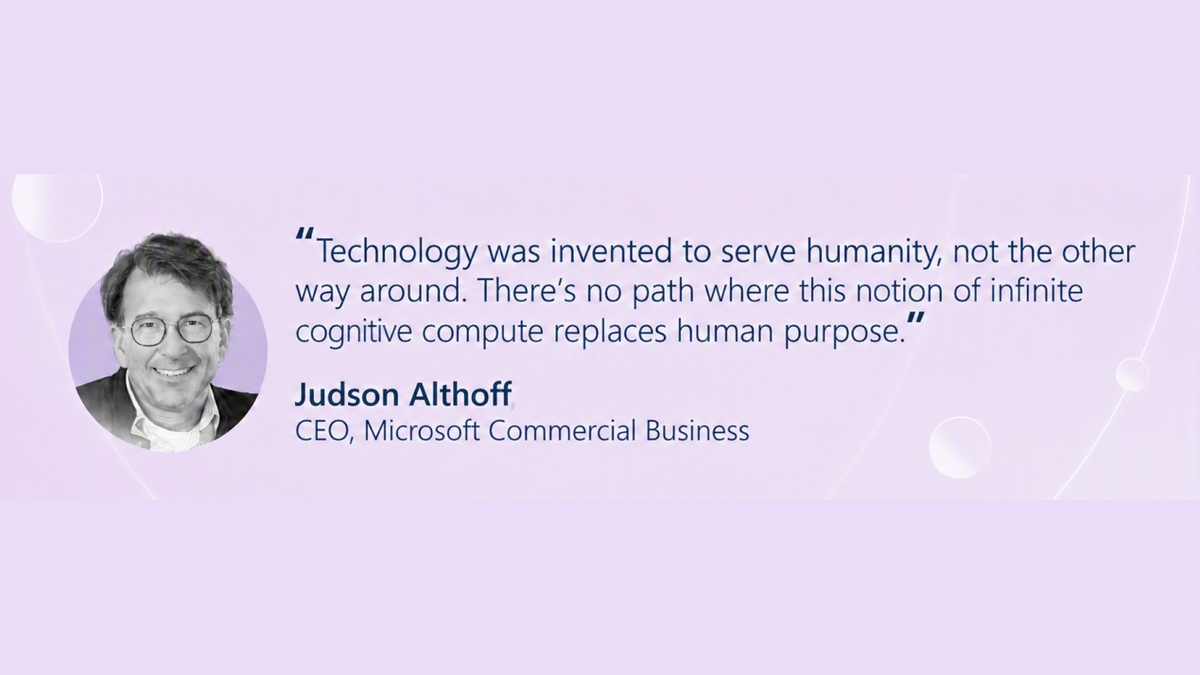
The Microsoft Frontier Transformation methodology fundamentally rejects the notion that sheer computational volume should drive corporate technology adoption. Microsoft emphasizes that artificial intelligence exists to serve human ambition rather than replacing organizational judgment or strategic corporate purpose.
At the core of this Microsoft Frontier Transformation framework lie three foundational pillars: human ambition, amplified intelligence, and verifiable trust. These principles dictate that technological deployments must generate documented return on investment rather than merely showcasing automated novelties.
Enterprise leaders have frequently struggled with disconnected artificial intelligence pilots that fail to deliver tangible operational velocity. By anchoring the operational transformation around concrete business objectives, organizations avoid speculative technical debt while accelerating institutional modernization.
This philosophical realignment coincides with monumental compute scaling across modern hyperscale cloud datacenters. Just as our hardware analysis of the AMD Ryzen 7 9800X3D gaming processor demonstrated structural silicon efficiency, enterprise software architectures require disciplined execution.
Through this outcome-oriented framework, the Microsoft Frontier Transformation bridges executive board priorities with distributed day-to-day operations. Companies transition away from isolated generative chatbot experiments toward cohesive, mission-critical autonomous platforms that actively generate business value.
Copilot and Work IQ Integration: Scaling Contextual Reasoning Across Hundreds of Thousands of Employees
Within the Microsoft Frontier Transformation blueprint, Copilot serves as the primary interaction surface for knowledge workers across every department. It unifies conversational prompts with institutional knowledge graphs, converting routine desktop interfaces into adaptive agentic command centers.
Automotive manufacturing giant Volkswagen has scaled this Microsoft Frontier Transformation concept by deploying Copilot to more than 330,000 global workers. Employees utilize Work IQ to ground analytical decision-making directly within proprietary operational telemetry and historical corporate datasets.
Volkswagen paired its Copilot rollout with an Intelligent Data Foundation built on Microsoft Fabric, centralizing multi-region supply data. This integration proves how Microsoft’s unified data strategy turns fragmented enterprise data silos into accessible contextual fuel for front-line workers.
Japanese technology conglomerate Fujitsu deployed Copilot across 100,000 employees as part of its Microsoft Frontier Transformation adoption. The company achieved over 90 percent employee utilization, connecting personnel to specialized agents that handle internal support, procurement, and accounting workflows.
Remarkably, Fujitsu resolved roughly 75 percent of initial service desk triage automatically across 300,000 annual IT tickets. Operating as customer zero, Fujitsu demonstrates that modern agentic deployments deliver massive administrative compression in high-volume enterprise helpdesk environments.
Domain-Specific AI Deployments: How Global Leaders Operationalize Autonomous Agents in Production
Industrial manufacturer Kohler implemented the Microsoft Frontier Transformation within its software engineering division using GitHub Copilot. The engineering group increased production release cadence by 25 percent while reducing post-deployment code defects by an astonishing 75 percent across active repositories.
Beyond software development, Kohler employees created over 3,000 custom declarative agents to streamline daily operations. This widespread internal democratization reflects the core Microsoft Frontier Transformation philosophy of empowering non-technical employees to automate repetitive clerical bottlenecks without engineering dependencies.
In cyber defense, South Korean gaming studio Krafton embraced modern agentic security through Security Copilot and Defender XDR. The publisher behind PlayerUnknown’s Battlegrounds combined internal telemetry with threat intelligence to automate critical alert triaging workflows.
Krafton reduced security incident recognition intervals by 95 percent, slashing response times to under sixty seconds. The studio automated 95 percent of incident reports, showing how the Microsoft Frontier Transformation frees cybersecurity specialists to combat sophisticated threat vectors.
In biopharmaceuticals, Bristol Myers Squibb operationalized advanced laboratory discovery by deploying its proprietary RABIT molecular research agent. The specialized model screens 4.7 million molecular interactions in minutes, significantly accelerating early-stage oncology therapeutic discovery pipelines.
Agent 365 Governance and Observability: Centralizing Multi-Agent Telemetry and Lifecycle Management
As enterprises deploy thousands of autonomous workers, the Microsoft Frontier Transformation introduces Microsoft Agent 365 to establish rigorous administrative observability. The centralized control plane enables security teams to inspect, manage, and govern declarative agents across complex IT estates.
Without rigorous lifecycle management, sprawling autonomous agents risk creating critical security vulnerabilities and shadow IT liabilities. The Microsoft Frontier Transformation mitigates these governance hazards by providing comprehensive audit logging, granular permission mapping, and automated identity isolation protocols.
| Enterprise Organization | Industry Sector | Platform Implementation | Quantitative Operational Benchmark |
|---|---|---|---|
| Volkswagen Group | Automotive Manufacturing | Copilot with Work IQ & Microsoft Fabric | 330,000 users with unified Intelligent Data Foundation |
| Fujitsu | IT Services & Consulting | Copilot multi-agent front door | 75% automated triage across 300,000 annual IT tickets |
| Kohler | Industrial Manufacturing | GitHub Copilot & 3,000 custom agents | 25% faster releases and 75% reduction in code defects |
| Krafton | Interactive Gaming & Cyber | Security Copilot & Defender XDR | Alert triage slashed by 95% from tens of minutes to <1 min |
| Truist Financial | Banking & Financial Services | Agent 365 & 50,000 M365 E7 seats | 13,000 agents governed with strict 45-day inactivity purge |
| Bristol Myers Squibb | Biopharmaceuticals & Life Sci | RABIT Molecular Agent on Azure Foundry | Screening 4.7 million compound interactions in minutes |
| Telstra | Telecommunications | Agentic service migration engine | 272,000 automated migrations at 95%+ production accuracy |
Financial institution Truist demonstrated this disciplined enterprise governance oversight by managing more than 13,000 declarative agents via Agent 365. The bank mandates strict named executive ownership and enforces automated agent deactivation following 45 days of operational inactivity.
This rigorous governance policy sustains over 8,000 monthly active agents across Truist without administrative degradation. Bolstering its commitment, Truist secured over 50,000 Microsoft 365 E7 Frontier Suite seats to support ongoing agentic expansion across its retail banking branches.
Similarly, global systems integrator Insight Enterprises deployed Agent 365 under the Microsoft Frontier Transformation framework, cataloging 9,734 active agents. Real-time observability allows administrators to monitor data access boundaries, ensuring compliance across highly regulated commercial and financial sectors.
Enterprise Platform Matrix: Analyzing M365 E7 Packaging, Fabric Foundations, and Foundry Operations
Commercial monetization for the Microsoft Frontier Transformation centers on the Microsoft 365 E7 Frontier Suite licensing tier. Global financial group Manulife adopted the E7 suite for 30,000 workers, providing a unified framework for enterprise agent orchestration and enterprise security.
Manulife already leverages generative solutions to support 110 million customer service calls annually while lifting developer output by 30 percent. Expanding its Microsoft Frontier Transformation investments positions the multinational insurer to deploy complex autonomous workflows with robust fiscal predictability.
Underpinning this cognitive infrastructure is Microsoft Azure and Foundry, providing small task-specific language models. Just as our analysis of Xbox cloud gaming pay-as-you-go bundles highlighted server fleet efficiency, Foundry optimizes enterprise model runtime efficiency.
Professional services firm KPMG expanded Copilot across 276,000 professionals while deploying Agent 365 across its multi-agent KPMG Workbench. This Microsoft Frontier Transformation adoption empowers audit and advisory teams to coordinate specialized client-facing agents with verified security guarantees.
Telecommunications provider Telstra automated 272,000 enterprise service migrations at 95 percent accuracy using human-in-the-loop agentic architectures. Telstra proves that Microsoft’s agentic platform enables mission-critical infrastructure operators to scale autonomous reasoning safely within heavily audited production networks.
Frequently Asked Questions
What is the Microsoft Frontier Transformation initiative?
The Microsoft Frontier Transformation represents an enterprise strategy prioritizing concrete business outcomes over raw compute scale, orchestrating Copilot, Work IQ, and Agent 365 governance.
What role does Agent 365 play in enterprise agent management?
Agent 365 functions as an enterprise observability and control plane, giving organizations real-time discovery, permission monitoring, and automated lifecycle governance for thousands of autonomous agents.
How does Microsoft 365 E7 package these advanced AI capabilities?
Microsoft 365 E7, titled The Frontier Suite, combines Copilot, Work IQ capabilities, and Agent 365 management into a unified commercial licensing bundle for large-scale enterprise deployments.
How are companies enforcing agent security and lifecycle controls?
Organizations like Truist Financial enforce mandatory accountable owners for every agent and automatically deactivate declarative agents after 45 days of inactivity through the unified Frontier platform.
Which global enterprises have deployed Frontier platform components at scale?
Volkswagen, Fujitsu, Kohler, Krafton, Truist, Manulife, KPMG, Dow, and Telstra have deployed Frontier platform capabilities, automating customer operations and code releases across hundreds of thousands of employees.
Final Verdict: Microsoft’s Enterprise Platform Play for the Autonomous Agent Era
The Microsoft Frontier Transformation establishes a cohesive operational blueprint for organizations seeking to transcend fragmented artificial intelligence experiments. By linking human ambition with grounded enterprise context and rigorous control planes, Microsoft delivers unmatched commercial clarity.
The introduction of Agent 365 solves a critical operational bottleneck by delivering centralized governance for thousands of autonomous agents. Organizations can now scale agentic workflows confidently while maintaining strict regulatory compliance and identity isolation across business systems.
Ultimately, the Microsoft Frontier Transformation redefines enterprise digital strategy by subordinating computational capacity to tangible business results. For global enterprises navigating the agentic era, Microsoft’s integrated platform provides the essential foundation for sustainable operational superiority.
