


Table of Contents
Modern businesses are experiencing widespread generative adoption, yet unlocking sustainable economic returns remains an elusive challenge. Successfully scaling enterprise AI value separates leading market innovators from cautious adopters, proving that business alignment outweighs sheer raw computational expenditure.
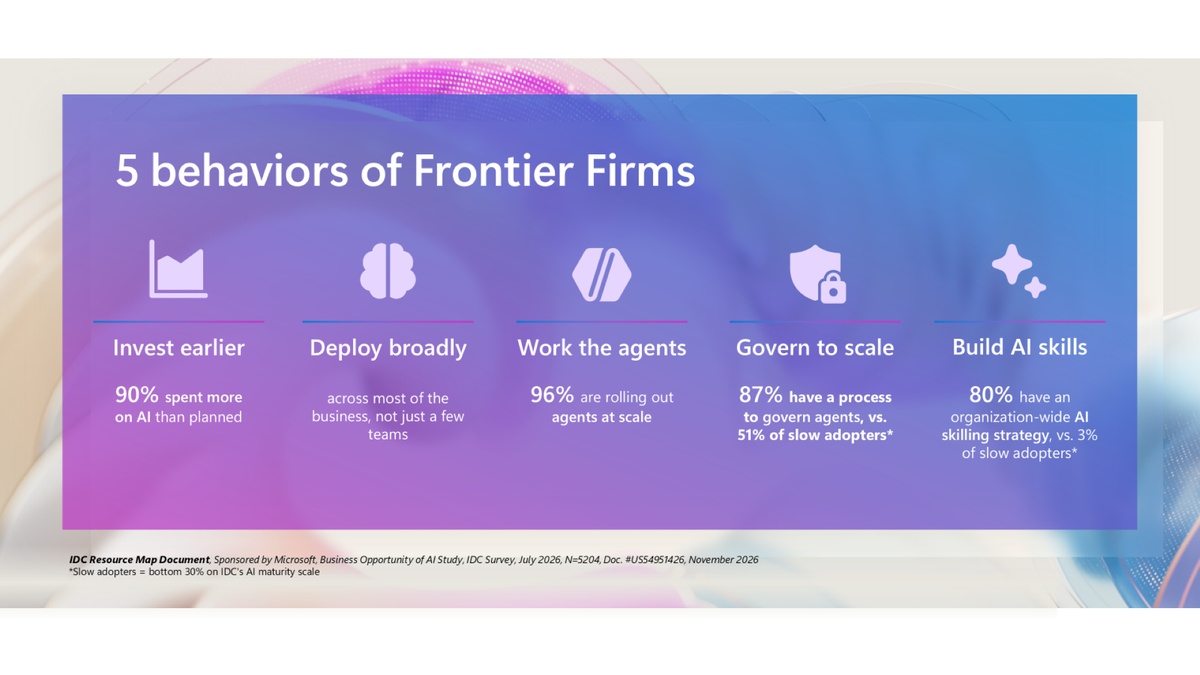
Drawing on data from over 5,200 enterprise leaders, research from IDC commissioned by Microsoft identifies Frontier Firms as the elite ten percent capturing outsized margins through systematic process redesign.
| Operational Dimension | Slow Adopters (Bottom 30%) | Typical Enterprises (Average) | Frontier Firms (Top 10%) |
|---|---|---|---|
| Average Reported AI ROI | 2.7x Return Multiple | 3.1x Return Multiple | 4.0x Return Multiple (39% > 5x) |
| Autonomous Agent Deployment | 36% Stuck in Pilot Phase | 54% Departmental Rollouts | 96% Scaled (53% Orchestrated) |
| Agent Governance & Oversight | 51% Basic Framework | 65% Formal Policy | 87% Enforced Steering Governance |
| Enterprise Skilling Strategy | 3% Comprehensive Program | 20% Dedicated Skilling | 80% Organization-Wide Curriculum |
| Cross-Functional AI Breadth | 1.8 Business Departments | 4.2 Business Departments | 6.5+ Enterprise Business Areas |
| Confidence in ROI Measurement | 32% Confident in Tracking | 61% Moderately Confident | 93% High Financial Confidence |
The Fourfold Return Divide: How Frontier Firms Lead Scaling Enterprise Ai Value
According to the latest fourth-year global survey published on the Microsoft Blog, top-tier Frontier Firms report an average 4x return on artificial intelligence investments compared to just 2.7x for slower adopting organizations.
Furthermore, thirty-nine percent of these leading enterprises realize returns exceeding 5x, whereas only four percent of lagging organizations achieve equivalent financial milestones. This dramatic divergence demonstrates that scaling enterprise AI value requires treating computational models as unified business assets rather than fragmented technical trials.
Measurement represents the critical operational differentiator between market tiers. While ninety-three percent of Frontier Firms report high confidence in quantifying operational return on investment, only sixty-one percent of typical enterprise organizations possess reliable accounting methodologies to track computational productivity gains.
Without rigorous financial observability, enterprise leadership struggles to justify expanding model infrastructure. Consequently, scaling enterprise AI value stalls in budgetary limbo when executive teams cannot correlate token consumption with tangible revenue acceleration, cost mitigation, or streamlined product delivery cycles.
Leading organizations deliberately surpass initial spending projections, with ninety percent investing ahead of schedule to lock in competitive advantages. By executing aggressive funding strategies, these market pioneers turn scaling enterprise AI value into an ongoing compounding economic flywheel across multiple operational divisions.
Autonomous Agent Orchestration: Moving Beyond Isolated Workflow Pilots
The transition from static predictive assistants to autonomous digital agents represents the next frontier in computational automation. While thirty-six percent of typical enterprises remain trapped in isolated experimental pilots, ninety-six percent of frontier leaders are actively scaling enterprise AI value through scaled agent deployments.
More importantly, fifty-three percent of elite organizations orchestrate multi-agent workflows across complex departmental chains. Rather than functioning as standalone chatbots, these autonomous systems interact directly with enterprise resource software, managing inventory adjustments, customer fulfillment, and automated invoice verification without continuous manual intervention.
Enterprise agent coordination requires architectural discipline reminiscent of scalable distributed computing. As detailed in our operational breakdown of Xbox cloud gaming pay-as-you-go pricing bundles, managing dynamic computational workloads demands modular backend frameworks that maintain stability under fluctuating peak demand.
Real-world enterprise deployments showcase substantial operational efficiency improvements. At global pharmaceutical firm Bristol Myers Squibb, the proprietary RABIT agent connects strategic insights across meetings, reducing administrative documentation overhead and saving project managers an estimated twenty percent of their daily time.
When digital agents collaborate across interconnected data repositories, organizational productivity expands exponentially. Enterprises successfully scaling enterprise AI value by embedding intelligent automation directly into mission-critical workflows, freeing skilled human knowledge workers to pursue complex strategic objectives.
Governance and Observability: Mitigating Security Risks Behind Enterprise Guardrails
Accelerating autonomous agent deployments without establishing comprehensive institutional oversight introduces severe operational vulnerabilities. Although sixty-five percent of organizations maintain basic agent governance policies, only sixty percent express genuine confidence in addressing security, compliance, and algorithmic hallucination risks.
In contrast, eighty-seven percent of frontier enterprises enforce structured governance and continuous audit frameworks. Effectively scaling enterprise AI value requires implementing strict access management, verifiable logging, and deterministic guardrails so digital agents remain fully compliant within enterprise security perimeters.
Conagra Brands exemplifies this security-first philosophy by establishing dedicated executive steering committees to review algorithmic risk factors, identity management, and observability pipelines before expanding enterprise access. Establishing rigorous framework controls supports scaling enterprise AI value by preventing sensitive corporate data leaks.
Enterprise lifecycle governance mirrors the necessity of retiring unsupported software dependencies before vulnerabilities compound. As analyzed in our review of NVIDIA ending Windows 10 support, proactive infrastructure oversight prevents unexpected compliance disruptions across mission-critical corporate computing environments.
Trust must be earned continuously as autonomous workflows assume greater operational responsibility across business units. By maintaining transparent auditability and human-in-the-loop validation checkpoints, organizations master scaling enterprise AI value without exposing their brand to catastrophic regulatory penalties.
Workforce Readiness and Change Management: Bridging the Skilling Divide
Workforce education represents the widest structural gap separating elite innovators from lagging competitors. While sixty-seven percent of enterprise employees report high personal trust in machine learning tools, scaling enterprise AI value falters when human personnel lack structured training programs.
Remarkably, only twenty percent of standard organizations maintain comprehensive, enterprise-wide skilling programs. Meanwhile, eighty percent of Frontier Firms invest heavily in continuous workforce education, compared to an astonishingly low three percent among slow-adopting enterprise organizations.
Eric Tabor, Chief Digital Officer at KOHLER, emphasizes that effective transformation prioritizes operational skilling over narrow algorithmic coding. Successful enterprises dissect existing human workflows, systematically identifying how departmental teams can collaborate alongside intelligent agents to streamline daily commercial outputs.
| Pillar Architecture | Operational Objective | Implementation Mechanism | Business Impact |
|---|---|---|---|
| Multi-Agent Orchestration | Cross-Functional Automation | API Integration & Event Triggers | Eliminates 20% Administrative Overhead |
| Observability & Risk Guardrails | Compliance & Data Sovereignty | Steering Committees & Identity RBAC | Mitigates Algorithmic Hallucination & Leaks |
| Enterprise Workforce Skilling | Operational Process Redesign | Cohort Learning & Workflow Dissection | Drives 98% Copilot Adoption Rates |
| Tiered Model Topology | Compute Cost Optimization | Dynamic SLM/LLM Task Routing | Prevents Uncontrolled Cloud Ingestion Costs |
| Value & ROI Instrumentation | Financial Attribution Tracking | Before-and-After Workflow Audits | Secures Budget for Scaling AI Value |
Engineering and construction leader Black & Veatch achieved ninety-eight percent organizational adoption of Microsoft 365 Copilot by establishing structured change management cohorts. Surfacing practical use cases across early adopters accelerated scaling enterprise AI value while cultivating grassroots momentum across project teams.
Optimizing workforce efficiency through tailored computing hardware follows similar strategic principles, as seen in our architectural analysis of the Apple M4 Mac mini redesign. Equipping employees with efficient, purpose-built tools eliminates operational bottlenecks and accelerates task turnaround across corporate departments.
Closing the internal knowledge deficit ensures enterprise teams embrace algorithmic automation rather than resisting technological change. By investing equally in human talent and digital infrastructure, forward-thinking executives maintain consistent momentum while scaling enterprise AI value.
Model Selection and Platform Economics: Aligning Workloads with Infrastructure Costs
Enterprise leaders evaluate model selection across three equally weighted criteria: trust and security, state-of-the-art capability, and raw inference throughput. Each dimension captures forty-four percent of executive mindshare, underscoring the demand for flexible multi-model orchestration platforms.
Rather than relying on a single monolithic foundation model, sophisticated technology leaders match specific algorithmic architectures to targeted workloads. Successfully scaling enterprise AI value requires deploying compact, cost-effective models for high-frequency classification tasks while reserving costly frontier reasoning models for complex strategic synthesis.
Protecting corporate intellectual property remains a paramount requirement when selecting commercial hosting environments. Organizations establish private inference endpoints to ensure proprietary corporate databases, trade formulas, and sensitive customer communications never leak into external public model training corpuses.
With seventy-one percent of enterprise technology leaders projecting annual budget increases exceeding ten percent, disciplined cost management is vital. Organizations achieve sustainable economics by monitoring token consumption rates and auditing workload efficiency, ensuring scaling enterprise AI value scales without unconstrained cloud hosting inflation.
Balancing computational performance against commercial operating expenses establishes a durable architectural foundation for ongoing growth. Enterprises that strategically match tasks to specialized neural architectures extract superior operational accuracy while maintaining predictable, controllable balance sheet expenditures.
Frequently Asked Questions
What does scaling enterprise AI value mean for modern enterprises?
Scaling enterprise ai value involves deploying artificial intelligence models and autonomous agents across core business functions while ensuring strict governance, measurable return on investment, and comprehensive employee training.
Why do Frontier Firms achieve 4x returns compared to slow adopters?
Frontier Firms achieve 4x returns because they orchestrate autonomous agents across multiple workflows, establish strict governance steering committees, invest ahead of budget, and implement organization-wide workforce skilling strategies.
What are the primary governance risks associated with autonomous digital agents?
Primary governance risks include unauthorized data access, identity spoofing, algorithmic hallucinations, and unintended automated actions. Elite organizations counter these hazards with continuous observability, strict access control, and human oversight checkpoints.
How does workforce training influence scaling enterprise AI value?
Workforce training is the largest differentiator in enterprise success. Eighty percent of Frontier Firms maintain company-wide skilling programs, empowering employees to redesign workflows and utilize autonomous agents effectively across daily business operations.
How do enterprises balance foundation model performance against cloud computing costs?
Enterprises optimize computational expenditure by matching specific tasks to appropriate model tiers. Lightweight quantized models handle routine high-volume workloads, reserving expensive frontier reasoning engines strictly for mission-critical analysis.
Final Verdict: The Strategic Blueprint for Enterprise Intelligence
The definitive findings from Microsoft and IDC confirm that commercial success in artificial intelligence is governed by strategic execution rather than technology hype. Organizations committed to scaling enterprise AI value must transcend experimental pilot projects by embedding autonomous agents directly into cross-functional workflows.
Bridging the stark skilling gap between workforce trust and organizational training will determine which market competitors capture lasting efficiency advantages. By establishing dedicated governance councils and robust observability frameworks, enterprise executives ensure rapid innovation proceeds without sacrificing corporate control.
As annual technology budgets accelerate across twenty-eight global industries, disciplined multi-model orchestration separates market leaders from lagging peers. Embracing the proven operating principles of Frontier Firms provides an actionable roadmap for scaling enterprise AI value sustainably over the coming decade.
