


A groundbreaking PROLED MacBook Pro teardown conducted by iFixit has uncovered the intricate engineering behind Apple’s newest flagship laptop, revealing how hardware designers integrated dedicated illumination diodes and stiffened chassis mechanics while shedding substantial overall weight.
According to comprehensive technical findings published by MacRumors, disassembling this touchscreen machine exposes how self-emissive display panels require bespoke optical solutions to revive iconic industrial design elements.
| Hardware & Teardown Metric | PROLED MacBook Pro (Touchscreen) | 14-Inch M6 MacBook Pro | M5 MacBook Pro Reference |
|---|---|---|---|
| Display Panel Technology | Self-Emissive Tandem PROLED Touchscreen | Liquid Retina XDR (Mini-LED Backlit) | Liquid Retina XDR (Mini-LED Backlit) |
| Glowing Apple Logo Hardware | 4 Dedicated Discrete LEDs with Diffuser & Mirror | Passive Backlight Illumination (Historical) / Solid | Solid Polished Metallic Inlay (Unlit) |
| Mechanical Hinge Architecture | Higher-Tension Calibrated Anti-Wobble Hinge | Standard Torsion Dual Hinge Mechanism | Standard Friction Hinge Mechanism |
| Display Assembly Weight | 101 grams lighter than M6 predecessor | Baseline standard display lid weight | Historical baseline weight |
| Lower Chassis Base Weight | 364 grams (CNC-Milled Aluminum Interior) | 456 grams (Standard unibody aluminum) | 458 grams (Standard unibody aluminum) |
| Trackpad Dimensions | Slightly reduced footprint for cabling | Standard expansive Force Touch glass | Standard expansive Force Touch glass |
| Port Replaceability | Modular Thunderbolt ports; soldered HDMI & SDXC | Modular Thunderbolt ports; soldered HDMI & SDXC | Modular Thunderbolt ports; soldered HDMI & SDXC |
| Motherboard Parts Pairing | Repair Assistant calibrates touch & Touch ID | Repair Assistant required for display swap | Strict software serialization locks |
| iFixit Repairability Score | 5 out of 10 (Moderate Repairability) | 4 out of 10 (Challenging Repairability) | 4 out of 10 (Challenging Repairability) |
Table of Contents
1. Dedicated Logo Illumination: Why Apple Engineered Four Independent LEDs
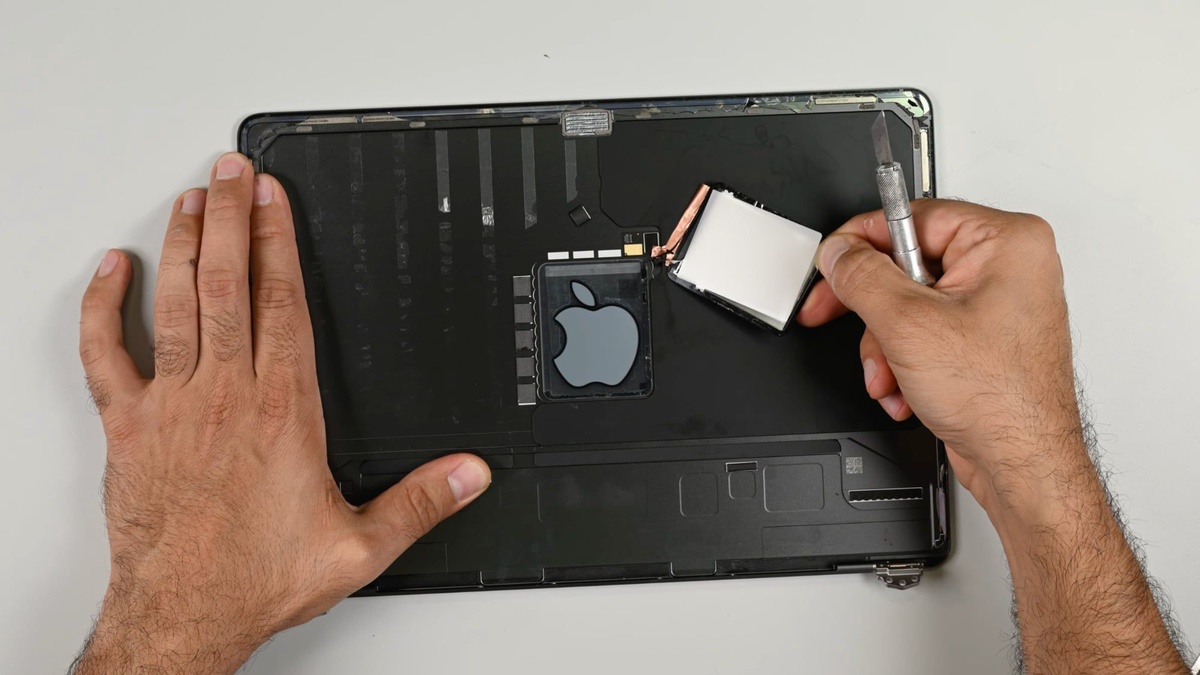
The most striking revelation from the PROLED MacBook Pro teardown centers on how Apple engineered the return of the illuminated rear emblem without relying on legacy display backlighting.
Decades ago, classic MacBooks illuminated their translucent white logos passively by redirecting surplus photons generated by the cold cathode or LED backlighting units powering the liquid crystal panel.
Because self-emissive organic diode panels produce light at individual subpixel junctions, there is no ambient rear backlight available to bleed through the exterior aluminum casing.
To overcome this physical barrier, hardware designers created an independent lighting module consisting of four dedicated surface-mounted LEDs, an optical diffuser sheet, and a specialized reflective backing.
When inactive, a two-way mirrored exterior coating provides a pristine reflective finish, transforming seamlessly into a bright, uniformly illuminated emblem whenever the machine wakes from low-power sleep.
However, servicing this illumination module proved catastrophic during testing, as removing the adhesive-bonded display glass delaminated the fragile panel underneath, permanently destroying the expensive touchscreen.
2. Touchscreen Stability: Analyzing the Re-Engineered Anti-Wobble Hinge
Another critical focal point of the PROLED MacBook Pro teardown involved evaluating the mechanical hinge, which marketing documentation promoted as custom-engineered for responsive finger input.
Laptop touchscreens frequently suffer from annoying display wobble whenever users tap user interface targets, requiring robust structural bracing to keep the panel stable during repetitive gestures.
Curiously, iFixit discovered during their teardown analysis that the hinge clutch mechanism shares an identical physical architecture with the standard 14-inch M6 chassis.
Rather than inventing an entirely novel mechanical pivot, manufacturing engineers dramatically increased the rotational friction and spring tension calibration within the dual barrel assemblies.
This tighter mechanical resistance successfully eliminates touchscreen bounce when tapping near top window controls, delivering stable touch interaction without introducing bulky 360-degree convertible hinge mechanisms.
Engineering teams balancing structural stiffness against thermal management reflect similar dense packaging trends seen in our analysis of the Apple M4 Mac Mini redesign.
3. Precision Chassis Weight Loss: Shaving Grams Across Aluminum and Glass
Shedding physical bulk while introducing new display hardware represents another remarkable revelation documented throughout this PROLED MacBook Pro teardown investigation.
Integrating a capacitive touch digitizer, glass cover sheets, and active logo diodes usually increases laptop mass, yet Apple achieved an overall lighter machine.
The primary weight savings stem from sophisticated CNC machining inside the lower chassis, where engineers carved out pocketed aluminum cavities to reduce metal volume.
Weighing individual structural components confirmed that the lower aluminum enclosure dropped from 456 grams on the M6 version to 364 grams, saving 92 grams.
Furthermore, eliminating bulky multi-layer mini-LED optical sheets allowed the entire lid and display assembly to shed 101 grams, while the lithium-polymer battery shaved two grams.
To accommodate these revised internal weight distributions, Apple slightly downsized the glass Force Touch trackpad, optimizing internal cabling without sacrificing comfortable multi-touch gesturing.
4. Internal Modular Components: Ports, Thermal Fans, and Logic Board Layout
Examining peripheral board layout during the PROLED MacBook Pro teardown highlights Apple’s evolving philosophy regarding modular serviceability versus permanent board-level integration.
High-wear interfaces like the Thunderbolt 5 USB-C ports and the dual centrifugal cooling fans remain fully modular assemblies secured with standard Torx fasteners.
Unfortunately, accessing and replacing these modular connectors requires complete removal of the primary logic board, increasing repair labor and risks of accidental ribbon tearing.
| Chassis Subassembly | Modularity & Mounting Method | Serviceability Assessment | Teardown Impact Notes |
|---|---|---|---|
| Illuminated Logo LED Module | Internal display-layer adhesive bonding | Non-serviceable without panel removal | Removing glass permanently cracked OLED substrate |
| Touchscreen Display Assembly | Bonded glass and digitizer layers | Full display assembly replacement only | Delicate cable routing through tight hinge clutch |
| Thunderbolt 5 / USB-C Ports | Modular daughtercards with Torx screws | Independently replaceable | Requires complete logic board removal to access |
| HDMI 2.1 & SDXC Card Reader | Direct surface-mount soldering to logic board | Non-modular (Requires micro-soldering) | Port failure necessitates full motherboard replacement |
| Dual Thermal Cooling Fans | Screw-mounted centrifugal fan modules | Fully replaceable independently | Simple dust cleaning once logic board is freed |
| Unified Memory & SSD Storage | Direct BGA silicon soldering on SoC substrate | Non-upgradable and non-repairable | Eliminates post-purchase expansion possibilities |
In contrast, the full-sized HDMI 2.1 port and SDXC card reader remain surface-soldered directly to the motherboard, meaning port damage necessitates full board replacement.
Just as enterprise systems must manage board obsolescence, as seen with Nvidia ending Windows 10 support, soldered laptop interfaces force costly board swaps.
Furthermore, unified memory chips and flash storage NAND remain non-upgradable BGA components, mirroring density priorities observed on the AMD Ryzen 7 9800X3D gaming CPU.
5. Logic Board Swapping and Calibration: Repair Assistant and 5/10 Score
A crucial milestone evaluated during this PROLED MacBook Pro teardown was testing Apple’s modern software serialization protocols through direct hardware board exchanges.
Technicians transplanted the entire logic board assembly between two retail units to determine whether undocumented security handshakes would disable touch sensitivity or biometrics.
Following hardware reassembly, the team executed Apple’s built-in Repair Assistant diagnostic software, which automatically recalibrated and authenticated all onboard subsystems without displaying ominous error warnings.
Both the capacitive touchscreen and the biometric Touch ID sensor functioned flawlessly, demonstrating that Apple did not introduce punitive cryptographic parts-pairing blocks.
Thanks to these diagnostic advancements and modular port design, iFixit awarded a PROLED MacBook Pro teardown repairability score of 5 out of 10.
While decentralized cloud services reduce device dependencies, as noted in our look at Xbox Cloud Gaming pricing bundles, physical repairability remains vital for hardware ownership.
Frequently Asked Questions
Why did Apple need separate LEDs for the glowing logo in the PROLED MacBook Pro teardown?
Because OLED screens lack an ambient backlight, the PROLED MacBook Pro teardown relies on four independent surface-mounted LEDs, an optical diffuser, and a reflective mirror layer to illuminate the rear emblem.
How did the PROLED MacBook Pro teardown verify touchscreen hinge stability?
The PROLED MacBook Pro teardown discovered that Apple utilized the existing M6 hinge architecture but calibrated significantly tighter rotational spring tension to eliminate display bounce when tapping controls.
What components are modular according to the PROLED MacBook Pro teardown?
The PROLED MacBook Pro teardown confirmed that Thunderbolt ports and cooling fans are modular screw-in parts, whereas the HDMI port, SD card reader, unified memory, and storage remain soldered.
Did swapping logic boards cause parts-pairing issues in the PROLED MacBook Pro teardown?
No, executing Apple’s Repair Assistant after swapping motherboards successfully calibrated both Touch ID and touchscreen digitizers without error alerts during the PROLED MacBook Pro teardown testing process.
What repairability score was assigned to the PROLED MacBook Pro teardown?
iFixit awarded the machine a 5 out of 10 score, praising modular ports and Repair Assistant compatibility while noting hazardous display adhesive and soldered components.
Final Verdict: A Fascinating Engineering Compromise Between Thinness and Repairability
The PROLED MacBook Pro teardown demonstrates Apple’s peerless mechanical refinement, successfully reintroducing beloved aesthetic nostalgia alongside touchscreen functionality while reducing overall laptop weight through aggressive CNC aluminum milling.
Although the lack of modular storage and dangerous display adhesive continue to hinder complete consumer repairability, seamless Repair Assistant calibration represents tangible progress toward accessible repairs.
For power users and mobile professionals, this PROLED MacBook Pro teardown proves that Apple can deliver modern display innovation without compromising structural rigidity or core modular connectivity.
