


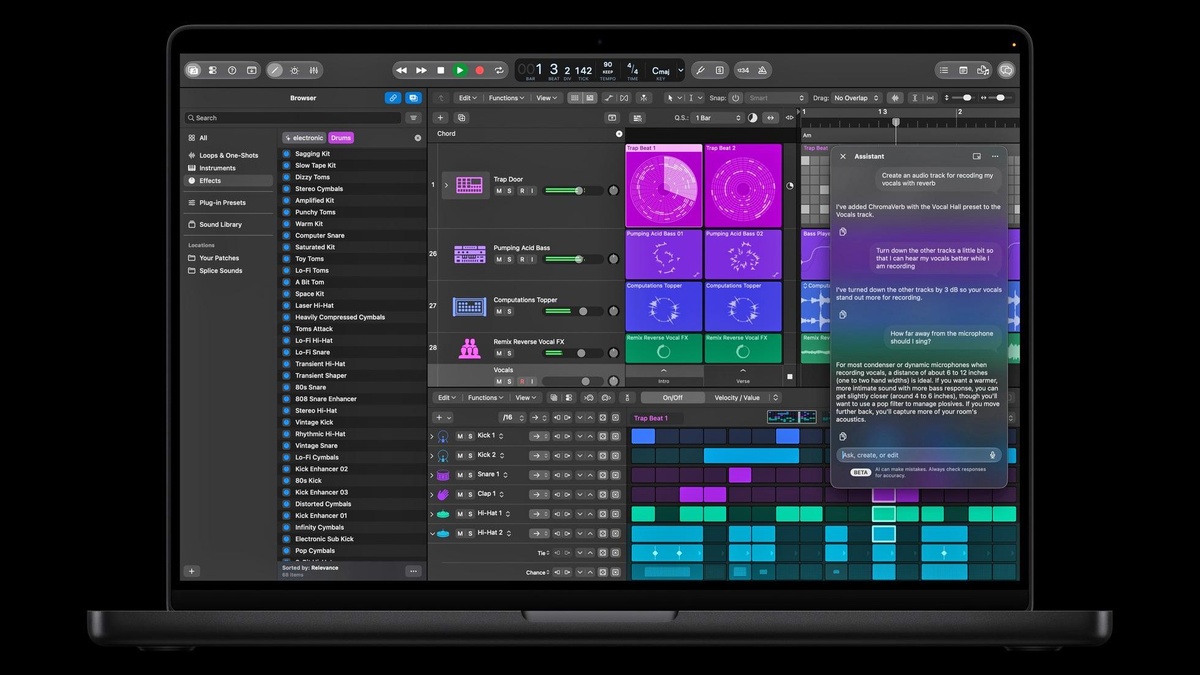
Apple has quietly unveiled a new monetization framework for its suite of generative creative tools, introducing Apple Intelligence Usage Packs priced at forty-nine dollars and ninety-nine cents to provide extended server-side computational capacity.
First spotted within the latest production update to Logic Pro by reporting outlets including The Verge, these specialized capacity bundles establish how hardware-centric platform ecosystems monetize heavy cloud-backed foundation models.
| Operational Dimension | Apple Intelligence Usage Packs | Standard Baseline Quota | Third-Party Compute Pipeline | Creator Studio Scope |
|---|---|---|---|---|
| Retail Pricing & Billing | $49.99 One-Time Add-On | Included with macOS Sequoia | OpenAI and Google Gemini APIs | Logic Pro, Final Cut, Pixelmator |
| Quota Metering Metric | Complex Assistant Queries | Standard Prompt Throughput | Private Cloud Compute Routing | Multitrack Audio and Render Tools |
| Rollover & Expiration Window | 12-Month Hard Rolling Expiry | Monthly Automatic Reset | Stateless Cloud Session Cache | Unused Capacity Carries Forward |
| Account Binding & Restrictions | Single Apple Account Lock | Hardware Device Binding | Zero-Data Retention Enclaves | Family Sharing Strictly Excluded |
| Primary Target Workflows | Stem Generation and Track Setup | Basic Text Summarization | High-Parameter Diffusion Models | Professional Creative Pipelines |
Table of Contents
1. Cloud Compute Constraints: Why Foundation Models Demand Usage Tiers
When Apple initially previewed its artificial intelligence ecosystem, executive leadership framed system features around local silicon execution, yet Apple Intelligence Usage Packs address the harsh physical realities of high-throughput server workloads.
While local Neural Engine accelerators handle lightweight text generation and on-device photo filtering efficiently, demanding multimodal creative operations require massive cloud foundation models hosted across dedicated Private Cloud Compute clusters.
Much like the silicon density scaling analyzed in our Apple M4 Mac mini hardware architecture breakdown, on-device accelerators reach thermal and memory bandwidth saturation when processing multi-billion parameter foundation architectures.
To prevent server exhaustion, Apple established initial monthly allocation limits in earlier support documentation, warning creators that unbounded conversational queries and heavy generative tasks could exhaust bundled allotments.
By deploying Apple Intelligence Usage Packs, the Cupertino hardware maker establishes a sustainable economic mechanism allowing heavy commercial studios to purchase additional inference time without throttling general consumer services.
This operational pivot demonstrates that paid server tiers represent the necessary bridge connecting consumer on-device machine learning with high-performance distributed cloud computing clusters across global datacenters.
2. Logic Pro AI Assistant Integration: Stem Separation and Project Prompting
Within the updated digital audio workstation environment, Apple Intelligence Usage Packs directly power the integrated creative assistant capable of assembling complex musical sessions from plain text prompts.
According to initial operational teardowns documented by 9to5Mac, the intelligent assistant can configure multi-instrument vocal tracks, route signal chains, and automate auxiliary mixing buses effortlessly.
However, audio generation and context-aware session reasoning require substantial contextual token ingestion, rapidly consuming standard monthly capacity limits during intensive songwriting or commercial mastering sessions.
Users encountering service constraints receive direct in-app prompts pointing toward the dedicated usage menu, where they can purchase additional operational tokens seamlessly without abandoning active multi-track projects.
Studio engineers utilizing Apple Intelligence Usage Packs retain uninhibited access to automated compositional suggestions, avoiding disruptive workflow pauses when orchestrating sophisticated acoustic arrangements under tight client production deadlines.
Consequently, supplementary cloud tokens ensure professional recording studios maintain consistent throughput across elaborate production pipelines without encountering sudden computational degradation.
3. Token Architecture and Account Locking: Rollover Rules and Expiration Limits
A critical operational detail governing Apple Intelligence Usage Packs centers on Apple’s account binding architecture and credit rollover lifecycle policies for prospective commercial buyers.
Purchased capacity packs remain strictly tied to the individual Apple Account executing the retail transaction, meaning studios cannot distribute tokens across shared Family Sharing accounts or collaborative teams.
To maximize buyer value, Apple allows unused capacity to carry forward each month, ensuring users do not forfeit remaining compute allocations during lighter project development periods.
Crucially, all purchased capacity carries a strict twelve-month expiration timestamp from the moment of purchase, preventing users from banking indefinitely accumulated tokens across multi-year cycles.
As highlighted in our analysis of Xbox Cloud Gaming pay-as-you-go pricing bundles, tokenized computational credits represent an increasingly standard billing framework for resource-intensive consumer cloud services.
Understanding these rigid account restrictions ensures independent audio producers plan their capital investments wisely when securing Apple Intelligence Usage Packs for forthcoming production schedules.
4. Creator Studio Ecosystem Expansion: Beyond Audio to Video and Design
Although Logic Pro serves as the premiere proving ground, Apple Intelligence Usage Packs represent a foundational commercial infrastructure preparing for extensive cross-platform deployment.
Apple has already confirmed plans to extend this cloud capacity framework into other core creative applications, including Final Cut Pro, Motion, and recently acquired Pixelmator Pro.
Furthermore, core productivity suites including Pages, Keynote, and Numbers are slated to integrate the same underlying conversational assistant architecture throughout subsequent software maintenance releases.
| Application Platform | Native AI Feature Set | Primary Compute Destination | Usage Pack Dependency | Rollout Timeline |
|---|---|---|---|---|
| Logic Pro 11 | Prompt-to-Project & Vocal Stems | Private Cloud Compute & Gemini | High (Complex Audio Sessions) | Available Immediately |
| Final Cut Pro | Automated Multicam & Object Mask | Hybrid Neural Engine & Cloud | Moderate (Render Pipeline) | Phased November Release |
| Pixelmator Pro | Generative Inpainting & Synthesis | Cloud Diffusion Infrastructure | High (High-Res Asset Generation) | Upcoming Creative Suite |
| Pages, Keynote & Numbers | Document Synthesis & Styling | Core Foundation Models | Low to Moderate (Text Generation) | Productivity Maintenance Cycle |
| Xcode Assistant | Predictive Syntax & Unit Tests | On-Device & Swift Cloud Enclave | Tiered Developer Allocation | Developer Beta Channel |
As visual media creators adopt generative video editing and automated color grading tools, reliance on external server clusters will naturally increase across high-resolution rendering workflows.
Similar to the immense computing throughput detailed in our AMD Ryzen 7 9800X3D gaming processor architecture, heavy creative tasks require massive processing capabilities that surpass basic client hardware limitations.
By establishing a unified transaction layer, these capacity expansions provide video editors, digital illustrators, and office professionals with identical access rules across Apple’s creative ecosystem.
5. Pricing Analysis and Enterprise Economics: Evaluating the Fifty Dollar Tier
Evaluating the fifty-dollar price point of Apple Intelligence Usage Packs reveals a pragmatic corporate calculation designed for professional commercial creators rather than casual hobbyists.
Unlike Adobe Creative Cloud or Microsoft Copilot, which require compulsory monthly subscription commitments, Apple provides an unbundled pay-as-you-go expansion structure with rolling twelve-month validity.
For professional production houses billing commercial clients hundreds of dollars per hour, a fifty-dollar expansion represents negligible operating overhead for maintaining continuous generative acceleration.
Conversely, casual home enthusiasts may balk at paying fifty dollars for supplementary assistant interactions, especially when basic on-device Siri capabilities remain entirely free.
This distinct separation between free local inference and premium Apple Intelligence Usage Packs signals Apple’s intention to monetize heavy enterprise workloads while keeping standard consumers satisfied.
Ultimately, these professional usage packages validate that commercial artificial intelligence carries real infrastructure expenses that hardware margins alone can no longer completely absorb.
Frequently Asked Questions
What are Apple Intelligence Usage Packs?
Apple Intelligence Usage Packs are paid top-up add-ons allowing creators to purchase additional cloud computing capacity for generative features in Logic Pro and Creator Studio apps.
How much does extra cloud usage cost in Logic Pro?
Each pack costs forty-nine dollars and ninety-nine cents as a one-time purchase, providing supplemental tokens that roll over monthly but expire twelve months after purchase.
Can the new usage packs be shared via Family Sharing?
No, Apple explicitly restricts purchased usage packs to the individual purchasing Apple Account, preventing pooled token sharing across multi-user family groups or corporate teams.
Which applications will support the new usage packs?
Currently, Logic Pro is the first supported app, with Final Cut Pro, Pixelmator Pro, Motion, Pages, Keynote, and Numbers scheduled to receive support shortly.
Why did Apple introduce Apple Intelligence Usage Packs?
Apple introduced Apple Intelligence Usage Packs because complex creative queries rely on external cloud models from OpenAI and Google Gemini, generating substantial ongoing datacenter compute costs.
Final Verdict: A Pragmatic Pivot for Apple Cloud AI
The rollout of Apple Intelligence Usage Packs marks a significant turning point in Apple’s software monetization philosophy, acknowledging the financial boundaries of free cloud AI compute.
By delivering an unbundled, non-subscription add-on that rolls over across twelve months, Apple offers professional creators dependable capacity without enforcing burdensome recurring lock-in.
As generative creative tooling matures across macOS, these specialized capacity packs will serve as the pragmatic standard balancing premium cloud performance with sustainable infrastructure economics.
