


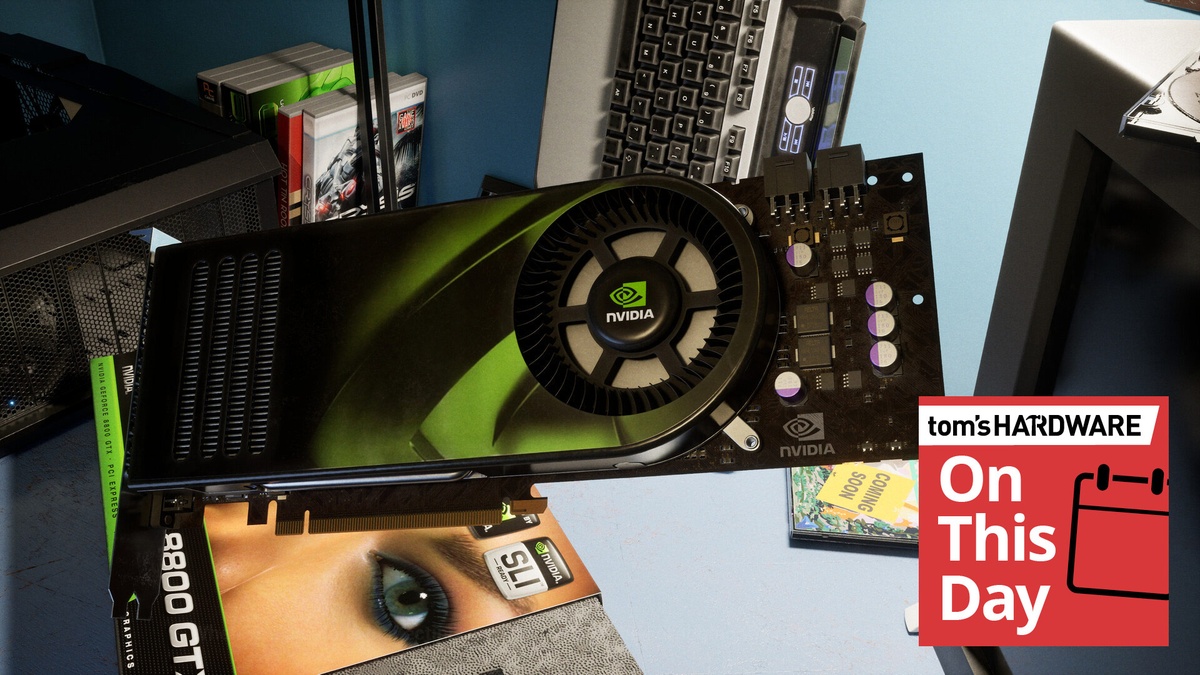
Two decades ago today, PC gaming witnessed an architectural revolution that forever reshaped computer graphics when Team Green unveiled the groundbreaking Nvidia GeForce 8800 GTX graphics card.
According to anniversary coverage published by Tom’s Hardware, Nvidia is commemorating this twenty-year milestone with a free interactive Steam homage created in Unreal Engine by senior special effects artist Dylan Browne.
| Hardware Specification | Original 2006 GeForce 8800 GTX | Steam 20th Anniversary Demo | Modern RTX 4070 Baseline | Historical Architectural Significance |
|---|---|---|---|---|
| Silicon Architecture | G80 Microarchitecture (90nm) | Unreal Engine Custom Pipeline | Ada Lovelace (TSMC 4N) | Unified stream processors replaced fixed vertex and pixel pipelines |
| Shader Execution Units | 128 Unified Stream Processors | Path-Traced Real-Time Shading | 5,888 CUDA Cores | Pioneered scalar general-purpose execution for gaming software |
| VRAM & Memory Bus | 768MB GDDR3 (384-Bit Bus) | 32GB High-Speed System RAM | 12GB GDDR6X (192-Bit Bus) | Delivered massive memory bandwidth required for high-resolution textures |
| Compute Framework | Original CUDA Implementation | DirectX 12 Ultimate & DLSS | CUDA Compute Capability 8.9 | Transformed desktop graphics cards into universal parallel supercomputers |
| Required GPU Hardware | PCI Express x16 Slot | GeForce RTX 4070 Minimum | Full Path Tracing Acceleration | Enforces cutting-edge modern graphics silicon for retro nostalgia |
| Storage Footprint | Under 10GB Game Installations | 30GB Free Solid-State Storage | NVMe High-Speed SSD Storage | Demonstrates exponential asset fidelity expansion over two decades |
| Original Launch Price | $599 MSRP (November 2006) | Free Interactive Steam Demo | $599 Enthusiast Baseline | Established the modern high-end consumer GPU price tier |
Table of Contents
1. The 20th Anniversary Steam Homage: Interactive Path-Traced Nostalgia
To commemorate the twentieth anniversary of the Nvidia GeForce 8800 GTX, visual effects artist Dylan Browne collaborated with Nvidia to craft a playable homage titled GeForce 8800 GTX – 20 Years of a Legend on Steam.
The free interactive experience transports enthusiasts directly into a mid-2000s enthusiast PC gaming bedroom, complete with authentic CRT monitors, era-accurate hardware boxes, and nostalgic period decor.
Players can inspect the packaging, unbox the legendary graphics card, and physically seat the dual-slot cooler into a virtual beige PC tower chassis running an era-accurate operating system.
Beyond the hardware installation process, developer Dylan Browne tucked numerous hidden Easter eggs throughout the retro room, rewarding sharp-eyed PC gaming enthusiasts who explore the environment.
While the aesthetic captures the spirit of mid-2000s computing, rendering this nostalgic den requires modern graphics muscle, celebrating the Nvidia GeForce 8800 GTX through state-of-the-art visual fidelity.
2. G80 Microarchitecture Legacy: Unified Shaders and the Birth of CUDA
When Team Green launched the Nvidia GeForce 8800 GTX on November 8, 2006, it fundamentally altered silicon engineering by debuting the revolutionary G80 microarchitecture.
Prior to G80, graphics chips relied on rigidly separated hardware pipelines dedicated exclusively to vertex or pixel calculations, which frequently led to severe execution bottlenecks during complex 3D workloads.
Historical hardware analyses documented on AnandTech praised how the Nvidia GeForce 8800 GTX replaced dedicated pipelines with 128 scalar stream processors operating dynamically across any shading task.
Crucially, the G80 silicon introduced the world to CUDA, empowering developers to utilize graphics processors for general-purpose parallel mathematics, computational science, and physics simulation.
This pivotal hardware transformation laid the technical groundwork for modern artificial intelligence accelerators, turning the Nvidia GeForce 8800 GTX into one of the most influential consumer chips in history.
3. Eye-Watering System Requirements: Unreal Engine Demands RTX 5080 Power
Despite celebrating vintage hardware from two decades ago, the Steam interactive homage dedicated to the classic flagship imposes hardware requirements that leave even contemporary PC enthusiasts wide-eyed.
According to official Steam system specifications, users must possess at least a GeForce RTX 4070 graphics card alongside thirty-two gigabytes of RAM to achieve playable frame rates.
Furthermore, achieving ideal fidelity across path-traced lighting pipelines requires Nvidia’s upcoming flagship silicon, with recommended configurations listing an eye-watering GeForce RTX 5080.
The software leverages cutting-edge rendering techniques including DLSS 4.5 with Dynamic Multi Frame Generation, Ray Reconstruction, hardware path tracing, and Nanite-style Mega Geometry.
Demanding thirty gigabytes of high-speed solid-state storage, this anniversary homage pushes modern GPUs just as aggressively as the original Nvidia GeForce 8800 GTX challenged systems in 2006.
4. Generational Hardware Comparison: 2006 G80 Silicon Versus Modern Flagships
Contrasting the Nvidia GeForce 8800 GTX with modern graphics silicon illustrates the staggering exponential growth achieved across semiconductor fabrication over the last twenty years.
Fabricated on TSMC’s 90-nanometer manufacturing node, the original G80 die packed 681 million transistors across a massive 484-square-millimeter silicon surface area.
In stark contrast, modern GPUs pack tens of billions of transistors into smaller silicon footprints while delivering thousands of times more compute throughput for ray tracing.
| Architectural Parameter | GeForce 8800 GTX (2006) | GeForce GTX 1080 (2016) | GeForce RTX 4080 / 5080 (Current) | Two-Decade Evolution Metric |
|---|---|---|---|---|
| Fabrication Node | TSMC 90nm Process | TSMC 16nm FinFET | TSMC 4N / 3nm Advanced | Over 30x reduction in physical gate dimensions |
| Transistor Density | 681 Million Transistors | 7.2 Billion Transistors | Over 45 Billion Transistors | 66x increase in total on-die logic circuits |
| Shader Compute Throughput | ~345 GFLOPS (FP32) | ~8.9 TFLOPS (FP32) | Over 48 TFLOPS (FP32) | Massive 140x leap in single-precision floating point |
| Frame Buffer Capacity | 768MB GDDR3 Memory | 8GB GDDR5X Memory | 16GB High-Speed GDDR7 | 21x expansion in local video memory capacity |
| Memory Bus & Bandwidth | 384-Bit (86.4 GB/s) | 256-Bit (320 GB/s) | 256-Bit (>1,000 GB/s) | Over 11x leap in sustained VRAM memory bandwidth |
| DirectX API Generation | DirectX 10 / SM 4.0 | DirectX 12 / Feature 12_1 | DirectX 12 Ultimate / SM 6.7 | Shift from rasterization to real-time neural path tracing |
Gamers seeking top-tier platform performance should review our analysis of the AMD Ryzen 7 9800X3D gaming CPU specs to pair potent processors with modern GPUs.
Additionally, while legacy hardware ran on Windows XP, users should consult our guide on how Nvidia ends Windows 10 support for PC gamers as modern operating systems evolve.
5. Cultural Impact and Longevity: From ‘Can It Run Crysis?’ to the AI Era
Beyond raw technical specifications, the Nvidia GeForce 8800 GTX holds an legendary cultural position as the defining graphics card of the late 2000s PC gaming renaissance.
When Crytek released Crysis in late 2007, the game became the ultimate visual benchmark, sparking the immortal gaming question that defined an entire era of enthusiast culture.
Equipped with 768 megabytes of VRAM and a 384-bit bus, the Nvidia GeForce 8800 GTX was among the few consumer cards capable of running Crysis with high graphical settings.
Furthermore, Nvidia supported the G80 architecture with official graphics driver updates for nearly a full decade, cementing its reputation for exceptional consumer hardware durability.
By establishing unified parallel compute, the Nvidia GeForce 8800 GTX directly sparked the modern deep learning boom that powers contemporary robotics, generative models, and neural rendering.
Frequently Asked Questions
When was the Nvidia GeForce 8800 GTX originally released?
The Nvidia GeForce 8800 GTX was officially released on November 8, 2006, debuting at an MSRP of $599 alongside the slightly trimmed GeForce 8800 GTS.
What is the 20th anniversary Steam homage demo?
It is a free interactive Unreal Engine demo on Steam created by visual effects artist Dylan Browne, letting enthusiasts unbox the Nvidia GeForce 8800 GTX inside a retro bedroom.
What are the minimum system requirements for the Steam demo?
Running the interactive homage requires at least an Nvidia GeForce RTX 4070 graphics card, thirty-two gigabytes of system RAM, and thirty gigabytes of free solid-state storage.
Why was the G80 microarchitecture so historically important?
G80 introduced unified stream shaders that replaced separated pixel and vertex pipelines, while also launching CUDA compute capability that transformed graphics cards into general-purpose parallel supercomputers.
Could the Nvidia GeForce 8800 GTX run Crysis at launch?
Yes, the Nvidia GeForce 8800 GTX was widely recognized as the premier graphics card capable of tackling Crysis in 2007, delivering playable frame rates at high graphical presets.
Final Verdict: Two Decades of Unrivaled GPU Disruption
Twenty years after its historic unveiling, the Nvidia GeForce 8800 GTX remains one of the most transformative hardware milestones in the history of personal computing.
Dylan Browne’s path-traced Steam demo serves as a fitting homage, combining nostalgic retro enthusiast memories with the demanding rendering technologies that modern silicon now enables.
From pioneering unified shaders to igniting the modern AI computing revolution, the enduring legacy of the Nvidia GeForce 8800 GTX will continue shaping computer graphics for decades to come.
