


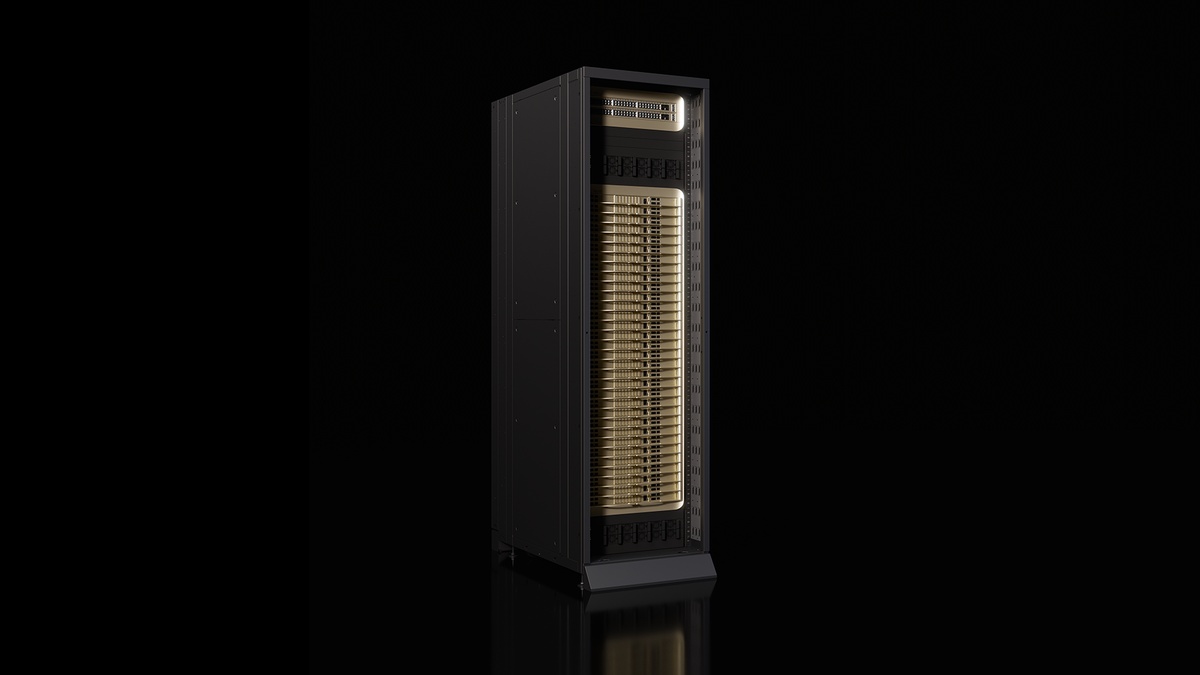
Modern artificial intelligence infrastructure reached a turning point today as the NVIDIA Vera CPU was officially revealed, redefining how hyperscale data centers balance sequential host execution with intensive parallel GPU reasoning.
Documented in full by the NVIDIA Blog, this enterprise processor introduces 176 dedicated cores built specifically to accelerate autonomous software agent workloads without exceeding strict facility power envelopes.
| Hardware Specification Metric | NVIDIA Vera CPU | Fastest Enterprise x86 Server | High-Efficiency Dense x86 Server |
|---|---|---|---|
| Physical Core Architecture | 176 Custom Arm Cores | Up to 128 x86 Performance Cores | Up to 192 x86 Efficiency Cores |
| Agent Capacity Efficiency | 1.6x Higher Agents Per Watt | Baseline Energy Density | 0.9x Adjusted Workload Density |
| Agentic Task Execution Speed | 2.0x Faster Workflow Completion | 1.0x Baseline Response Latency | 0.5x Extended Task Latency |
| 1,000 Sandbox Initialization | 10.8 Seconds (Daytona Verified) | 88.4 Seconds (Standard Linux VM) | 112.5 Seconds (Container Clones) |
| Interconnect Architecture | Coherent High-Bandwidth NVLink | Standard PCIe Gen 5 Fabric | Standard PCIe Gen 5 Fabric |
Table of Contents
1. Agentic Acceleration Architecture: Eliminating The CPU-GPU Reasoning Bottleneck
Autonomous AI agents spend substantial compute time executing sequential host instructions between neural network inference passes, which places unprecedented performance pressure on the NVIDIA Vera CPU to prevent pipeline starvation.
When intelligent software agents search external repositories, query relational databases, and test newly compiled code, traditional server processors frequently create severe latency bottlenecks while high-performance graphics clusters sit completely idle waiting for input.
To overcome these operational stalls, the enterprise processor integrates high-bandwidth coherent interconnects directly with next-generation accelerators, ensuring near-instantaneous memory synchronization across complex tool-calling routines.
This hardware-level co-design mirrors recent enterprise architectural evolutions, similar to principles observed in our deep-dive analysis of the Apple M4 Mac mini redesign M4 Pro specs.
By optimizing hardware pipelines for alternating reasoning and execution stages, the NVIDIA Vera CPU allows modern AI factories to sustain continuous execution across millions of concurrent autonomous agent processes.
2. 176 High-Throughput Cores: Massively Parallel Microarchitecture for AI Factories
At the physical heart of the NVIDIA Vera CPU sits a monolithic die topology housing 176 custom Arm-based cores engineered specifically for sustained multi-tenant throughput under heavy virtualization.
Unlike legacy server processors that rely on aggressive clock frequency spikes at the cost of thermal runaway, this architecture focuses on ultra-dense, energy-conscious instruction pipelines tailored for modern cloud software stacks.
Each individual core within the microarchitecture features dedicated cache hierarchies optimized for high-frequency context switching, dramatically lowering task orchestration latency when scheduling concurrent sandboxed microservices.
Similar thermal and microarchitecture efficiency optimizations have redefined desktop compute standards, as demonstrated in our comprehensive review of the AMD Ryzen 7 9800X3D gaming CPU specs.
Consequently, enterprise cloud administrators deploying the NVIDIA Vera CPU gain the ability to consolidate dozens of traditional dual-socket server nodes into streamlined, single-socket high-density server sleds.
3. Energy Efficiency Faceoff: Delivering 1.6x Higher Agent Capacity Per Megawatt
Data center facility operators face rigid electrical power thresholds, making the energy efficiency benchmarks of the NVIDIA Vera CPU an absolute game changer for commercial hyperscale deployments.
In rigorous 100-megawatt data center comparative evaluations, Nvidia demonstrated that Vera delivers 1.6x more active agent instances per watt compared to the industry’s fastest competing x86 server hardware platforms.
Furthermore, when evaluated against the most energy-efficient low-power x86 alternatives, the silicon platform delivered a commanding 2x performance advantage in end-to-end autonomous agent workflow completion speeds.
This dual-spectrum leadership eliminates the historic architectural compromise where data center architects had to deploy separate high-frequency and high-density processor clusters to support varying enterprise workload profiles.
By consolidating diverse server tasks under the NVIDIA Vera CPU, operators can dramatically reduce facility cooling infrastructure expenditures and optimize overall power usage effectiveness across enterprise server halls.
4. Production Benchmark Analysis: Perplexity, ClickHouse, and Modal Validation
Early enterprise deployment partners have already reported dramatic real-world performance gains, verifying that the NVIDIA Vera CPU delivers unmatched execution speeds in mission-critical customer-facing production environments.
Leading conversational search engine Perplexity recorded a remarkable 1.5x speedup during automated coding workflows, officially committing to deploy Vera silicon across their next-generation production serving architecture.
Simultaneously, serverless cloud platform Modal achieved up to 2x higher containerized sandbox throughput per core on Vera silicon, maintaining stable execution curves even under peak orchestrator utilization.
| Enterprise Production Partner | Tested Agentic Workload | Vera Benchmark Outcome | Relative Performance Uplift |
|---|---|---|---|
| Perplexity AI | Automated Code Writing & Testing | Production Serving Architecture | 1.5x Faster Task Execution |
| DeepInfra | Multi-Agent Tool Orchestration | Fastest of 4 Tested Architectures | Up to 2.2x Best x86 Speed |
| Daytona | 1,000 Sandbox Cold Starts | 10.8s Boot, 12.7 Jobs/s at Scale | 8.2x Faster Instance Creation |
| ClickHouse | Analytical ClickBench Suite | Linear Scaling Across 176 Cores | Ranked #1 Hardware Leaderboard |
| DuckLabs | TPC-H SF1000 Analytics Baseline | Median Query Throughput | 1.5x Median Intel Xeon 6 Speed |
| Modal | Containerized Sandbox Serving | Dual-Core High-Load Throughput | Up to 2.0x Throughput Per Core |
Developer environment platform Daytona demonstrated that Vera initialized 1,000 isolated agent sandboxes in merely 10.8 seconds, soundly outperforming equivalent x86 enterprise clusters that required 88.4 seconds to complete.
Database platform ClickHouse confirmed that uncompiled standard binaries scaled near-linearly across all 176 cores of the NVIDIA Vera CPU, securing top honors across the industry-standard ClickBench server leaderboard.
5. Enterprise Deployment Roadmap: Integrating Vera Silicon Across Hyperscale Racks
The commercial debut of the NVIDIA Vera CPU signals a sweeping transition toward integrated superchip rack platforms, pairing host processors with Vera Rubin GPUs through next-generation NVLink coherency.
Just as legacy client operating systems face inevitable retirement, as highlighted when Nvidia ends Windows 10 support for PC gamers, data centers must modernize their aging compute infrastructure.
Independent hardware analysts at AnandTech emphasize that server architectures must adapt to agentic software workflows that demand constant inter-socket coordination and microsecond response times.
Modern cloud gaming and interactive infrastructure, including platforms delivering Xbox Cloud Gaming pay as you go bundles, demonstrate that ultra-low latency host processing remains vital for real-time responsiveness.
As hyperscale providers construct the next generation of gigawatt-scale AI factories, the NVIDIA Vera CPU establishes a new architectural standard for power-conscious enterprise server acceleration.
Frequently Asked Questions
What is the NVIDIA Vera CPU and what workloads is it designed for?
The NVIDIA Vera CPU is an enterprise processor featuring 176 high-throughput cores designed to accelerate autonomous AI agent orchestration, database queries, and secure code sandboxing in data centers.
How does the chip compare against traditional x86 server processors?
In a 100-megawatt data center evaluation, the enterprise processor delivered 1.6x more agents per watt than the fastest x86 processor and 2x faster execution than the most efficient x86 chip.
Which major AI enterprises have verified Vera performance in production?
Key enterprise partners testing the NVIDIA Vera CPU include Perplexity with 1.5x faster coding tasks, Daytona with 10.8-second sandbox boots, and Modal with 2x containerized throughput per core.
Does the processor require customized software builds or compiler tuning?
No, standard software stacks run seamlessly across the server architecture, as demonstrated by ClickHouse scaling near-linearly across 176 cores using default binaries without custom tuning.
How does Vera integrate with upcoming Rubin GPU server architectures?
The NVIDIA Vera CPU pairs directly with Rubin GPUs via high-bandwidth NVLink coherency, creating unified superchip modules designed for liquid-cooled hyperscale rack-scale AI factories.
Final Verdict: The Definitive Host Silicon for Autonomous Intelligence
The introduction of the NVIDIA Vera CPU marks a pivotal milestone in data center engineering, definitively proving that agentic AI demands host processors purpose-built for high-speed tool orchestration.
By delivering superior throughput per watt alongside class-leading single-thread responsiveness, Nvidia has successfully eliminated the painful compromise between compute density and raw execution velocity in modern server farms.
As enterprise organizations rapidly shift from passive query generation to autonomous multi-agent pipelines, the newly unveiled silicon delivers the exact architectural foundation required to power tomorrow’s intelligent software economy.
